

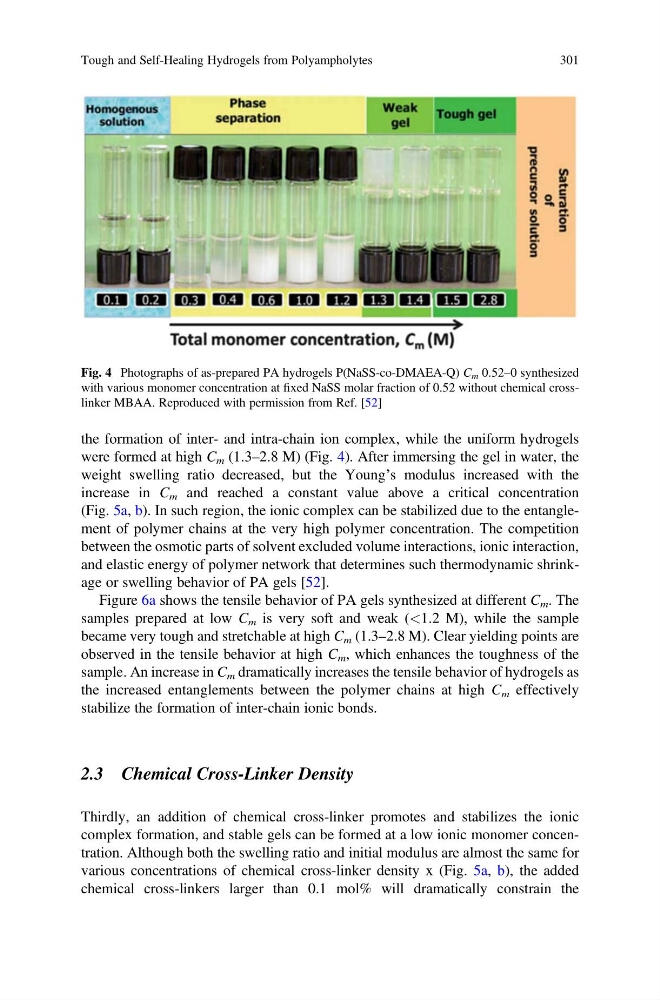
the formation of inter- and intra-chain ion complex, while the uniform hydrogels
were formed at high C m (1.3–2.8 M) (Fig. 4). After immersing the gel in water, the
weight swelling ratio decreased, but the Young’s modulus increased with the
increase in C m and reached a constant value above a critical concentration
(Fig. 5a, b). In such region, the ionic complex can be stabilized due to the entanglement of polymer chains at the very high polymer concentration. The competition
between the osmotic parts of solvent excluded volume interactions, ionic interaction,
and elastic energy of polymer network that determines such thermodynamic shrinkage or swelling behavior of PA gels [52].
Figure 6a shows the tensile behavior of PA gels synthesized at different C m . The
samples prepared at low C m is very soft and weak (<1.2 M), while the sample
became very tough and stretchable at high C m (1.3–2.8 M). Clear yielding points are
observed in the tensile behavior at high C m , which enhances the toughness of the
sample. An increase in C m dramatically increases the tensile behavior of hydrogels as
the increased entanglements between the polymer chains at high C m effectively
stabilize the formation of inter-chain ionic bonds.
2.3 Chemical Cross-Linker Density
Thirdly, an addition of chemical cross-linker promotes and stabilizes the ionic
complex formation, and stable gels can be formed at a low ionic monomer concentration. Although both the swelling ratio and initial modulus are almost the same for
various concentrations of chemical cross-linker density x (Fig. 5a, b), the added
chemical cross-linkers larger than 0.1 mol% will dramatically constrain the
Fig. 4 Photographs of as-prepared PA hydrogels P(NaSS-co-DMAEA-Q) C m 0.52–0 synthesized
with various monomer concentration at fixed NaSS molar fraction of 0.52 without chemical crosslinker MBAA. Reproduced with permission from Ref. [52]
Tough and Self-Healing Hydrogels from Polyampholytes
301
were formed at high C m (1.3–2.8 M) (Fig. 4). After immersing the gel in water, the
weight swelling ratio decreased, but the Young’s modulus increased with the
increase in C m and reached a constant value above a critical concentration
(Fig. 5a, b). In such region, the ionic complex can be stabilized due to the entanglement of polymer chains at the very high polymer concentration. The competition
between the osmotic parts of solvent excluded volume interactions, ionic interaction,
and elastic energy of polymer network that determines such thermodynamic shrinkage or swelling behavior of PA gels [52].
Figure 6a shows the tensile behavior of PA gels synthesized at different C m . The
samples prepared at low C m is very soft and weak (<1.2 M), while the sample
became very tough and stretchable at high C m (1.3–2.8 M). Clear yielding points are
observed in the tensile behavior at high C m , which enhances the toughness of the
sample. An increase in C m dramatically increases the tensile behavior of hydrogels as
the increased entanglements between the polymer chains at high C m effectively
stabilize the formation of inter-chain ionic bonds.
2.3 Chemical Cross-Linker Density
Thirdly, an addition of chemical cross-linker promotes and stabilizes the ionic
complex formation, and stable gels can be formed at a low ionic monomer concentration. Although both the swelling ratio and initial modulus are almost the same for
various concentrations of chemical cross-linker density x (Fig. 5a, b), the added
chemical cross-linkers larger than 0.1 mol% will dramatically constrain the
Fig. 4 Photographs of as-prepared PA hydrogels P(NaSS-co-DMAEA-Q) C m 0.52–0 synthesized
with various monomer concentration at fixed NaSS molar fraction of 0.52 without chemical crosslinker MBAA. Reproduced with permission from Ref. [52]
Tough and Self-Healing Hydrogels from Polyampholytes
301