

increasing strain (5–400%) were done to compare self-healing ability of the
hydrogels. For the ABC hydrogel, upon reducing strain (400–5%), G
0 recovered
quickly to the initial value. Additionally, mesenchymal stem cells embedded in
hydrogel showed good viability, and growth factor (BMP-4)-loaded hydrogels
prompted neo-bone that could promote bone genesis. It was claimed that this selfhealing hydrogel with tunable properties can be used as cranial bone tissue engineering scaffold and promote bone formation.
Another dual-responsive hydrogel system was recently reported by Yang and
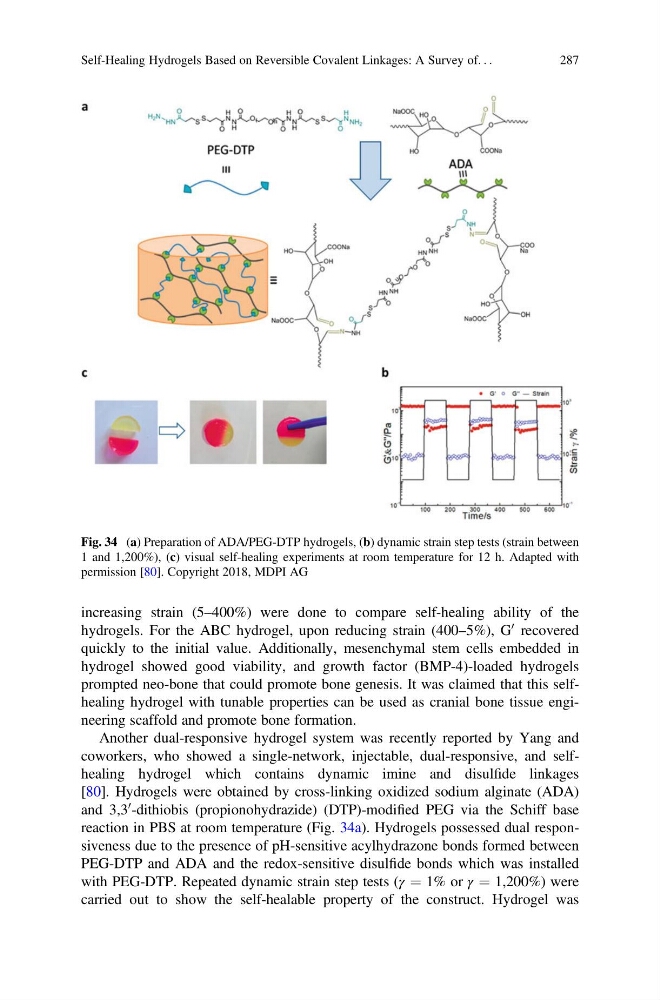
coworkers, who showed a single-network, injectable, dual-responsive, and selfhealing hydrogel which contains dynamic imine and disulfide linkages
[80]. Hydrogels were obtained by cross-linking oxidized sodium alginate (ADA)
and 3,3
0 -dithiobis (propionohydrazide) (DTP)-modified PEG via the Schiff base
reaction in PBS at room temperature (Fig. 34a). Hydrogels possessed dual responsiveness due to the presence of pH-sensitive acylhydrazone bonds formed between
PEG-DTP and ADA and the redox-sensitive disulfide bonds which was installed
with PEG-DTP. Repeated dynamic strain step tests (γ ¼ 1% or γ ¼ 1,200%) were
carried out to show the self-healable property of the construct. Hydrogel was
Fig. 34 (a) Preparation of ADA/PEG-DTP hydrogels, (b) dynamic strain step tests (strain between
1 and 1,200%), (c) visual self-healing experiments at room temperature for 12 h. Adapted with
permission [80]. Copyright 2018, MDPI AG
Self-Healing Hydrogels Based on Reversible Covalent Linkages: A Survey of. . .
287
hydrogels. For the ABC hydrogel, upon reducing strain (400–5%), G
0 recovered
quickly to the initial value. Additionally, mesenchymal stem cells embedded in
hydrogel showed good viability, and growth factor (BMP-4)-loaded hydrogels
prompted neo-bone that could promote bone genesis. It was claimed that this selfhealing hydrogel with tunable properties can be used as cranial bone tissue engineering scaffold and promote bone formation.
Another dual-responsive hydrogel system was recently reported by Yang and
coworkers, who showed a single-network, injectable, dual-responsive, and selfhealing hydrogel which contains dynamic imine and disulfide linkages
[80]. Hydrogels were obtained by cross-linking oxidized sodium alginate (ADA)
and 3,3
0 -dithiobis (propionohydrazide) (DTP)-modified PEG via the Schiff base
reaction in PBS at room temperature (Fig. 34a). Hydrogels possessed dual responsiveness due to the presence of pH-sensitive acylhydrazone bonds formed between
PEG-DTP and ADA and the redox-sensitive disulfide bonds which was installed
with PEG-DTP. Repeated dynamic strain step tests (γ ¼ 1% or γ ¼ 1,200%) were
carried out to show the self-healable property of the construct. Hydrogel was
Fig. 34 (a) Preparation of ADA/PEG-DTP hydrogels, (b) dynamic strain step tests (strain between
1 and 1,200%), (c) visual self-healing experiments at room temperature for 12 h. Adapted with
permission [80]. Copyright 2018, MDPI AG
Self-Healing Hydrogels Based on Reversible Covalent Linkages: A Survey of. . .
287