

8 Dual-Responsive Self-Healing Hydrogels
Utilization of more than one dynamic cross-linking within hydrogel network allows
dual or multi-responsivity, which can extend the functional attributes of the material
in biomedical applications. For example, pH-sensitive hydrogels can be used to
release drug on demand at the target site, yet preserving hydrogels integrity to have a
sustained and prolonged release is crucial under physiological conditions. Such
modulation of mechanical properties of hydrogels can be achieved by introduction
of multiple cross-linking chemistries. In recent years, such dual-responsive
hydrogels reported in literature exhibit enhanced properties such as higher tunability,
faster healing, and biomimetic behavior. Among possible configurations, multiresponsive hydrogels can be designed as either single-network (SN) or doublenetwork (DN) cross-linked materials.
One of the earliest examples of an SN dynamic hydrogel with dual responsivity
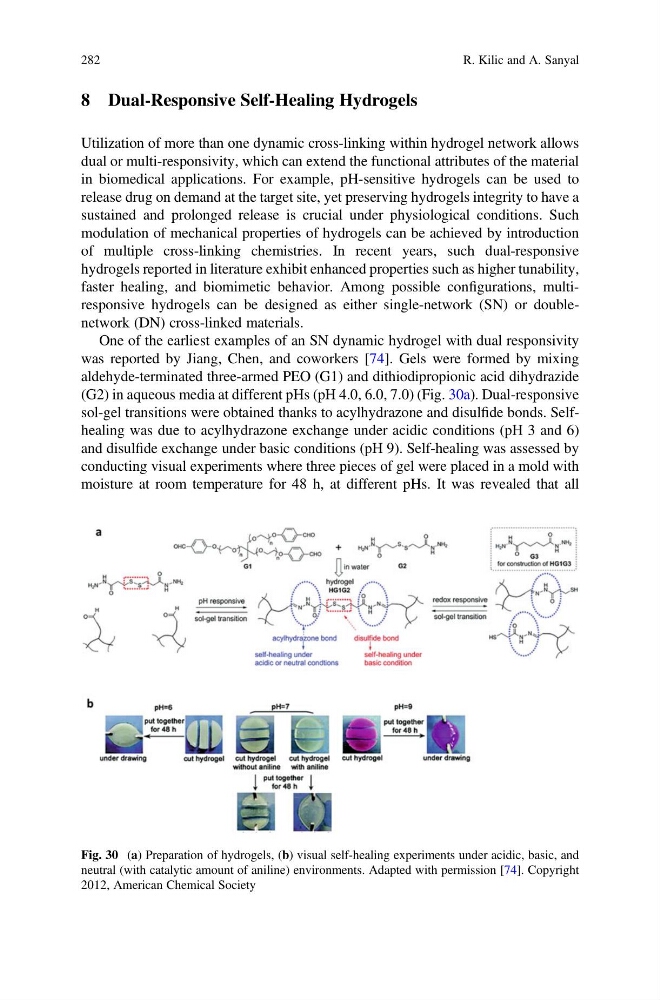
was reported by Jiang, Chen, and coworkers [74]. Gels were formed by mixing
aldehyde-terminated three-armed PEO (G1) and dithiodipropionic acid dihydrazide
(G2) in aqueous media at different pHs (pH 4.0, 6.0, 7.0) (Fig. 30a). Dual-responsive
sol-gel transitions were obtained thanks to acylhydrazone and disulfide bonds. Selfhealing was due to acylhydrazone exchange under acidic conditions (pH 3 and 6)
and disulfide exchange under basic conditions (pH 9). Self-healing was assessed by
conducting visual experiments where three pieces of gel were placed in a mold with
moisture at room temperature for 48 h, at different pHs. It was revealed that all
Fig. 30 (a) Preparation of hydrogels, (b) visual self-healing experiments under acidic, basic, and
neutral (with catalytic amount of aniline) environments. Adapted with permission [74]. Copyright
2012, American Chemical Society
282
R. Kilic and A. Sanyal
Utilization of more than one dynamic cross-linking within hydrogel network allows
dual or multi-responsivity, which can extend the functional attributes of the material
in biomedical applications. For example, pH-sensitive hydrogels can be used to
release drug on demand at the target site, yet preserving hydrogels integrity to have a
sustained and prolonged release is crucial under physiological conditions. Such
modulation of mechanical properties of hydrogels can be achieved by introduction
of multiple cross-linking chemistries. In recent years, such dual-responsive
hydrogels reported in literature exhibit enhanced properties such as higher tunability,
faster healing, and biomimetic behavior. Among possible configurations, multiresponsive hydrogels can be designed as either single-network (SN) or doublenetwork (DN) cross-linked materials.
One of the earliest examples of an SN dynamic hydrogel with dual responsivity
was reported by Jiang, Chen, and coworkers [74]. Gels were formed by mixing
aldehyde-terminated three-armed PEO (G1) and dithiodipropionic acid dihydrazide
(G2) in aqueous media at different pHs (pH 4.0, 6.0, 7.0) (Fig. 30a). Dual-responsive
sol-gel transitions were obtained thanks to acylhydrazone and disulfide bonds. Selfhealing was due to acylhydrazone exchange under acidic conditions (pH 3 and 6)
and disulfide exchange under basic conditions (pH 9). Self-healing was assessed by
conducting visual experiments where three pieces of gel were placed in a mold with
moisture at room temperature for 48 h, at different pHs. It was revealed that all
Fig. 30 (a) Preparation of hydrogels, (b) visual self-healing experiments under acidic, basic, and
neutral (with catalytic amount of aniline) environments. Adapted with permission [74]. Copyright
2012, American Chemical Society
282
R. Kilic and A. Sanyal