

linked through boronic ester bond, and mechanical property was tuned by incorporating a photocontrollable azobenzene bearing boronic acid in hydrogel construct
(Fig. 29a). An amine-terminated tetra-arm PEG was end-functionalized with
glucono-d-lactone (P1) to obtain diols and with different azobenzene-boronic acid
monomers (P2, P2-F 2 , P3, P4) to obtain complementary boronic acids. To yield
cross-linked network, polymeric precursors (P1/P2) were mixed in PBS (7.5) and the
solution turned into gel state upon UV irradiation at 365 nm for 10 min due to the
isomerization of azobenzene (E to Z). Reversibility of cross-linking by photoswitch
was assessed by exposing the same gel with 470 nm light for 30 s; the change in
storage modulus of resulted gels was investigated by rheological tests (Fig. 29b).
Furthermore, self-healing was demonstrated by visual experiments where hydrogel
(P1/P2-F 2 ) was formed by irradiating polymer solution for 1 h under 375 nm and cut
into two. Two halves were rejoined within minutes at room temperature and
remained in gel state at least for 1 week in the dark at 25
C (Fig. 29c).
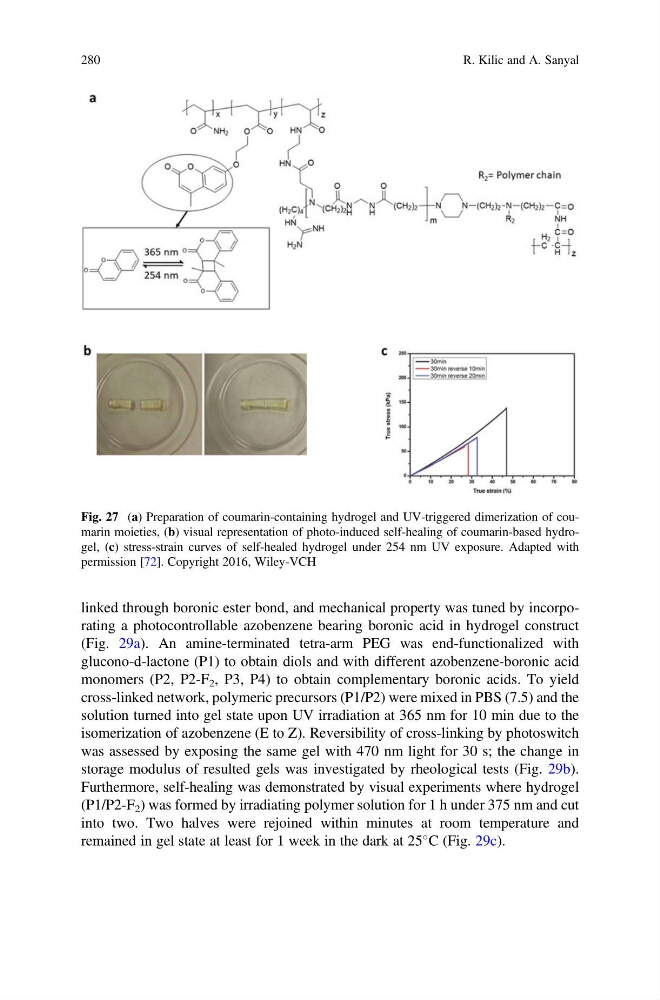
Fig. 27 (a) Preparation of coumarin-containing hydrogel and UV-triggered dimerization of coumarin moieties, (b) visual representation of photo-induced self-healing of coumarin-based hydrogel, (c) stress-strain curves of self-healed hydrogel under 254 nm UV exposure. Adapted with
permission [72]. Copyright 2016, Wiley-VCH
280
R. Kilic and A. Sanyal
(Fig. 29a). An amine-terminated tetra-arm PEG was end-functionalized with
glucono-d-lactone (P1) to obtain diols and with different azobenzene-boronic acid
monomers (P2, P2-F 2 , P3, P4) to obtain complementary boronic acids. To yield
cross-linked network, polymeric precursors (P1/P2) were mixed in PBS (7.5) and the
solution turned into gel state upon UV irradiation at 365 nm for 10 min due to the
isomerization of azobenzene (E to Z). Reversibility of cross-linking by photoswitch
was assessed by exposing the same gel with 470 nm light for 30 s; the change in
storage modulus of resulted gels was investigated by rheological tests (Fig. 29b).
Furthermore, self-healing was demonstrated by visual experiments where hydrogel
(P1/P2-F 2 ) was formed by irradiating polymer solution for 1 h under 375 nm and cut
into two. Two halves were rejoined within minutes at room temperature and
remained in gel state at least for 1 week in the dark at 25
C (Fig. 29c).
Fig. 27 (a) Preparation of coumarin-containing hydrogel and UV-triggered dimerization of coumarin moieties, (b) visual representation of photo-induced self-healing of coumarin-based hydrogel, (c) stress-strain curves of self-healed hydrogel under 254 nm UV exposure. Adapted with
permission [72]. Copyright 2016, Wiley-VCH
280
R. Kilic and A. Sanyal