

between 1 and 500% were carried out to assess self-healing behavior of hydrogels.
Hydrogel structure deformed under high strain and upon reducing strain to 1%, G
0
and G
00 fully recovered to their initial values due to presence of disulfide bonds
(Fig. 25b). Additionally, visual self-healing experiments demonstrated reformation
of two cut pieces of a hydrogel (Fig. 25c).
As an advancement of their earlier work [59], Waymouth and coworkers reported
different types of 1,2-dithiolane-functionalized cyclic carbonate groups (TMCDT
and TMCLA) containing triblock copolymer-based hydrogels [61]. Chemically
cross-linked hydrogels were fabricated through reversible cross-linking based on
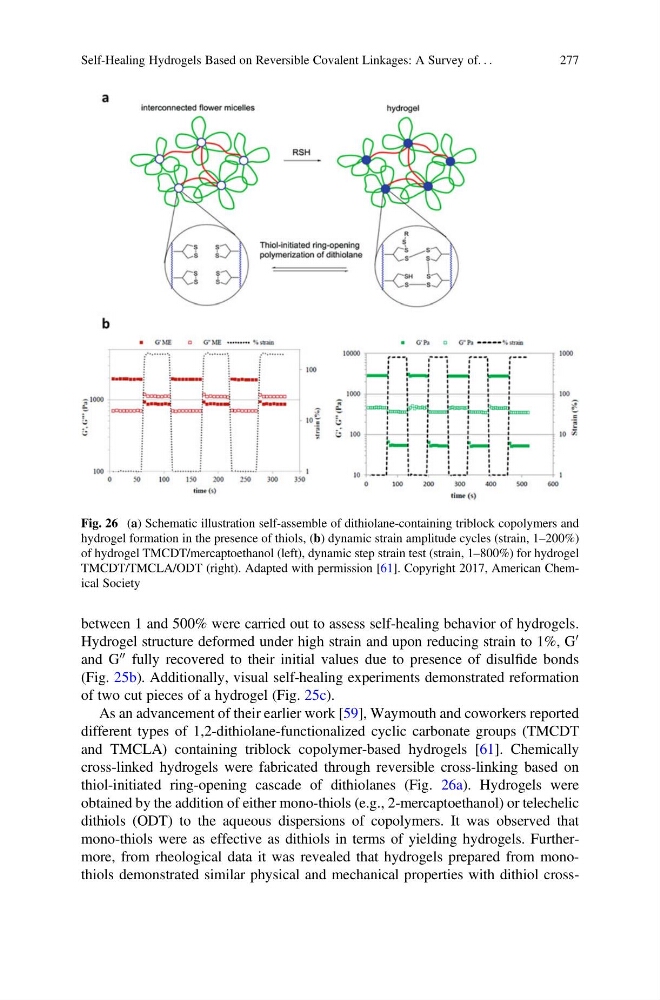
thiol-initiated ring-opening cascade of dithiolanes (Fig. 26a). Hydrogels were
obtained by the addition of either mono-thiols (e.g., 2-mercaptoethanol) or telechelic
dithiols (ODT) to the aqueous dispersions of copolymers. It was observed that
mono-thiols were as effective as dithiols in terms of yielding hydrogels. Furthermore, from rheological data it was revealed that hydrogels prepared from monothiols demonstrated similar physical and mechanical properties with dithiol crossFig. 26 (a) Schematic illustration self-assemble of dithiolane-containing triblock copolymers and
hydrogel formation in the presence of thiols, (b) dynamic strain amplitude cycles (strain, 1–200%)
of hydrogel TMCDT/mercaptoethanol (left), dynamic step strain test (strain, 1–800%) for hydrogel
TMCDT/TMCLA/ODT (right). Adapted with permission [61]. Copyright 2017, American Chemical Society
Self-Healing Hydrogels Based on Reversible Covalent Linkages: A Survey of. . .
277
Hydrogel structure deformed under high strain and upon reducing strain to 1%, G
0
and G
00 fully recovered to their initial values due to presence of disulfide bonds
(Fig. 25b). Additionally, visual self-healing experiments demonstrated reformation
of two cut pieces of a hydrogel (Fig. 25c).
As an advancement of their earlier work [59], Waymouth and coworkers reported
different types of 1,2-dithiolane-functionalized cyclic carbonate groups (TMCDT
and TMCLA) containing triblock copolymer-based hydrogels [61]. Chemically
cross-linked hydrogels were fabricated through reversible cross-linking based on
thiol-initiated ring-opening cascade of dithiolanes (Fig. 26a). Hydrogels were
obtained by the addition of either mono-thiols (e.g., 2-mercaptoethanol) or telechelic
dithiols (ODT) to the aqueous dispersions of copolymers. It was observed that
mono-thiols were as effective as dithiols in terms of yielding hydrogels. Furthermore, from rheological data it was revealed that hydrogels prepared from monothiols demonstrated similar physical and mechanical properties with dithiol crossFig. 26 (a) Schematic illustration self-assemble of dithiolane-containing triblock copolymers and
hydrogel formation in the presence of thiols, (b) dynamic strain amplitude cycles (strain, 1–200%)
of hydrogel TMCDT/mercaptoethanol (left), dynamic step strain test (strain, 1–800%) for hydrogel
TMCDT/TMCLA/ODT (right). Adapted with permission [61]. Copyright 2017, American Chemical Society
Self-Healing Hydrogels Based on Reversible Covalent Linkages: A Survey of. . .
277