

oxygen, and lacks by-product formation. However, it is still a concern to these
systems in biomedical applications due to the toxicity of furan derivatives
and requirement of relatively high temperatures for retro-Diels-Alder reaction.
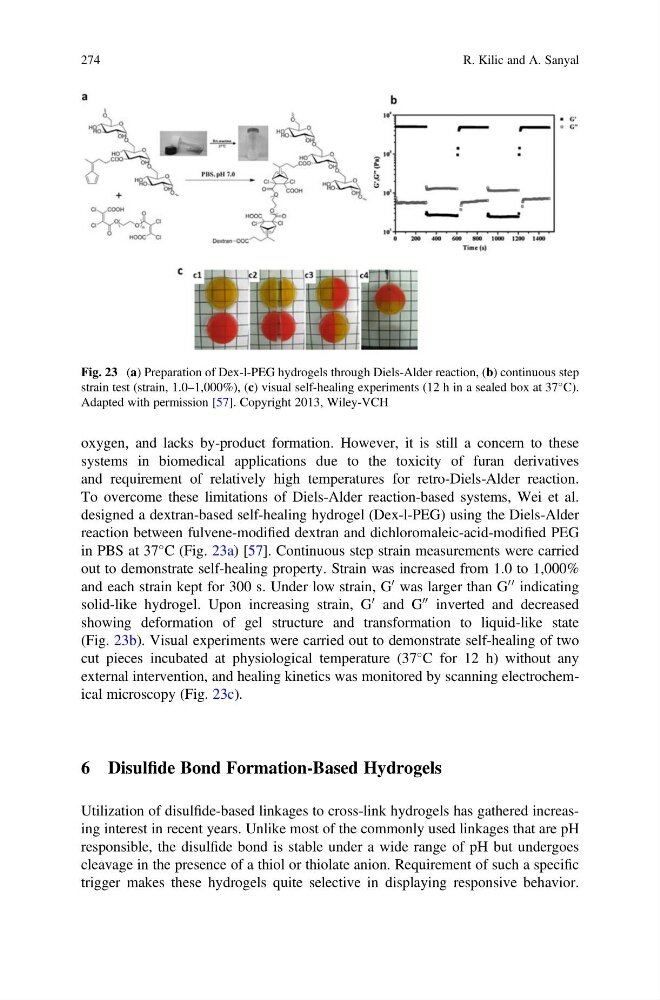
To overcome these limitations of Diels-Alder reaction-based systems, Wei et al.
designed a dextran-based self-healing hydrogel (Dex-l-PEG) using the Diels-Alder
reaction between fulvene-modified dextran and dichloromaleic-acid-modified PEG
in PBS at 37
C (Fig. 23a) [57]. Continuous step strain measurements were carried
out to demonstrate self-healing property. Strain was increased from 1.0 to 1,000%
and each strain kept for 300 s. Under low strain, G
0 was larger than G
00 indicating
solid-like hydrogel. Upon increasing strain, G
0 and G
00 inverted and decreased
showing deformation of gel structure and transformation to liquid-like state
(Fig. 23b). Visual experiments were carried out to demonstrate self-healing of two
cut pieces incubated at physiological temperature (37
C for 12 h) without any
external intervention, and healing kinetics was monitored by scanning electrochemical microscopy (Fig. 23c).
6 Disulfide Bond Formation-Based Hydrogels
Utilization of disulfide-based linkages to cross-link hydrogels has gathered increasing interest in recent years. Unlike most of the commonly used linkages that are pH
responsible, the disulfide bond is stable under a wide range of pH but undergoes
cleavage in the presence of a thiol or thiolate anion. Requirement of such a specific
trigger makes these hydrogels quite selective in displaying responsive behavior.
Fig. 23 (a) Preparation of Dex-l-PEG hydrogels through Diels-Alder reaction, (b) continuous step
strain test (strain, 1.0–1,000%), (c) visual self-healing experiments (12 h in a sealed box at 37
C).
Adapted with permission [57]. Copyright 2013, Wiley-VCH
274
R. Kilic and A. Sanyal
systems in biomedical applications due to the toxicity of furan derivatives
and requirement of relatively high temperatures for retro-Diels-Alder reaction.
To overcome these limitations of Diels-Alder reaction-based systems, Wei et al.
designed a dextran-based self-healing hydrogel (Dex-l-PEG) using the Diels-Alder
reaction between fulvene-modified dextran and dichloromaleic-acid-modified PEG
in PBS at 37
C (Fig. 23a) [57]. Continuous step strain measurements were carried
out to demonstrate self-healing property. Strain was increased from 1.0 to 1,000%
and each strain kept for 300 s. Under low strain, G
0 was larger than G
00 indicating
solid-like hydrogel. Upon increasing strain, G
0 and G
00 inverted and decreased
showing deformation of gel structure and transformation to liquid-like state
(Fig. 23b). Visual experiments were carried out to demonstrate self-healing of two
cut pieces incubated at physiological temperature (37
C for 12 h) without any
external intervention, and healing kinetics was monitored by scanning electrochemical microscopy (Fig. 23c).
6 Disulfide Bond Formation-Based Hydrogels
Utilization of disulfide-based linkages to cross-link hydrogels has gathered increasing interest in recent years. Unlike most of the commonly used linkages that are pH
responsible, the disulfide bond is stable under a wide range of pH but undergoes
cleavage in the presence of a thiol or thiolate anion. Requirement of such a specific
trigger makes these hydrogels quite selective in displaying responsive behavior.
Fig. 23 (a) Preparation of Dex-l-PEG hydrogels through Diels-Alder reaction, (b) continuous step
strain test (strain, 1.0–1,000%), (c) visual self-healing experiments (12 h in a sealed box at 37
C).
Adapted with permission [57]. Copyright 2013, Wiley-VCH
274
R. Kilic and A. Sanyal