

More recently, in 2018, An et al. designed a self-healing, thermo-responsive,
degradable hydrogel by cross-linking a water-soluble copolymer of Nisopropylacrylamide, formylphenyl acrylate and N,N-dimethylacrylamide, P
(NIPAM-FPA-DMA), with PEO dihydrazide in DI water [32]. Self-healing was
demonstrated by punching a hole on the hydrogel and placing another hydrogel to
fill the cavity. Two pieces were incubated for 24 h and the self-healed hydrogel
stretched and twisted without falling apart. Furthermore, physically encapsulated
hydrophobic chemotherapeutic agent DOX showed a controlled release profile over
12 h, both below and above cloud point (30 and 40
C). In an interesting example,
Shen et al. reported a cross-linking-induced thermo-responsive and self-healing
hydrogel with light-emitting property using ketone-based acylhydrazone dynamic
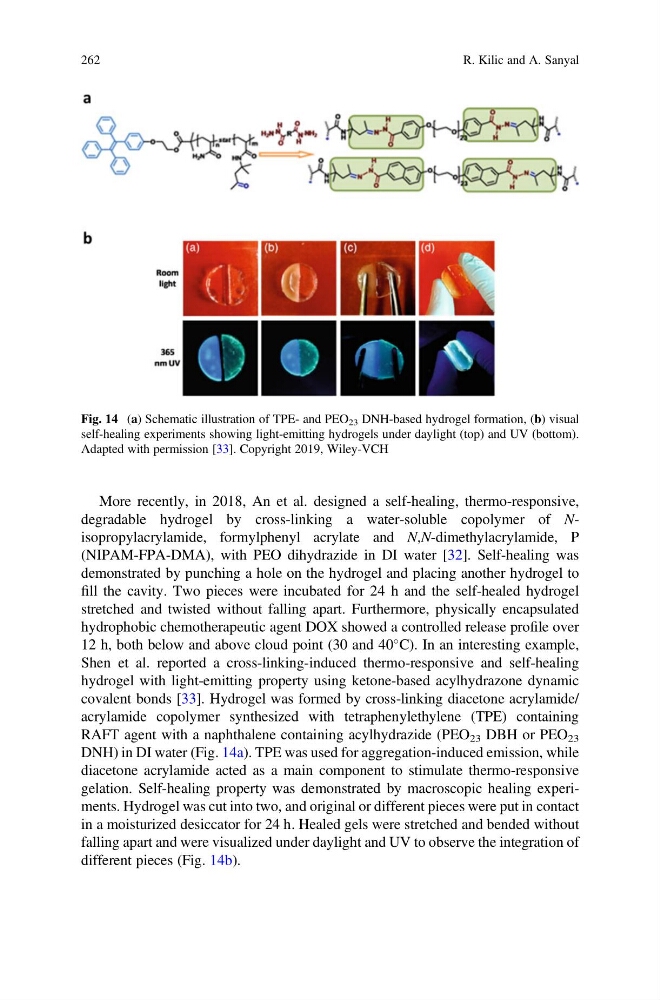
covalent bonds [33]. Hydrogel was formed by cross-linking diacetone acrylamide/
acrylamide copolymer synthesized with tetraphenylethylene (TPE) containing
RAFT agent with a naphthalene containing acylhydrazide (PEO 23 DBH or PEO 23
DNH) in DI water (Fig. 14a). TPE was used for aggregation-induced emission, while
diacetone acrylamide acted as a main component to stimulate thermo-responsive
gelation. Self-healing property was demonstrated by macroscopic healing experiments. Hydrogel was cut into two, and original or different pieces were put in contact
in a moisturized desiccator for 24 h. Healed gels were stretched and bended without
falling apart and were visualized under daylight and UV to observe the integration of
different pieces (Fig. 14b).
Fig. 14 (a) Schematic illustration of TPE- and PEO 23 DNH-based hydrogel formation, (b) visual
self-healing experiments showing light-emitting hydrogels under daylight (top) and UV (bottom).
Adapted with permission [33]. Copyright 2019, Wiley-VCH
262
R. Kilic and A. Sanyal
degradable hydrogel by cross-linking a water-soluble copolymer of Nisopropylacrylamide, formylphenyl acrylate and N,N-dimethylacrylamide, P
(NIPAM-FPA-DMA), with PEO dihydrazide in DI water [32]. Self-healing was
demonstrated by punching a hole on the hydrogel and placing another hydrogel to
fill the cavity. Two pieces were incubated for 24 h and the self-healed hydrogel
stretched and twisted without falling apart. Furthermore, physically encapsulated
hydrophobic chemotherapeutic agent DOX showed a controlled release profile over
12 h, both below and above cloud point (30 and 40
C). In an interesting example,
Shen et al. reported a cross-linking-induced thermo-responsive and self-healing
hydrogel with light-emitting property using ketone-based acylhydrazone dynamic
covalent bonds [33]. Hydrogel was formed by cross-linking diacetone acrylamide/
acrylamide copolymer synthesized with tetraphenylethylene (TPE) containing
RAFT agent with a naphthalene containing acylhydrazide (PEO 23 DBH or PEO 23
DNH) in DI water (Fig. 14a). TPE was used for aggregation-induced emission, while
diacetone acrylamide acted as a main component to stimulate thermo-responsive
gelation. Self-healing property was demonstrated by macroscopic healing experiments. Hydrogel was cut into two, and original or different pieces were put in contact
in a moisturized desiccator for 24 h. Healed gels were stretched and bended without
falling apart and were visualized under daylight and UV to observe the integration of
different pieces (Fig. 14b).
Fig. 14 (a) Schematic illustration of TPE- and PEO 23 DNH-based hydrogel formation, (b) visual
self-healing experiments showing light-emitting hydrogels under daylight (top) and UV (bottom).
Adapted with permission [33]. Copyright 2019, Wiley-VCH
262
R. Kilic and A. Sanyal