

acrylate-co-2-hydroxyethyl methacrylate) P(NaMAA-co-HEMA) hydrogels with
negative charges and poly(2-(dimethyl amino)ethyl methacrylate-co-2-hydroxyethyl
methacrylate) P(DMAEMA-co-HEMA) hydrogels with positive charges [58].
2-Hydroxyethyl methacrylate (HEMA) is used to modulate the modulus of the
hydrogels, and the concentrations of NaMAA and DMAEMA are changed to tune
the immobile charges in the networks.
As the hydrogels containing negative and positive charges are assembled
together, the immobilized polyions form a robust interface. As the assemblies are
pulled apart, one of the hydrogels is ruptured near the interface (Fig. 18a), and long
fibers are pulled out at the interface (Fig. 18b).
The tensile strength of the assemblies is used to measure the adhesion strength.
Figure 18c shows that the tensile strength increases from 35.4 kPa to a maximum of
104.5 kPa at the C MAA of 0.125 mol/L and then decreases to 42.0 kPa at C MAA of
0.15 mol/L. It is likely that the increase of the –COO
À charge density in the network
favors the interface strength. When the C MAA was over 0.1 mol/L, those counterions
(Na
+ ) remained inside the gels may screen the negative charges and thus reduce the
interface strength.
On the other hand, the effect of positive charge density or DMEAMA concentration in the gels on the interface strength is also investigated. Figure 18d shows
the tensile strength of hydrogels with different C DMAEMA . The interface strength
increases from 26.4 to 104.5 kPa as the C DMAEMA increases from 0.1 to 0.4 mol/L
and then decreases to 76.1 kPa as the C DMAEMA further increases to 0.5 mol/L. With
the C DMAEMA lower than 0.4 mol/L, the positive charge density increases with
C DMAEMA , leading to the enhancement of interface strength. With the C DMAEMA
higher than 0.4 mol/L, the free ions may partly shield the electrostatic interaction,
resulting in the reduction of interface strength.
The interface strength can be measured by using peel-off tests. In this method,
two hydrogel strips with opposite charges are assembled together. The free ends of
the bilayers are steadily pulled by using a tensile test instrument to separate the
assembly apart (Fig. 19a). The force and displacement are recorded. Figure 19b
shows representative force-displacement curve of the gels with different negative
charge (NaMAA) contents in the network. The oscillating peaks on the curves
indicate the gradual peeling-off at the interface.
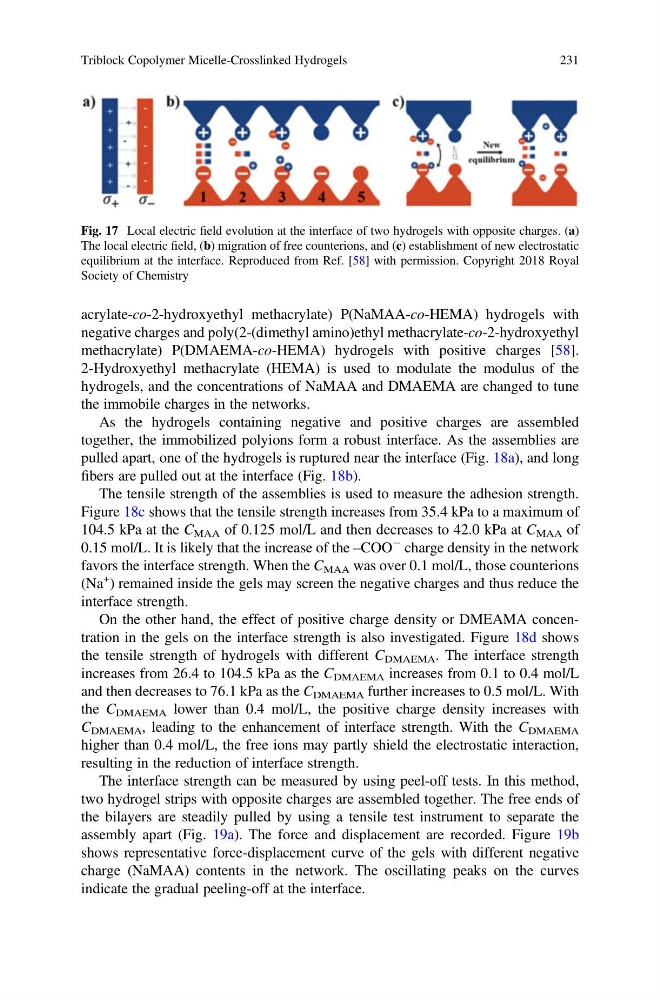
Fig. 17 Local electric field evolution at the interface of two hydrogels with opposite charges. (a)
The local electric field, (b) migration of free counterions, and (c) establishment of new electrostatic
equilibrium at the interface. Reproduced from Ref. [58] with permission. Copyright 2018 Royal
Society of Chemistry
Triblock Copolymer Micelle-Crosslinked Hydrogels
231
negative charges and poly(2-(dimethyl amino)ethyl methacrylate-co-2-hydroxyethyl
methacrylate) P(DMAEMA-co-HEMA) hydrogels with positive charges [58].
2-Hydroxyethyl methacrylate (HEMA) is used to modulate the modulus of the
hydrogels, and the concentrations of NaMAA and DMAEMA are changed to tune
the immobile charges in the networks.
As the hydrogels containing negative and positive charges are assembled
together, the immobilized polyions form a robust interface. As the assemblies are
pulled apart, one of the hydrogels is ruptured near the interface (Fig. 18a), and long
fibers are pulled out at the interface (Fig. 18b).
The tensile strength of the assemblies is used to measure the adhesion strength.
Figure 18c shows that the tensile strength increases from 35.4 kPa to a maximum of
104.5 kPa at the C MAA of 0.125 mol/L and then decreases to 42.0 kPa at C MAA of
0.15 mol/L. It is likely that the increase of the –COO
À charge density in the network
favors the interface strength. When the C MAA was over 0.1 mol/L, those counterions
(Na
+ ) remained inside the gels may screen the negative charges and thus reduce the
interface strength.
On the other hand, the effect of positive charge density or DMEAMA concentration in the gels on the interface strength is also investigated. Figure 18d shows
the tensile strength of hydrogels with different C DMAEMA . The interface strength
increases from 26.4 to 104.5 kPa as the C DMAEMA increases from 0.1 to 0.4 mol/L
and then decreases to 76.1 kPa as the C DMAEMA further increases to 0.5 mol/L. With
the C DMAEMA lower than 0.4 mol/L, the positive charge density increases with
C DMAEMA , leading to the enhancement of interface strength. With the C DMAEMA
higher than 0.4 mol/L, the free ions may partly shield the electrostatic interaction,
resulting in the reduction of interface strength.
The interface strength can be measured by using peel-off tests. In this method,
two hydrogel strips with opposite charges are assembled together. The free ends of
the bilayers are steadily pulled by using a tensile test instrument to separate the
assembly apart (Fig. 19a). The force and displacement are recorded. Figure 19b
shows representative force-displacement curve of the gels with different negative
charge (NaMAA) contents in the network. The oscillating peaks on the curves
indicate the gradual peeling-off at the interface.
Fig. 17 Local electric field evolution at the interface of two hydrogels with opposite charges. (a)
The local electric field, (b) migration of free counterions, and (c) establishment of new electrostatic
equilibrium at the interface. Reproduced from Ref. [58] with permission. Copyright 2018 Royal
Society of Chemistry
Triblock Copolymer Micelle-Crosslinked Hydrogels
231