

The obtained polyelectrolyte hydrogels show outstanding mechanical properties.
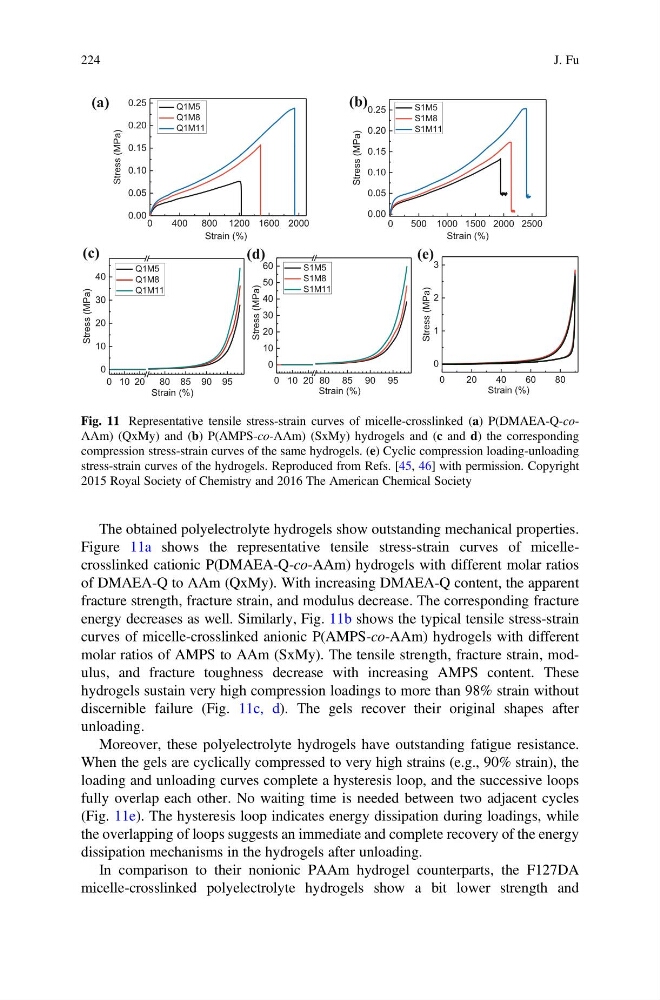
Figure 11a shows the representative tensile stress-strain curves of micellecrosslinked cationic P(DMAEA-Q-co-AAm) hydrogels with different molar ratios
of DMAEA-Q to AAm (QxMy). With increasing DMAEA-Q content, the apparent
fracture strength, fracture strain, and modulus decrease. The corresponding fracture
energy decreases as well. Similarly, Fig. 11b shows the typical tensile stress-strain
curves of micelle-crosslinked anionic P(AMPS-co-AAm) hydrogels with different
molar ratios of AMPS to AAm (SxMy). The tensile strength, fracture strain, modulus, and fracture toughness decrease with increasing AMPS content. These
hydrogels sustain very high compression loadings to more than 98% strain without
discernible failure (Fig. 11c, d). The gels recover their original shapes after
unloading.
Moreover, these polyelectrolyte hydrogels have outstanding fatigue resistance.
When the gels are cyclically compressed to very high strains (e.g., 90% strain), the
loading and unloading curves complete a hysteresis loop, and the successive loops
fully overlap each other. No waiting time is needed between two adjacent cycles
(Fig. 11e). The hysteresis loop indicates energy dissipation during loadings, while
the overlapping of loops suggests an immediate and complete recovery of the energy
dissipation mechanisms in the hydrogels after unloading.
In comparison to their nonionic PAAm hydrogel counterparts, the F127DA
micelle-crosslinked polyelectrolyte hydrogels show a bit lower strength and
0
500 1000 1500 2000 2500
0.00
0.05
0.10
0.15
0.20
0.25
)
a
P
M
(
s
s
e
r
t
S
Strain (%)
S1M5
S1M8
S1M11
0
400 800 1200 1600 2000
0.00
0.05
0.10
0.15
0.20
0.25
Q1M5
Q1M8
Q1M11
)
a
P
M
(
s
s
e
r
t
S
Strain (%)
0
2 0
4 0
6 0
8 0
0
1
2
3
)
a
P
M
(
s
s
e
r
t
S
Strain (%)
0 10 20
80 85 90 95
0
10
20
30
40
)
a
P
M
(
s
s
e
r
t
S
Strain (%)
Q1M5
Q1M8
Q1M11
0 10 20 80 85 90 95
0
10
20
30
40
50
60
)
a
P
M
(
s
s
e
r
t
S
Strain (%)
S1M5
S1M8
S1M11
(a)
(b)
(c)
(d)
(e)
Fig. 11 Representative tensile stress-strain curves of micelle-crosslinked (a) P(DMAEA-Q-coAAm) (QxMy) and (b) P(AMPS-co-AAm) (SxMy) hydrogels and (c and d) the corresponding
compression stress-strain curves of the same hydrogels. (e) Cyclic compression loading-unloading
stress-strain curves of the hydrogels. Reproduced from Refs. [45, 46] with permission. Copyright
2015 Royal Society of Chemistry and 2016 The American Chemical Society
224
J. Fu
Figure 11a shows the representative tensile stress-strain curves of micellecrosslinked cationic P(DMAEA-Q-co-AAm) hydrogels with different molar ratios
of DMAEA-Q to AAm (QxMy). With increasing DMAEA-Q content, the apparent
fracture strength, fracture strain, and modulus decrease. The corresponding fracture
energy decreases as well. Similarly, Fig. 11b shows the typical tensile stress-strain
curves of micelle-crosslinked anionic P(AMPS-co-AAm) hydrogels with different
molar ratios of AMPS to AAm (SxMy). The tensile strength, fracture strain, modulus, and fracture toughness decrease with increasing AMPS content. These
hydrogels sustain very high compression loadings to more than 98% strain without
discernible failure (Fig. 11c, d). The gels recover their original shapes after
unloading.
Moreover, these polyelectrolyte hydrogels have outstanding fatigue resistance.
When the gels are cyclically compressed to very high strains (e.g., 90% strain), the
loading and unloading curves complete a hysteresis loop, and the successive loops
fully overlap each other. No waiting time is needed between two adjacent cycles
(Fig. 11e). The hysteresis loop indicates energy dissipation during loadings, while
the overlapping of loops suggests an immediate and complete recovery of the energy
dissipation mechanisms in the hydrogels after unloading.
In comparison to their nonionic PAAm hydrogel counterparts, the F127DA
micelle-crosslinked polyelectrolyte hydrogels show a bit lower strength and
0
500 1000 1500 2000 2500
0.00
0.05
0.10
0.15
0.20
0.25
)
a
P
M
(
s
s
e
r
t
S
Strain (%)
S1M5
S1M8
S1M11
0
400 800 1200 1600 2000
0.00
0.05
0.10
0.15
0.20
0.25
Q1M5
Q1M8
Q1M11
)
a
P
M
(
s
s
e
r
t
S
Strain (%)
0
2 0
4 0
6 0
8 0
0
1
2
3
)
a
P
M
(
s
s
e
r
t
S
Strain (%)
0 10 20
80 85 90 95
0
10
20
30
40
)
a
P
M
(
s
s
e
r
t
S
Strain (%)
Q1M5
Q1M8
Q1M11
0 10 20 80 85 90 95
0
10
20
30
40
50
60
)
a
P
M
(
s
s
e
r
t
S
Strain (%)
S1M5
S1M8
S1M11
(a)
(b)
(c)
(d)
(e)
Fig. 11 Representative tensile stress-strain curves of micelle-crosslinked (a) P(DMAEA-Q-coAAm) (QxMy) and (b) P(AMPS-co-AAm) (SxMy) hydrogels and (c and d) the corresponding
compression stress-strain curves of the same hydrogels. (e) Cyclic compression loading-unloading
stress-strain curves of the hydrogels. Reproduced from Refs. [45, 46] with permission. Copyright
2015 Royal Society of Chemistry and 2016 The American Chemical Society
224
J. Fu