

were large enough to produce a transition of the hydrogel from a viscoelastic solid to
a viscoelastic liquid, i.e., when G
00
> G
0 .
The reversible mechanical behavior of the microstructure of a DF9 hydrogel is
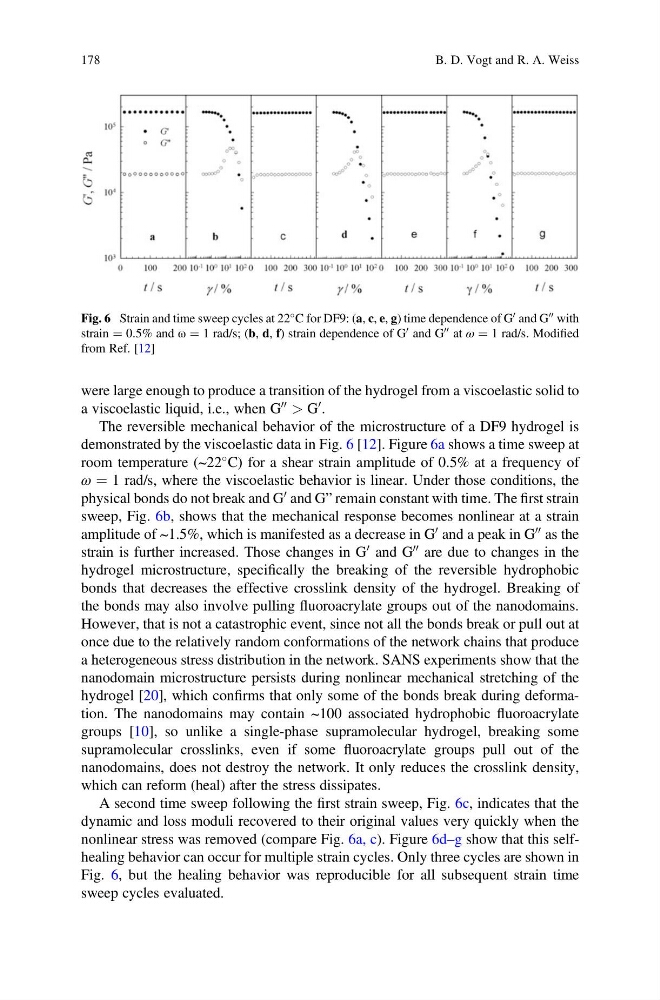
demonstrated by the viscoelastic data in Fig. 6 [12]. Figure 6a shows a time sweep at
room temperature (~22
C) for a shear strain amplitude of 0.5% at a frequency of
ω ¼ 1 rad/s, where the viscoelastic behavior is linear. Under those conditions, the
physical bonds do not break and G
0 and G” remain constant with time. The first strain
sweep, Fig. 6b, shows that the mechanical response becomes nonlinear at a strain
amplitude of ~1.5%, which is manifested as a decrease in G
0 and a peak in G
00 as the
strain is further increased. Those changes in G
0 and G
00 are due to changes in the
hydrogel microstructure, specifically the breaking of the reversible hydrophobic
bonds that decreases the effective crosslink density of the hydrogel. Breaking of
the bonds may also involve pulling fluoroacrylate groups out of the nanodomains.
However, that is not a catastrophic event, since not all the bonds break or pull out at
once due to the relatively random conformations of the network chains that produce
a heterogeneous stress distribution in the network. SANS experiments show that the
nanodomain microstructure persists during nonlinear mechanical stretching of the
hydrogel [20], which confirms that only some of the bonds break during deformation. The nanodomains may contain ~100 associated hydrophobic fluoroacrylate
groups [10], so unlike a single-phase supramolecular hydrogel, breaking some
supramolecular crosslinks, even if some fluoroacrylate groups pull out of the
nanodomains, does not destroy the network. It only reduces the crosslink density,
which can reform (heal) after the stress dissipates.
A second time sweep following the first strain sweep, Fig. 6c, indicates that the
dynamic and loss moduli recovered to their original values very quickly when the
nonlinear stress was removed (compare Fig. 6a, c). Figure 6d–g show that this selfhealing behavior can occur for multiple strain cycles. Only three cycles are shown in
Fig. 6, but the healing behavior was reproducible for all subsequent strain time
sweep cycles evaluated.
Fig. 6 Strain and time sweep cycles at 22
C for DF9: (a, c, e, g) time dependence of G
0 and G
00 with
strain ¼ 0.5% and ω ¼ 1 rad/s; (b, d, f) strain dependence of G
0 and G
00 at ω ¼ 1 rad/s. Modified
from Ref. [12]
178
B. D. Vogt and R. A. Weiss
a viscoelastic liquid, i.e., when G
00
> G
0 .
The reversible mechanical behavior of the microstructure of a DF9 hydrogel is
demonstrated by the viscoelastic data in Fig. 6 [12]. Figure 6a shows a time sweep at
room temperature (~22
C) for a shear strain amplitude of 0.5% at a frequency of
ω ¼ 1 rad/s, where the viscoelastic behavior is linear. Under those conditions, the
physical bonds do not break and G
0 and G” remain constant with time. The first strain
sweep, Fig. 6b, shows that the mechanical response becomes nonlinear at a strain
amplitude of ~1.5%, which is manifested as a decrease in G
0 and a peak in G
00 as the
strain is further increased. Those changes in G
0 and G
00 are due to changes in the
hydrogel microstructure, specifically the breaking of the reversible hydrophobic
bonds that decreases the effective crosslink density of the hydrogel. Breaking of
the bonds may also involve pulling fluoroacrylate groups out of the nanodomains.
However, that is not a catastrophic event, since not all the bonds break or pull out at
once due to the relatively random conformations of the network chains that produce
a heterogeneous stress distribution in the network. SANS experiments show that the
nanodomain microstructure persists during nonlinear mechanical stretching of the
hydrogel [20], which confirms that only some of the bonds break during deformation. The nanodomains may contain ~100 associated hydrophobic fluoroacrylate
groups [10], so unlike a single-phase supramolecular hydrogel, breaking some
supramolecular crosslinks, even if some fluoroacrylate groups pull out of the
nanodomains, does not destroy the network. It only reduces the crosslink density,
which can reform (heal) after the stress dissipates.
A second time sweep following the first strain sweep, Fig. 6c, indicates that the
dynamic and loss moduli recovered to their original values very quickly when the
nonlinear stress was removed (compare Fig. 6a, c). Figure 6d–g show that this selfhealing behavior can occur for multiple strain cycles. Only three cycles are shown in
Fig. 6, but the healing behavior was reproducible for all subsequent strain time
sweep cycles evaluated.
Fig. 6 Strain and time sweep cycles at 22
C for DF9: (a, c, e, g) time dependence of G
0 and G
00 with
strain ¼ 0.5% and ω ¼ 1 rad/s; (b, d, f) strain dependence of G
0 and G
00 at ω ¼ 1 rad/s. Modified
from Ref. [12]
178
B. D. Vogt and R. A. Weiss