

2.2 Preparation of Hydrophobically Associating
Supramolecular Hydrogels
Films of the copolymers were prepared by compression molding at elevated temperatures, e.g., 150
C, or by casting a polymer solution. Although the copolymers
containing more than 2 mol% fluoroacrylate monomer were generally insoluble in
water, they did dissolve in methanol, isopropanol, butanol, cyclohexanone, dimethyl
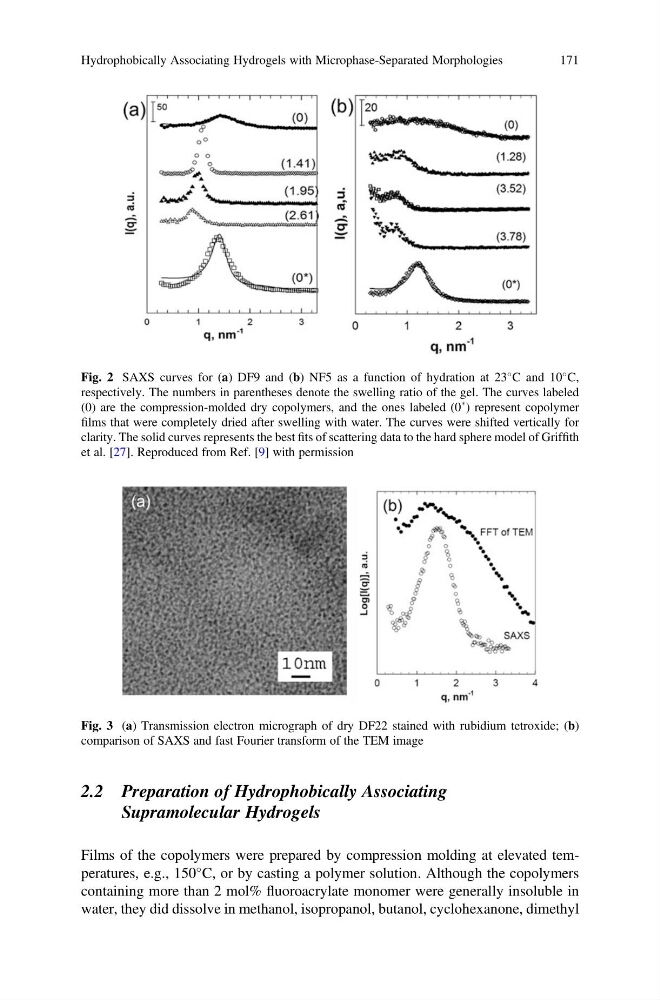
Fig. 2 SAXS curves for (a) DF9 and (b) NF5 as a function of hydration at 23
C and 10
C,
respectively. The numbers in parentheses denote the swelling ratio of the gel. The curves labeled
(0) are the compression-molded dry copolymers, and the ones labeled (0
Ã
) represent copolymer
films that were completely dried after swelling with water. The curves were shifted vertically for
clarity. The solid curves represents the best fits of scattering data to the hard sphere model of Griffith
et al. [27]. Reproduced from Ref. [9] with permission
Fig. 3 (a) Transmission electron micrograph of dry DF22 stained with rubidium tetroxide; (b)
comparison of SAXS and fast Fourier transform of the TEM image
Hydrophobically Associating Hydrogels with Microphase-Separated Morphologies
171
Supramolecular Hydrogels
Films of the copolymers were prepared by compression molding at elevated temperatures, e.g., 150
C, or by casting a polymer solution. Although the copolymers
containing more than 2 mol% fluoroacrylate monomer were generally insoluble in
water, they did dissolve in methanol, isopropanol, butanol, cyclohexanone, dimethyl
Fig. 2 SAXS curves for (a) DF9 and (b) NF5 as a function of hydration at 23
C and 10
C,
respectively. The numbers in parentheses denote the swelling ratio of the gel. The curves labeled
(0) are the compression-molded dry copolymers, and the ones labeled (0
Ã
) represent copolymer
films that were completely dried after swelling with water. The curves were shifted vertically for
clarity. The solid curves represents the best fits of scattering data to the hard sphere model of Griffith
et al. [27]. Reproduced from Ref. [9] with permission
Fig. 3 (a) Transmission electron micrograph of dry DF22 stained with rubidium tetroxide; (b)
comparison of SAXS and fast Fourier transform of the TEM image
Hydrophobically Associating Hydrogels with Microphase-Separated Morphologies
171