

Lennard-Jones potential shifted such that it is equal to zero at its minimum and then
truncated beyond that point. For polymer segments and permanent-reversible crosslinks, the Lennard-Jones parameters are set to ε ¼ 1E and σ ¼ 1D , so that the
effective diameter of these particles is d seg ¼ 1D.
The polymer segments and permanent cross-links are bound together by FENE
bonds, whose (bonded) potential is given by Eq. (7), where r 0 ¼ 1.5σ is the bond
length parameter and K sp ¼ 30E/σ
2 is the bond stiffness; σ and ε are the LennardJones length and energy parameters for the particle pair in question. Note that
particles bound by the FENE potential also interact via the repulsive WCA potential
(Eq. (10)).
A permanently cross-linked polymer network is formed in situ from the polymer
strands and permanent cross-link monomers in the simulation box. Each polymer
segment has one ‘sticker’ (see Sect. 3.2.2), and the permanent cross-link monomers
each have two. Strong short-ranged attractive Gaussian potentials between the
stickers are switched on, and the system is integrated through time so that the
permanent cross-links may form up to two connections with two different polymer
segments. Each connection that forms is transformed into a permanent bond with the
FENE potential Eq. (7). This network formation phase is carried out until every
permanent cross-link has connected its two stickers to polymer segments.
4.1.2 Swelling and Reversible Cross-Links
Once the network is formed, it is swollen to a new box volume of V swollen . The
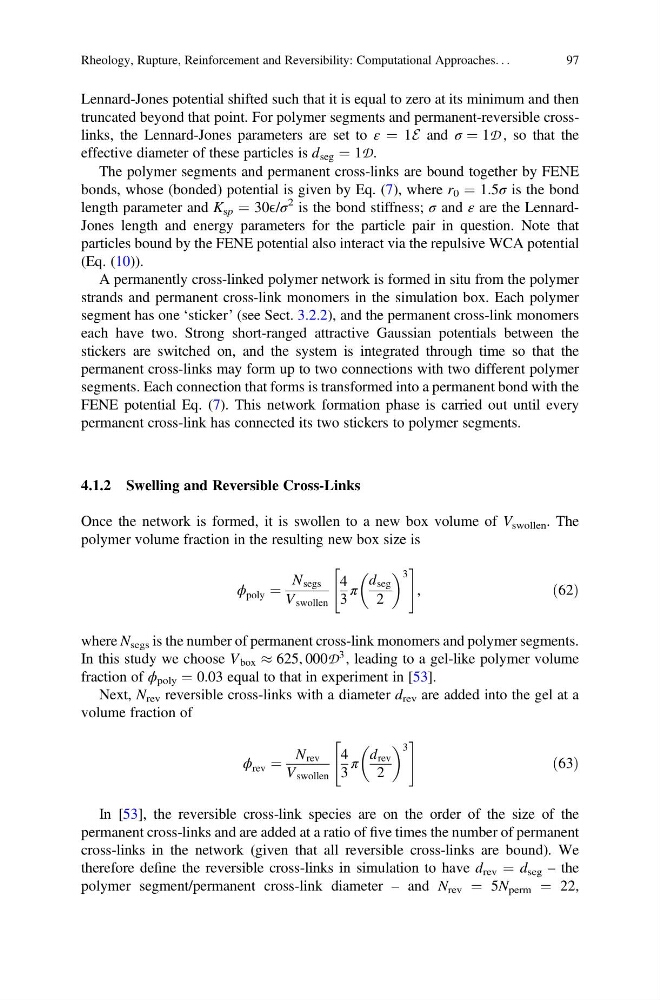
polymer volume fraction in the resulting new box size is
ϕ poly ¼
N segs
V swollen
4
3
π
d seg
2
3
"
#
,
ð62Þ
where N segs is the number of permanent cross-link monomers and polymer segments.
In this study we choose V box % 625, 000D
3 , leading to a gel-like polymer volume
fraction of ϕ poly ¼ 0.03 equal to that in experiment in [53].
Next, N rev reversible cross-links with a diameter d rev are added into the gel at a
volume fraction of
ϕ rev ¼
N rev
V swollen
4
3
π
d rev
2
3
"
#
ð63Þ
In [53], the reversible cross-link species are on the order of the size of the
permanent cross-links and are added at a ratio of five times the number of permanent
cross-links in the network (given that all reversible cross-links are bound). We
therefore define the reversible cross-links in simulation to have d rev ¼ d seg – the
polymer segment/permanent cross-link diameter – and N rev ¼ 5N perm ¼ 22,
Rheology, Rupture, Reinforcement and Reversibility: Computational Approaches. . .
97
truncated beyond that point. For polymer segments and permanent-reversible crosslinks, the Lennard-Jones parameters are set to ε ¼ 1E and σ ¼ 1D , so that the
effective diameter of these particles is d seg ¼ 1D.
The polymer segments and permanent cross-links are bound together by FENE
bonds, whose (bonded) potential is given by Eq. (7), where r 0 ¼ 1.5σ is the bond
length parameter and K sp ¼ 30E/σ
2 is the bond stiffness; σ and ε are the LennardJones length and energy parameters for the particle pair in question. Note that
particles bound by the FENE potential also interact via the repulsive WCA potential
(Eq. (10)).
A permanently cross-linked polymer network is formed in situ from the polymer
strands and permanent cross-link monomers in the simulation box. Each polymer
segment has one ‘sticker’ (see Sect. 3.2.2), and the permanent cross-link monomers
each have two. Strong short-ranged attractive Gaussian potentials between the
stickers are switched on, and the system is integrated through time so that the
permanent cross-links may form up to two connections with two different polymer
segments. Each connection that forms is transformed into a permanent bond with the
FENE potential Eq. (7). This network formation phase is carried out until every
permanent cross-link has connected its two stickers to polymer segments.
4.1.2 Swelling and Reversible Cross-Links
Once the network is formed, it is swollen to a new box volume of V swollen . The
polymer volume fraction in the resulting new box size is
ϕ poly ¼
N segs
V swollen
4
3
π
d seg
2
3
"
#
,
ð62Þ
where N segs is the number of permanent cross-link monomers and polymer segments.
In this study we choose V box % 625, 000D
3 , leading to a gel-like polymer volume
fraction of ϕ poly ¼ 0.03 equal to that in experiment in [53].
Next, N rev reversible cross-links with a diameter d rev are added into the gel at a
volume fraction of
ϕ rev ¼
N rev
V swollen
4
3
π
d rev
2
3
"
#
ð63Þ
In [53], the reversible cross-link species are on the order of the size of the
permanent cross-links and are added at a ratio of five times the number of permanent
cross-links in the network (given that all reversible cross-links are bound). We
therefore define the reversible cross-links in simulation to have d rev ¼ d seg – the
polymer segment/permanent cross-link diameter – and N rev ¼ 5N perm ¼ 22,
Rheology, Rupture, Reinforcement and Reversibility: Computational Approaches. . .
97