

Dispersive Optical Model
87
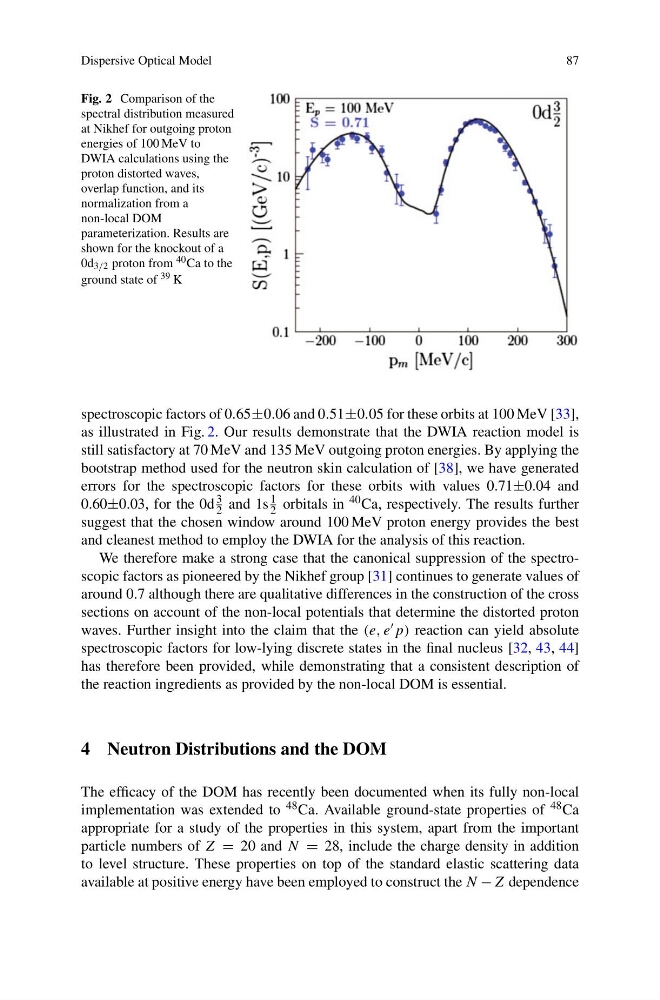
Fig. 2 Comparison of the
spectral distribution measured
at Nikhef for outgoing proton
energies of 100 MeV to
DWIA calculations using the
proton distorted waves,
overlap function, and its
normalization from a
non-local DOM
parameterization. Results are
shown for the knockout of a
0d 3/2 proton from 40 Ca to the
ground state of 39 K
spectroscopic factors of 0.65±0.06 and 0.51±0.05 for these orbits at 100 MeV [33],
as illustrated in Fig. 2. Our results demonstrate that the DWIA reaction model is
still satisfactory at 70 MeV and 135 MeV outgoing proton energies. By applying the
bootstrap method used for the neutron skin calculation of [38], we have generated
errors for the spectroscopic factors for these orbits with values 0.71±0.04 and
0.60±0.03, for the 0d
3
2 and 1s
1
2 orbitals in 40 Ca, respectively. The results further
suggest that the chosen window around 100 MeV proton energy provides the best
and cleanest method to employ the DWIA for the analysis of this reaction.
We therefore make a strong case that the canonical suppression of the spectroscopic factors as pioneered by the Nikhef group [31] continues to generate values of
around 0.7 although there are qualitative differences in the construction of the cross
sections on account of the non-local potentials that determine the distorted proton
waves. Further insight into the claim that the (e, e p) reaction can yield absolute
spectroscopic factors for low-lying discrete states in the final nucleus [32, 43, 44]
has therefore been provided, while demonstrating that a consistent description of
the reaction ingredients as provided by the non-local DOM is essential.
4 Neutron Distributions and the DOM
The efficacy of the DOM has recently been documented when its fully non-local
implementation was extended to 48 Ca. Available ground-state properties of 48 Ca
appropriate for a study of the properties in this system, apart from the important
particle numbers of Z = 20 and N = 28, include the charge density in addition
to level structure. These properties on top of the standard elastic scattering data
available at positive energy have been employed to construct the N − Z dependence
87
Fig. 2 Comparison of the
spectral distribution measured
at Nikhef for outgoing proton
energies of 100 MeV to
DWIA calculations using the
proton distorted waves,
overlap function, and its
normalization from a
non-local DOM
parameterization. Results are
shown for the knockout of a
0d 3/2 proton from 40 Ca to the
ground state of 39 K
spectroscopic factors of 0.65±0.06 and 0.51±0.05 for these orbits at 100 MeV [33],
as illustrated in Fig. 2. Our results demonstrate that the DWIA reaction model is
still satisfactory at 70 MeV and 135 MeV outgoing proton energies. By applying the
bootstrap method used for the neutron skin calculation of [38], we have generated
errors for the spectroscopic factors for these orbits with values 0.71±0.04 and
0.60±0.03, for the 0d
3
2 and 1s
1
2 orbitals in 40 Ca, respectively. The results further
suggest that the chosen window around 100 MeV proton energy provides the best
and cleanest method to employ the DWIA for the analysis of this reaction.
We therefore make a strong case that the canonical suppression of the spectroscopic factors as pioneered by the Nikhef group [31] continues to generate values of
around 0.7 although there are qualitative differences in the construction of the cross
sections on account of the non-local potentials that determine the distorted proton
waves. Further insight into the claim that the (e, e p) reaction can yield absolute
spectroscopic factors for low-lying discrete states in the final nucleus [32, 43, 44]
has therefore been provided, while demonstrating that a consistent description of
the reaction ingredients as provided by the non-local DOM is essential.
4 Neutron Distributions and the DOM
The efficacy of the DOM has recently been documented when its fully non-local
implementation was extended to 48 Ca. Available ground-state properties of 48 Ca
appropriate for a study of the properties in this system, apart from the important
particle numbers of Z = 20 and N = 28, include the charge density in addition
to level structure. These properties on top of the standard elastic scattering data
available at positive energy have been employed to construct the N − Z dependence