

Dispersive Optical Model
85
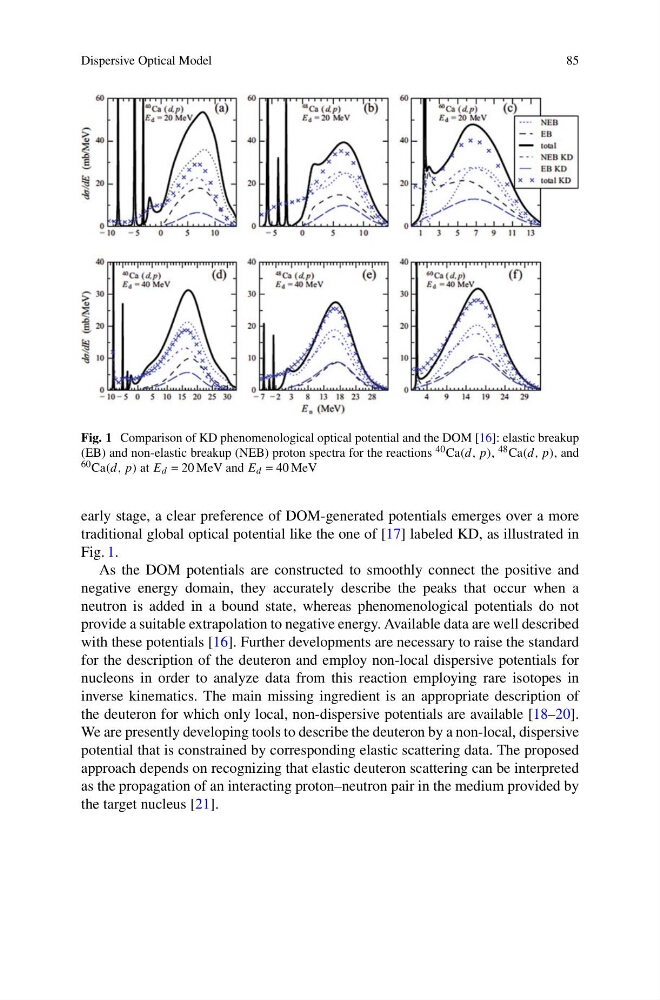
Fig. 1 Comparison of KD phenomenological optical potential and the DOM [16]: elastic breakup
(EB) and non-elastic breakup (NEB) proton spectra for the reactions 40 Ca(d, p), 48 Ca(d, p), and
60 Ca(d, p) at E d = 20 MeV and E d = 40 MeV
early stage, a clear preference of DOM-generated potentials emerges over a more
traditional global optical potential like the one of [17] labeled KD, as illustrated in
Fig. 1.
As the DOM potentials are constructed to smoothly connect the positive and
negative energy domain, they accurately describe the peaks that occur when a
neutron is added in a bound state, whereas phenomenological potentials do not
provide a suitable extrapolation to negative energy. Available data are well described
with these potentials [16]. Further developments are necessary to raise the standard
for the description of the deuteron and employ non-local dispersive potentials for
nucleons in order to analyze data from this reaction employing rare isotopes in
inverse kinematics. The main missing ingredient is an appropriate description of
the deuteron for which only local, non-dispersive potentials are available [18–20].
We are presently developing tools to describe the deuteron by a non-local, dispersive
potential that is constrained by corresponding elastic scattering data. The proposed
approach depends on recognizing that elastic deuteron scattering can be interpreted
as the propagation of an interacting proton–neutron pair in the medium provided by
the target nucleus [21].
85
Fig. 1 Comparison of KD phenomenological optical potential and the DOM [16]: elastic breakup
(EB) and non-elastic breakup (NEB) proton spectra for the reactions 40 Ca(d, p), 48 Ca(d, p), and
60 Ca(d, p) at E d = 20 MeV and E d = 40 MeV
early stage, a clear preference of DOM-generated potentials emerges over a more
traditional global optical potential like the one of [17] labeled KD, as illustrated in
Fig. 1.
As the DOM potentials are constructed to smoothly connect the positive and
negative energy domain, they accurately describe the peaks that occur when a
neutron is added in a bound state, whereas phenomenological potentials do not
provide a suitable extrapolation to negative energy. Available data are well described
with these potentials [16]. Further developments are necessary to raise the standard
for the description of the deuteron and employ non-local dispersive potentials for
nucleons in order to analyze data from this reaction employing rare isotopes in
inverse kinematics. The main missing ingredient is an appropriate description of
the deuteron for which only local, non-dispersive potentials are available [18–20].
We are presently developing tools to describe the deuteron by a non-local, dispersive
potential that is constrained by corresponding elastic scattering data. The proposed
approach depends on recognizing that elastic deuteron scattering can be interpreted
as the propagation of an interacting proton–neutron pair in the medium provided by
the target nucleus [21].