

Multi-step Direct Reaction Models and Collectivity
71
0
50
100
150
200
E pm (MeV)
0
10
20
30
40
50
P(E pm
)
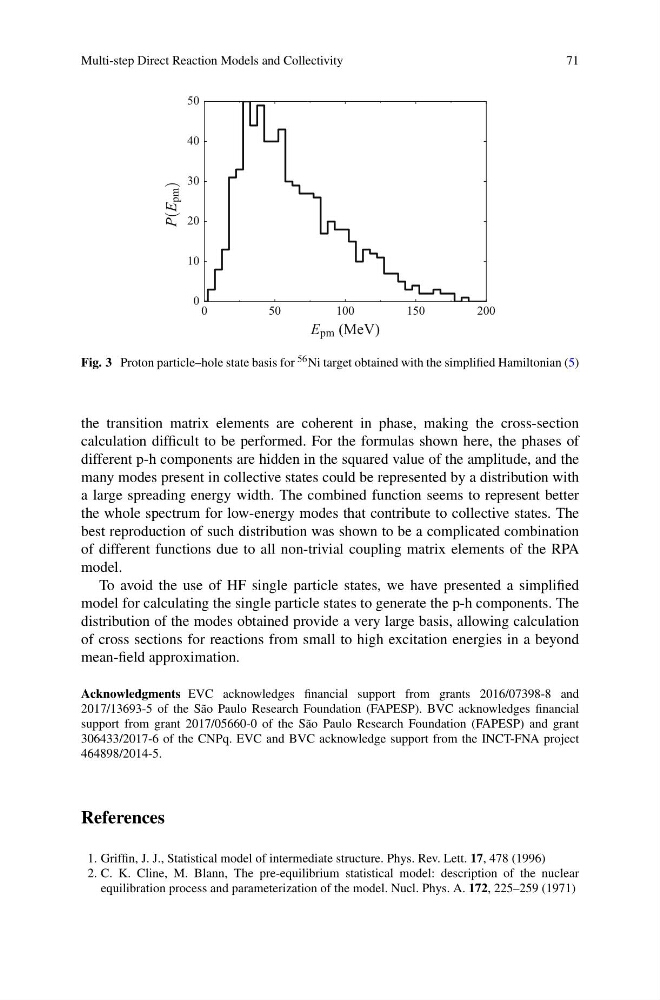
Fig. 3 Proton particle–hole state basis for 56 Ni target obtained with the simplified Hamiltonian (5)
the transition matrix elements are coherent in phase, making the cross-section
calculation difficult to be performed. For the formulas shown here, the phases of
different p-h components are hidden in the squared value of the amplitude, and the
many modes present in collective states could be represented by a distribution with
a large spreading energy width. The combined function seems to represent better
the whole spectrum for low-energy modes that contribute to collective states. The
best reproduction of such distribution was shown to be a complicated combination
of different functions due to all non-trivial coupling matrix elements of the RPA
model.
To avoid the use of HF single particle states, we have presented a simplified
model for calculating the single particle states to generate the p-h components. The
distribution of the modes obtained provide a very large basis, allowing calculation
of cross sections for reactions from small to high excitation energies in a beyond
mean-field approximation.
Acknowledgments EVC acknowledges financial support from grants 2016/07398-8 and
2017/13693-5 of the São Paulo Research Foundation (FAPESP). BVC acknowledges financial
support from grant 2017/05660-0 of the São Paulo Research Foundation (FAPESP) and grant
306433/2017-6 of the CNPq. EVC and BVC acknowledge support from the INCT-FNA project
464898/2014-5.
References
1. Griffin, J. J., Statistical model of intermediate structure. Phys. Rev. Lett. 17, 478 (1996)
2. C. K. Cline, M. Blann, The pre-equilibrium statistical model: description of the nuclear
equilibration process and parameterization of the model. Nucl. Phys. A. 172, 225–259 (1971)
71
0
50
100
150
200
E pm (MeV)
0
10
20
30
40
50
P(E pm
)
Fig. 3 Proton particle–hole state basis for 56 Ni target obtained with the simplified Hamiltonian (5)
the transition matrix elements are coherent in phase, making the cross-section
calculation difficult to be performed. For the formulas shown here, the phases of
different p-h components are hidden in the squared value of the amplitude, and the
many modes present in collective states could be represented by a distribution with
a large spreading energy width. The combined function seems to represent better
the whole spectrum for low-energy modes that contribute to collective states. The
best reproduction of such distribution was shown to be a complicated combination
of different functions due to all non-trivial coupling matrix elements of the RPA
model.
To avoid the use of HF single particle states, we have presented a simplified
model for calculating the single particle states to generate the p-h components. The
distribution of the modes obtained provide a very large basis, allowing calculation
of cross sections for reactions from small to high excitation energies in a beyond
mean-field approximation.
Acknowledgments EVC acknowledges financial support from grants 2016/07398-8 and
2017/13693-5 of the São Paulo Research Foundation (FAPESP). BVC acknowledges financial
support from grant 2017/05660-0 of the São Paulo Research Foundation (FAPESP) and grant
306433/2017-6 of the CNPq. EVC and BVC acknowledge support from the INCT-FNA project
464898/2014-5.
References
1. Griffin, J. J., Statistical model of intermediate structure. Phys. Rev. Lett. 17, 478 (1996)
2. C. K. Cline, M. Blann, The pre-equilibrium statistical model: description of the nuclear
equilibration process and parameterization of the model. Nucl. Phys. A. 172, 225–259 (1971)