

58
D. Brown et al.
σ
cn
ab = σ
abs
a
Γ b
c Γ c
W ab () with σ
abs
a =
π g a Γ a
Dk 2
a
.
(1)
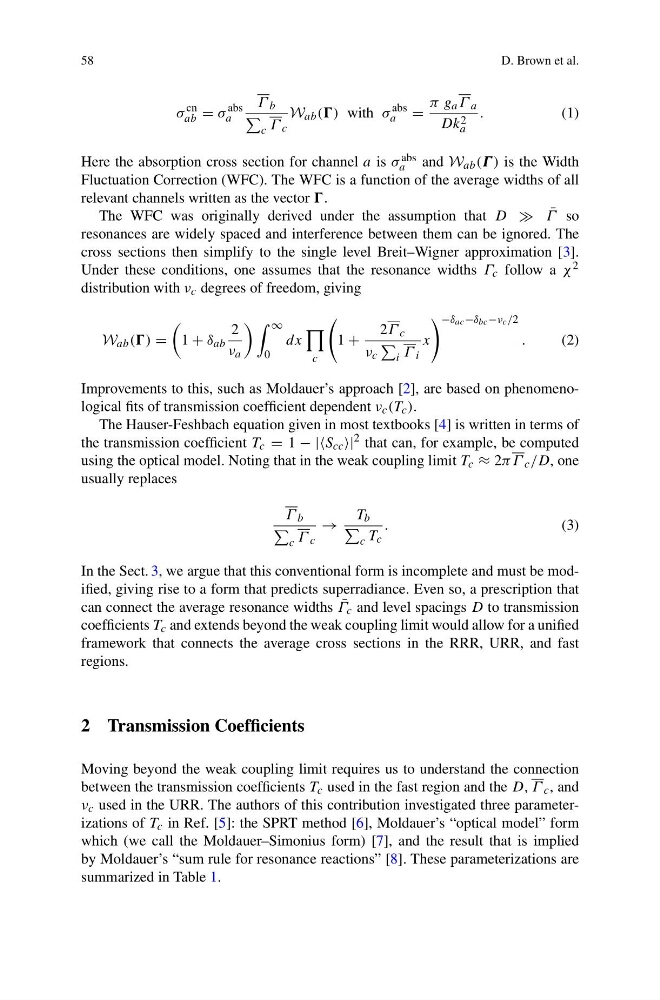
Here the absorption cross section for channel a is σ abs
a
and W ab (Γ ) is the Width
Fluctuation Correction (WFC). The WFC is a function of the average widths of all
relevant channels written as the vector .
The WFC was originally derived under the assumption that D ¯
Γ so
resonances are widely spaced and interference between them can be ignored. The
cross sections then simplify to the single level Breit–Wigner approximation [3].
Under these conditions, one assumes that the resonance widths Γ c follow a χ 2
distribution with ν c degrees of freedom, giving
W ab () =
1 + δ ab
2
ν a
∞
0
dx
c
1 +
2Γ c
ν c
i Γ i
x
−δ ac −δ bc −ν c /2
.
(2)
Improvements to this, such as Moldauer’s approach [2], are based on phenomenological fits of transmission coefficient dependent ν c (T c ).
The Hauser-Feshbach equation given in most textbooks [4] is written in terms of
the transmission coefficient T c = 1 − ||S cc | 2 that can, for example, be computed
using the optical model. Noting that in the weak coupling limit T c ≈ 2π Γ c /D, one
usually replaces
Γ b
c Γ c
→
T b
c T c
.
(3)
In the Sect. 3, we argue that this conventional form is incomplete and must be modified, giving rise to a form that predicts superradiance. Even so, a prescription that
can connect the average resonance widths ¯
Γ c and level spacings D to transmission
coefficients T c and extends beyond the weak coupling limit would allow for a unified
framework that connects the average cross sections in the RRR, URR, and fast
regions.
2 Transmission Coefficients
Moving beyond the weak coupling limit requires us to understand the connection
between the transmission coefficients T c used in the fast region and the D, Γ c , and
ν c used in the URR. The authors of this contribution investigated three parameterizations of T c in Ref. [5]: the SPRT method [6], Moldauer’s “optical model” form
which (we call the Moldauer–Simonius form) [7], and the result that is implied
by Moldauer’s “sum rule for resonance reactions” [8]. These parameterizations are
summarized in Table 1.
D. Brown et al.
σ
cn
ab = σ
abs
a
Γ b
c Γ c
W ab () with σ
abs
a =
π g a Γ a
Dk 2
a
.
(1)
Here the absorption cross section for channel a is σ abs
a
and W ab (Γ ) is the Width
Fluctuation Correction (WFC). The WFC is a function of the average widths of all
relevant channels written as the vector .
The WFC was originally derived under the assumption that D ¯
Γ so
resonances are widely spaced and interference between them can be ignored. The
cross sections then simplify to the single level Breit–Wigner approximation [3].
Under these conditions, one assumes that the resonance widths Γ c follow a χ 2
distribution with ν c degrees of freedom, giving
W ab () =
1 + δ ab
2
ν a
∞
0
dx
c
1 +
2Γ c
ν c
i Γ i
x
−δ ac −δ bc −ν c /2
.
(2)
Improvements to this, such as Moldauer’s approach [2], are based on phenomenological fits of transmission coefficient dependent ν c (T c ).
The Hauser-Feshbach equation given in most textbooks [4] is written in terms of
the transmission coefficient T c = 1 − ||S cc | 2 that can, for example, be computed
using the optical model. Noting that in the weak coupling limit T c ≈ 2π Γ c /D, one
usually replaces
Γ b
c Γ c
→
T b
c T c
.
(3)
In the Sect. 3, we argue that this conventional form is incomplete and must be modified, giving rise to a form that predicts superradiance. Even so, a prescription that
can connect the average resonance widths ¯
Γ c and level spacings D to transmission
coefficients T c and extends beyond the weak coupling limit would allow for a unified
framework that connects the average cross sections in the RRR, URR, and fast
regions.
2 Transmission Coefficients
Moving beyond the weak coupling limit requires us to understand the connection
between the transmission coefficients T c used in the fast region and the D, Γ c , and
ν c used in the URR. The authors of this contribution investigated three parameterizations of T c in Ref. [5]: the SPRT method [6], Moldauer’s “optical model” form
which (we call the Moldauer–Simonius form) [7], and the result that is implied
by Moldauer’s “sum rule for resonance reactions” [8]. These parameterizations are
summarized in Table 1.