

48
C. R. Brune
0
1
2
3
4
5
6
7
E c.m. (MeV)
10
18
10
19
S (eV-b)
present
Non-Smoker
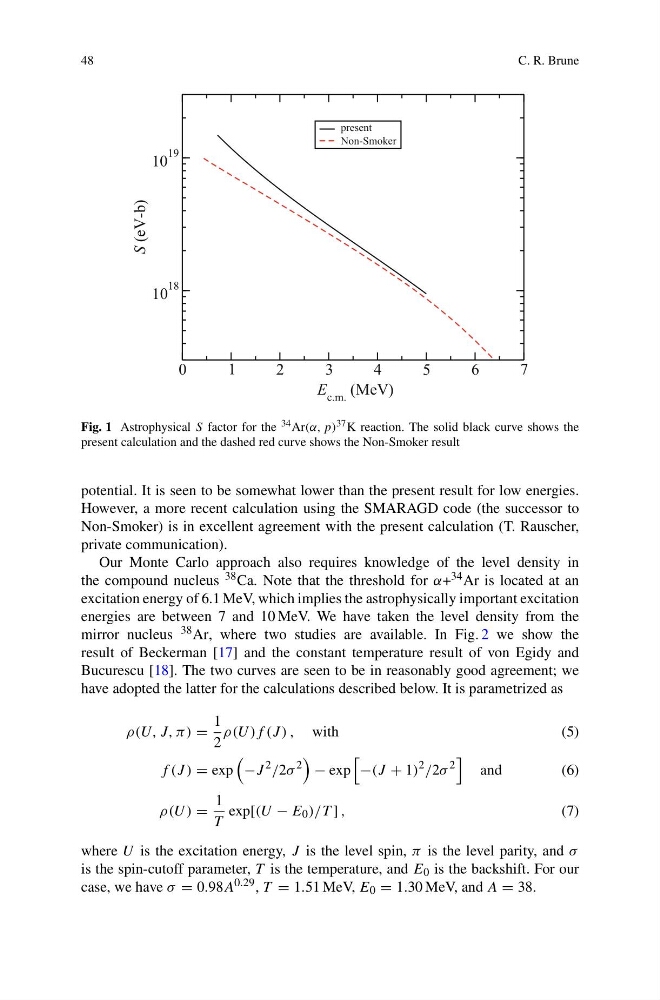
Fig. 1 Astrophysical S factor for the 34 Ar(α, p) 37 K reaction. The solid black curve shows the
present calculation and the dashed red curve shows the Non-Smoker result
potential. It is seen to be somewhat lower than the present result for low energies.
However, a more recent calculation using the SMARAGD code (the successor to
Non-Smoker) is in excellent agreement with the present calculation (T. Rauscher,
private communication).
Our Monte Carlo approach also requires knowledge of the level density in
the compound nucleus 38 Ca. Note that the threshold for α+ 34 Ar is located at an
excitation energy of 6.1 MeV, which implies the astrophysically important excitation
energies are between 7 and 10 MeV. We have taken the level density from the
mirror nucleus 38 Ar, where two studies are available. In Fig. 2 we show the
result of Beckerman [17] and the constant temperature result of von Egidy and
Bucurescu [18]. The two curves are seen to be in reasonably good agreement; we
have adopted the latter for the calculations described below. It is parametrized as
ρ(U, J, π) =
1
2
ρ(U )f (J ) , with
(5)
f (J ) = exp
−J
2 /2σ
2
− exp
−(J + 1)
2 /2σ
2
and
(6)
ρ(U ) =
1
T
exp[(U − E 0 )/T ] ,
(7)
where U is the excitation energy, J is the level spin, π is the level parity, and σ
is the spin-cutoff parameter, T is the temperature, and E 0 is the backshift. For our
case, we have σ = 0.98A 0.29 , T = 1.51 MeV, E 0 = 1.30 MeV, and A = 38.
C. R. Brune
0
1
2
3
4
5
6
7
E c.m. (MeV)
10
18
10
19
S (eV-b)
present
Non-Smoker
Fig. 1 Astrophysical S factor for the 34 Ar(α, p) 37 K reaction. The solid black curve shows the
present calculation and the dashed red curve shows the Non-Smoker result
potential. It is seen to be somewhat lower than the present result for low energies.
However, a more recent calculation using the SMARAGD code (the successor to
Non-Smoker) is in excellent agreement with the present calculation (T. Rauscher,
private communication).
Our Monte Carlo approach also requires knowledge of the level density in
the compound nucleus 38 Ca. Note that the threshold for α+ 34 Ar is located at an
excitation energy of 6.1 MeV, which implies the astrophysically important excitation
energies are between 7 and 10 MeV. We have taken the level density from the
mirror nucleus 38 Ar, where two studies are available. In Fig. 2 we show the
result of Beckerman [17] and the constant temperature result of von Egidy and
Bucurescu [18]. The two curves are seen to be in reasonably good agreement; we
have adopted the latter for the calculations described below. It is parametrized as
ρ(U, J, π) =
1
2
ρ(U )f (J ) , with
(5)
f (J ) = exp
−J
2 /2σ
2
− exp
−(J + 1)
2 /2σ
2
and
(6)
ρ(U ) =
1
T
exp[(U − E 0 )/T ] ,
(7)
where U is the excitation energy, J is the level spin, π is the level parity, and σ
is the spin-cutoff parameter, T is the temperature, and E 0 is the backshift. For our
case, we have σ = 0.98A 0.29 , T = 1.51 MeV, E 0 = 1.30 MeV, and A = 38.