

Advances in R-matrix Data Analysis
39
I have written a python program FERDINAND.PY, to translate between most of
the input and output formats of these codes, using GNDS [14] as the intermediate
structure. It is also able to make ENDF output sections in the MT= 151 format
for evaluations. This kind of interchangeability makes it much easier to track down
discrepant details, and to verify and build on each other’s work.
4 Example in A = 7 Scattering
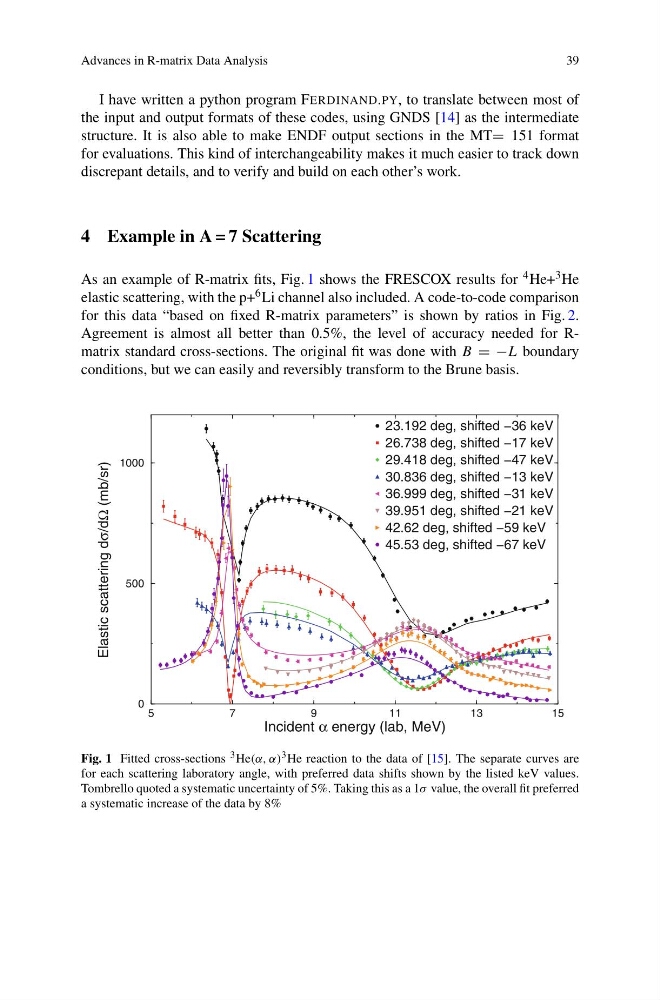
As an example of R-matrix fits, Fig. 1 shows the FRESCOX results for 4 He+ 3 He
elastic scattering, with the p+ 6 Li channel also included. A code-to-code comparison
for this data “based on fixed R-matrix parameters” is shown by ratios in Fig. 2.
Agreement is almost all better than 0.5%, the level of accuracy needed for Rmatrix standard cross-sections. The original fit was done with B = −L boundary
conditions, but we can easily and reversibly transform to the Brune basis.
5
7
9
1 1
1 3
1 5
Incident α energy (lab, MeV)
0
500
1000
Elastic scattering dσ/dΩ (mb/sr)
23.192 deg, shifted −36 keV
26.738 deg, shifted −17 keV
29.418 deg, shifted −47 keV
30.836 deg, shifted −13 keV
36.999 deg, shifted −31 keV
39.951 deg, shifted −21 keV
42.62 deg, shifted −59 keV
45.53 deg, shifted −67 keV
Fig. 1 Fitted cross-sections 3 He(α, α) 3 He reaction to the data of [15]. The separate curves are
for each scattering laboratory angle, with preferred data shifts shown by the listed keV values.
Tombrello quoted a systematic uncertainty of 5%. Taking this as a 1σ value, the overall fit preferred
a systematic increase of the data by 8%
39
I have written a python program FERDINAND.PY, to translate between most of
the input and output formats of these codes, using GNDS [14] as the intermediate
structure. It is also able to make ENDF output sections in the MT= 151 format
for evaluations. This kind of interchangeability makes it much easier to track down
discrepant details, and to verify and build on each other’s work.
4 Example in A = 7 Scattering
As an example of R-matrix fits, Fig. 1 shows the FRESCOX results for 4 He+ 3 He
elastic scattering, with the p+ 6 Li channel also included. A code-to-code comparison
for this data “based on fixed R-matrix parameters” is shown by ratios in Fig. 2.
Agreement is almost all better than 0.5%, the level of accuracy needed for Rmatrix standard cross-sections. The original fit was done with B = −L boundary
conditions, but we can easily and reversibly transform to the Brune basis.
5
7
9
1 1
1 3
1 5
Incident α energy (lab, MeV)
0
500
1000
Elastic scattering dσ/dΩ (mb/sr)
23.192 deg, shifted −36 keV
26.738 deg, shifted −17 keV
29.418 deg, shifted −47 keV
30.836 deg, shifted −13 keV
36.999 deg, shifted −31 keV
39.951 deg, shifted −21 keV
42.62 deg, shifted −59 keV
45.53 deg, shifted −67 keV
Fig. 1 Fitted cross-sections 3 He(α, α) 3 He reaction to the data of [15]. The separate curves are
for each scattering laboratory angle, with preferred data shifts shown by the listed keV values.
Tombrello quoted a systematic uncertainty of 5%. Taking this as a 1σ value, the overall fit preferred
a systematic increase of the data by 8%