

EMPIRE
23
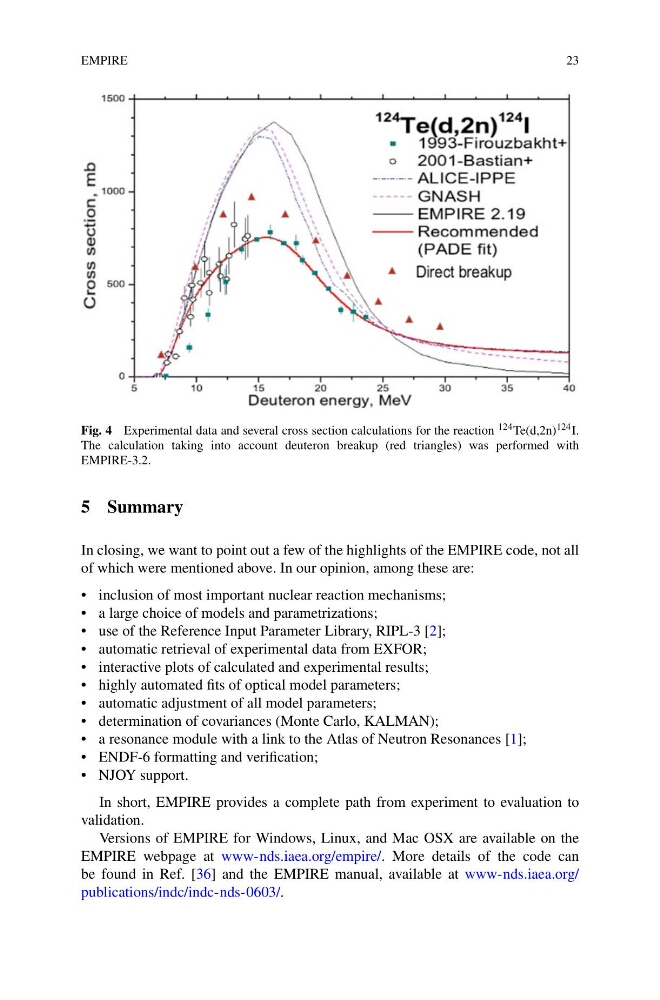
Fig. 4 Experimental data and several cross section calculations for the reaction 124 Te(d,2n) 124 I.
The calculation taking into account deuteron breakup (red triangles) was performed with
EMPIRE-3.2.
5 Summary
In closing, we want to point out a few of the highlights of the EMPIRE code, not all
of which were mentioned above. In our opinion, among these are:
• inclusion of most important nuclear reaction mechanisms;
• a large choice of models and parametrizations;
• use of the Reference Input Parameter Library, RIPL-3 [2];
• automatic retrieval of experimental data from EXFOR;
• interactive plots of calculated and experimental results;
• highly automated fits of optical model parameters;
• automatic adjustment of all model parameters;
• determination of covariances (Monte Carlo, KALMAN);
• a resonance module with a link to the Atlas of Neutron Resonances [1];
• ENDF-6 formatting and verification;
• NJOY support.
In short, EMPIRE provides a complete path from experiment to evaluation to
validation.
Versions of EMPIRE for Windows, Linux, and Mac OSX are available on the
EMPIRE webpage at www-nds.iaea.org/empire/. More details of the code can
be found in Ref. [36] and the EMPIRE manual, available at www-nds.iaea.org/
publications/indc/indc-nds-0603/.
23
Fig. 4 Experimental data and several cross section calculations for the reaction 124 Te(d,2n) 124 I.
The calculation taking into account deuteron breakup (red triangles) was performed with
EMPIRE-3.2.
5 Summary
In closing, we want to point out a few of the highlights of the EMPIRE code, not all
of which were mentioned above. In our opinion, among these are:
• inclusion of most important nuclear reaction mechanisms;
• a large choice of models and parametrizations;
• use of the Reference Input Parameter Library, RIPL-3 [2];
• automatic retrieval of experimental data from EXFOR;
• interactive plots of calculated and experimental results;
• highly automated fits of optical model parameters;
• automatic adjustment of all model parameters;
• determination of covariances (Monte Carlo, KALMAN);
• a resonance module with a link to the Atlas of Neutron Resonances [1];
• ENDF-6 formatting and verification;
• NJOY support.
In short, EMPIRE provides a complete path from experiment to evaluation to
validation.
Versions of EMPIRE for Windows, Linux, and Mac OSX are available on the
EMPIRE webpage at www-nds.iaea.org/empire/. More details of the code can
be found in Ref. [36] and the EMPIRE manual, available at www-nds.iaea.org/
publications/indc/indc-nds-0603/.