

EMPIRE
21
4 Cross Section Calculations Using EMPIRE-3.2
In the following, we compare EMPIRE calculations with experimental data for
several different reactions. We begin with the cross sections for neutron-induced
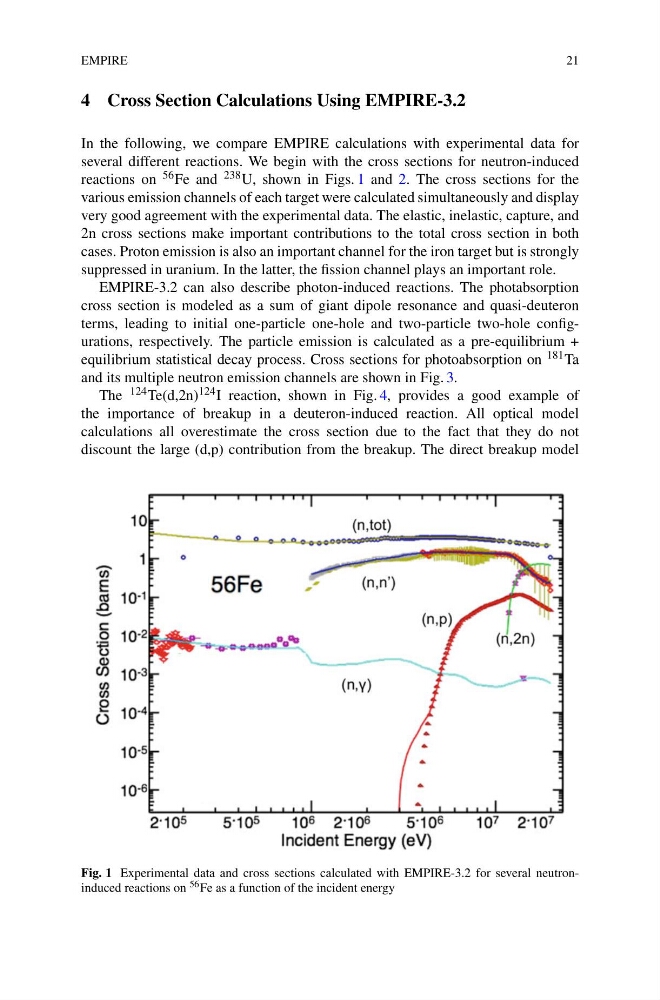
reactions on 56 Fe and 238 U, shown in Figs. 1 and 2. The cross sections for the
various emission channels of each target were calculated simultaneously and display
very good agreement with the experimental data. The elastic, inelastic, capture, and
2n cross sections make important contributions to the total cross section in both
cases. Proton emission is also an important channel for the iron target but is strongly
suppressed in uranium. In the latter, the fission channel plays an important role.
EMPIRE-3.2 can also describe photon-induced reactions. The photabsorption
cross section is modeled as a sum of giant dipole resonance and quasi-deuteron
terms, leading to initial one-particle one-hole and two-particle two-hole configurations, respectively. The particle emission is calculated as a pre-equilibrium +
equilibrium statistical decay process. Cross sections for photoabsorption on 181 Ta
and its multiple neutron emission channels are shown in Fig. 3.
The 124 Te(d,2n) 124 I reaction, shown in Fig. 4, provides a good example of
the importance of breakup in a deuteron-induced reaction. All optical model
calculations all overestimate the cross section due to the fact that they do not
discount the large (d,p) contribution from the breakup. The direct breakup model
Fig. 1 Experimental data and cross sections calculated with EMPIRE-3.2 for several neutroninduced reactions on 56 Fe as a function of the incident energy
21
4 Cross Section Calculations Using EMPIRE-3.2
In the following, we compare EMPIRE calculations with experimental data for
several different reactions. We begin with the cross sections for neutron-induced
reactions on 56 Fe and 238 U, shown in Figs. 1 and 2. The cross sections for the
various emission channels of each target were calculated simultaneously and display
very good agreement with the experimental data. The elastic, inelastic, capture, and
2n cross sections make important contributions to the total cross section in both
cases. Proton emission is also an important channel for the iron target but is strongly
suppressed in uranium. In the latter, the fission channel plays an important role.
EMPIRE-3.2 can also describe photon-induced reactions. The photabsorption
cross section is modeled as a sum of giant dipole resonance and quasi-deuteron
terms, leading to initial one-particle one-hole and two-particle two-hole configurations, respectively. The particle emission is calculated as a pre-equilibrium +
equilibrium statistical decay process. Cross sections for photoabsorption on 181 Ta
and its multiple neutron emission channels are shown in Fig. 3.
The 124 Te(d,2n) 124 I reaction, shown in Fig. 4, provides a good example of
the importance of breakup in a deuteron-induced reaction. All optical model
calculations all overestimate the cross section due to the fact that they do not
discount the large (d,p) contribution from the breakup. The direct breakup model
Fig. 1 Experimental data and cross sections calculated with EMPIRE-3.2 for several neutroninduced reactions on 56 Fe as a function of the incident energy