

316
M. Wiedeking
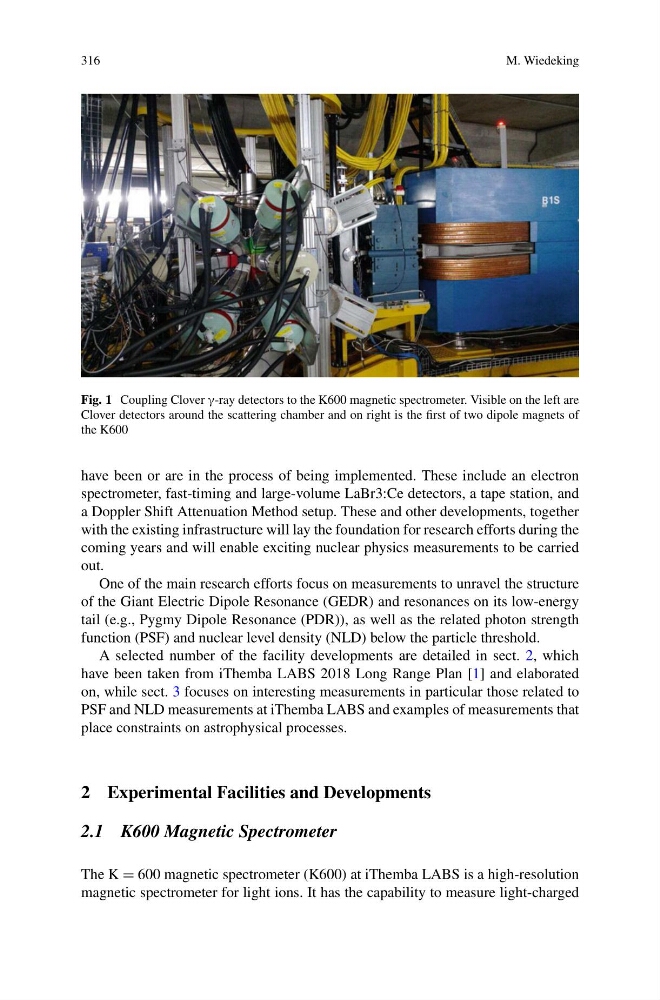
Fig. 1 Coupling Clover γ-ray detectors to the K600 magnetic spectrometer. Visible on the left are
Clover detectors around the scattering chamber and on right is the first of two dipole magnets of
the K600
have been or are in the process of being implemented. These include an electron
spectrometer, fast-timing and large-volume LaBr3:Ce detectors, a tape station, and
a Doppler Shift Attenuation Method setup. These and other developments, together
with the existing infrastructure will lay the foundation for research efforts during the
coming years and will enable exciting nuclear physics measurements to be carried
out.
One of the main research efforts focus on measurements to unravel the structure
of the Giant Electric Dipole Resonance (GEDR) and resonances on its low-energy
tail (e.g., Pygmy Dipole Resonance (PDR)), as well as the related photon strength
function (PSF) and nuclear level density (NLD) below the particle threshold.
A selected number of the facility developments are detailed in sect. 2, which
have been taken from iThemba LABS 2018 Long Range Plan [1] and elaborated
on, while sect. 3 focuses on interesting measurements in particular those related to
PSF and NLD measurements at iThemba LABS and examples of measurements that
place constraints on astrophysical processes.
2 Experimental Facilities and Developments
2.1 K600 Magnetic Spectrometer
The K = 600 magnetic spectrometer (K600) at iThemba LABS is a high-resolution
magnetic spectrometer for light ions. It has the capability to measure light-charged
M. Wiedeking
Fig. 1 Coupling Clover γ-ray detectors to the K600 magnetic spectrometer. Visible on the left are
Clover detectors around the scattering chamber and on right is the first of two dipole magnets of
the K600
have been or are in the process of being implemented. These include an electron
spectrometer, fast-timing and large-volume LaBr3:Ce detectors, a tape station, and
a Doppler Shift Attenuation Method setup. These and other developments, together
with the existing infrastructure will lay the foundation for research efforts during the
coming years and will enable exciting nuclear physics measurements to be carried
out.
One of the main research efforts focus on measurements to unravel the structure
of the Giant Electric Dipole Resonance (GEDR) and resonances on its low-energy
tail (e.g., Pygmy Dipole Resonance (PDR)), as well as the related photon strength
function (PSF) and nuclear level density (NLD) below the particle threshold.
A selected number of the facility developments are detailed in sect. 2, which
have been taken from iThemba LABS 2018 Long Range Plan [1] and elaborated
on, while sect. 3 focuses on interesting measurements in particular those related to
PSF and NLD measurements at iThemba LABS and examples of measurements that
place constraints on astrophysical processes.
2 Experimental Facilities and Developments
2.1 K600 Magnetic Spectrometer
The K = 600 magnetic spectrometer (K600) at iThemba LABS is a high-resolution
magnetic spectrometer for light ions. It has the capability to measure light-charged