

Resonance Measurements at Rensselaer Polytechnic Institute
313
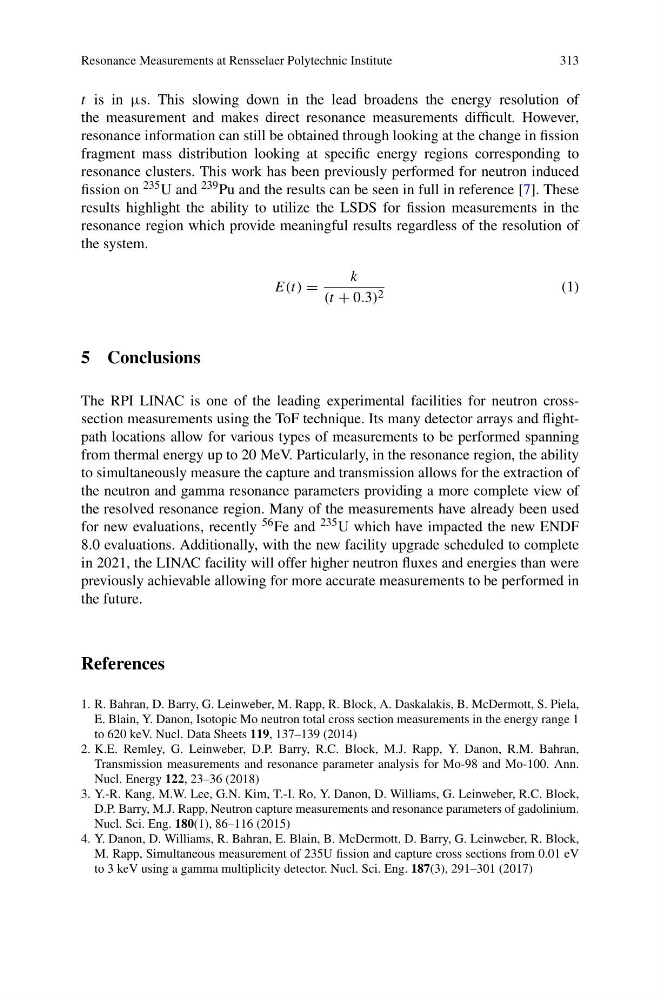
t is in μs. This slowing down in the lead broadens the energy resolution of
the measurement and makes direct resonance measurements difficult. However,
resonance information can still be obtained through looking at the change in fission
fragment mass distribution looking at specific energy regions corresponding to
resonance clusters. This work has been previously performed for neutron induced
fission on 235 U and 239 Pu and the results can be seen in full in reference [7]. These
results highlight the ability to utilize the LSDS for fission measurements in the
resonance region which provide meaningful results regardless of the resolution of
the system.
E(t) =
k
(t + 0.3) 2
(1)
5 Conclusions
The RPI LINAC is one of the leading experimental facilities for neutron crosssection measurements using the ToF technique. Its many detector arrays and flightpath locations allow for various types of measurements to be performed spanning
from thermal energy up to 20 MeV. Particularly, in the resonance region, the ability
to simultaneously measure the capture and transmission allows for the extraction of
the neutron and gamma resonance parameters providing a more complete view of
the resolved resonance region. Many of the measurements have already been used
for new evaluations, recently 56 Fe and 235 U which have impacted the new ENDF
8.0 evaluations. Additionally, with the new facility upgrade scheduled to complete
in 2021, the LINAC facility will offer higher neutron fluxes and energies than were
previously achievable allowing for more accurate measurements to be performed in
the future.
References
1. R. Bahran, D. Barry, G. Leinweber, M. Rapp, R. Block, A. Daskalakis, B. McDermott, S. Piela,
E. Blain, Y. Danon, Isotopic Mo neutron total cross section measurements in the energy range 1
to 620 keV. Nucl. Data Sheets 119, 137–139 (2014)
2. K.E. Remley, G. Leinweber, D.P. Barry, R.C. Block, M.J. Rapp, Y. Danon, R.M. Bahran,
Transmission measurements and resonance parameter analysis for Mo-98 and Mo-100. Ann.
Nucl. Energy 122, 23–36 (2018)
3. Y.-R. Kang, M.W. Lee, G.N. Kim, T.-I. Ro, Y. Danon, D. Williams, G. Leinweber, R.C. Block,
D.P. Barry, M.J. Rapp, Neutron capture measurements and resonance parameters of gadolinium.
Nucl. Sci. Eng. 180(1), 86–116 (2015)
4. Y. Danon, D. Williams, R. Bahran, E. Blain, B. McDermott, D. Barry, G. Leinweber, R. Block,
M. Rapp, Simultaneous measurement of 235U fission and capture cross sections from 0.01 eV
to 3 keV using a gamma multiplicity detector. Nucl. Sci. Eng. 187(3), 291–301 (2017)
313
t is in μs. This slowing down in the lead broadens the energy resolution of
the measurement and makes direct resonance measurements difficult. However,
resonance information can still be obtained through looking at the change in fission
fragment mass distribution looking at specific energy regions corresponding to
resonance clusters. This work has been previously performed for neutron induced
fission on 235 U and 239 Pu and the results can be seen in full in reference [7]. These
results highlight the ability to utilize the LSDS for fission measurements in the
resonance region which provide meaningful results regardless of the resolution of
the system.
E(t) =
k
(t + 0.3) 2
(1)
5 Conclusions
The RPI LINAC is one of the leading experimental facilities for neutron crosssection measurements using the ToF technique. Its many detector arrays and flightpath locations allow for various types of measurements to be performed spanning
from thermal energy up to 20 MeV. Particularly, in the resonance region, the ability
to simultaneously measure the capture and transmission allows for the extraction of
the neutron and gamma resonance parameters providing a more complete view of
the resolved resonance region. Many of the measurements have already been used
for new evaluations, recently 56 Fe and 235 U which have impacted the new ENDF
8.0 evaluations. Additionally, with the new facility upgrade scheduled to complete
in 2021, the LINAC facility will offer higher neutron fluxes and energies than were
previously achievable allowing for more accurate measurements to be performed in
the future.
References
1. R. Bahran, D. Barry, G. Leinweber, M. Rapp, R. Block, A. Daskalakis, B. McDermott, S. Piela,
E. Blain, Y. Danon, Isotopic Mo neutron total cross section measurements in the energy range 1
to 620 keV. Nucl. Data Sheets 119, 137–139 (2014)
2. K.E. Remley, G. Leinweber, D.P. Barry, R.C. Block, M.J. Rapp, Y. Danon, R.M. Bahran,
Transmission measurements and resonance parameter analysis for Mo-98 and Mo-100. Ann.
Nucl. Energy 122, 23–36 (2018)
3. Y.-R. Kang, M.W. Lee, G.N. Kim, T.-I. Ro, Y. Danon, D. Williams, G. Leinweber, R.C. Block,
D.P. Barry, M.J. Rapp, Neutron capture measurements and resonance parameters of gadolinium.
Nucl. Sci. Eng. 180(1), 86–116 (2015)
4. Y. Danon, D. Williams, R. Bahran, E. Blain, B. McDermott, D. Barry, G. Leinweber, R. Block,
M. Rapp, Simultaneous measurement of 235U fission and capture cross sections from 0.01 eV
to 3 keV using a gamma multiplicity detector. Nucl. Sci. Eng. 187(3), 291–301 (2017)