

298
R. Vogt et al.
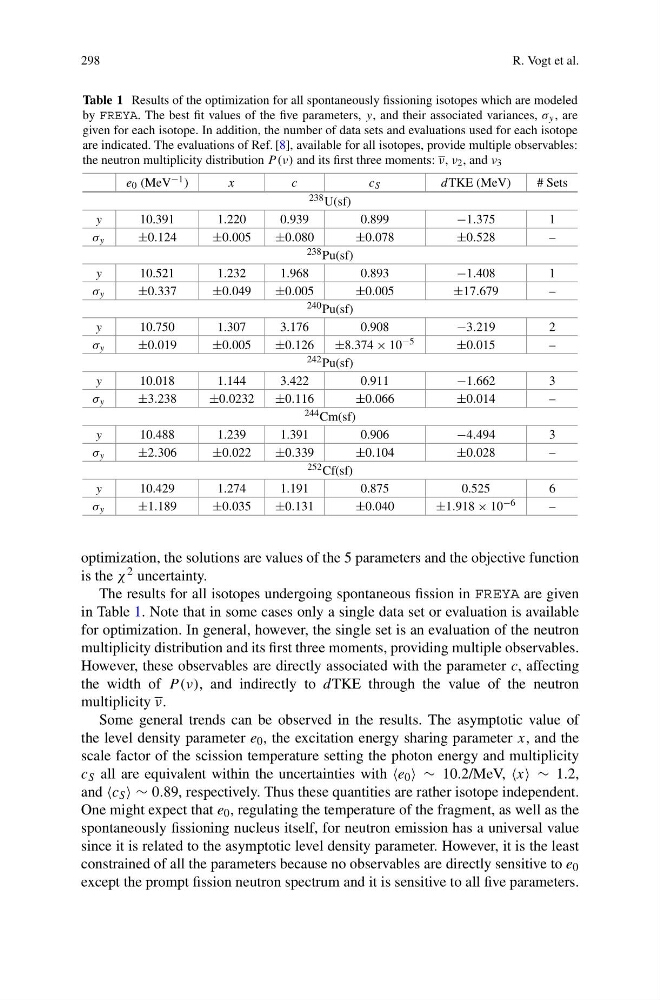
Table 1 Results of the optimization for all spontaneously fissioning isotopes which are modeled
by FREYA. The best fit values of the five parameters, y, and their associated variances, σ y , are
given for each isotope. In addition, the number of data sets and evaluations used for each isotope
are indicated. The evaluations of Ref. [8], available for all isotopes, provide multiple observables:
the neutron multiplicity distribution P (ν) and its first three moments: ν, ν 2 , and ν 3
e 0 (MeV −1 )
x
c
c S
dTKE (MeV)
# Sets
238 U(sf)
y
10.391
1.220
0.939
0.899
−1.375
1
σ y
±0.124
±0.005
±0.080
±0.078
±0.528
–
238 Pu(sf)
y
10.521
1.232
1.968
0.893
−1.408
1
σ y
±0.337
±0.049
±0.005
±0.005
±17.679
–
240 Pu(sf)
y
10.750
1.307
3.176
0.908
−3.219
2
σ y
±0.019
±0.005
±0.126
±8.374 × 10 −5
±0.015
–
242 Pu(sf)
y
10.018
1.144
3.422
0.911
−1.662
3
σ y
±3.238
±0.0232
±0.116
±0.066
±0.014
–
244 Cm(sf)
y
10.488
1.239
1.391
0.906
−4.494
3
σ y
±2.306
±0.022
±0.339
±0.104
±0.028
–
252 Cf(sf)
y
10.429
1.274
1.191
0.875
0.525
6
σ y
±1.189
±0.035
±0.131
±0.040
±1.918 × 10 −6
–
optimization, the solutions are values of the 5 parameters and the objective function
is the χ 2 uncertainty.
The results for all isotopes undergoing spontaneous fission in FREYA are given
in Table 1. Note that in some cases only a single data set or evaluation is available
for optimization. In general, however, the single set is an evaluation of the neutron
multiplicity distribution and its first three moments, providing multiple observables.
However, these observables are directly associated with the parameter c, affecting
the width of P (ν), and indirectly to dTKE through the value of the neutron
multiplicity ν.
Some general trends can be observed in the results. The asymptotic value of
the level density parameter e 0 , the excitation energy sharing parameter x, and the
scale factor of the scission temperature setting the photon energy and multiplicity
c S all are equivalent within the uncertainties with e 0 ∼ 10.2/MeV, x ∼ 1.2,
and c S ∼ 0.89, respectively. Thus these quantities are rather isotope independent.
One might expect that e 0 , regulating the temperature of the fragment, as well as the
spontaneously fissioning nucleus itself, for neutron emission has a universal value
since it is related to the asymptotic level density parameter. However, it is the least
constrained of all the parameters because no observables are directly sensitive to e 0
except the prompt fission neutron spectrum and it is sensitive to all five parameters.
R. Vogt et al.
Table 1 Results of the optimization for all spontaneously fissioning isotopes which are modeled
by FREYA. The best fit values of the five parameters, y, and their associated variances, σ y , are
given for each isotope. In addition, the number of data sets and evaluations used for each isotope
are indicated. The evaluations of Ref. [8], available for all isotopes, provide multiple observables:
the neutron multiplicity distribution P (ν) and its first three moments: ν, ν 2 , and ν 3
e 0 (MeV −1 )
x
c
c S
dTKE (MeV)
# Sets
238 U(sf)
y
10.391
1.220
0.939
0.899
−1.375
1
σ y
±0.124
±0.005
±0.080
±0.078
±0.528
–
238 Pu(sf)
y
10.521
1.232
1.968
0.893
−1.408
1
σ y
±0.337
±0.049
±0.005
±0.005
±17.679
–
240 Pu(sf)
y
10.750
1.307
3.176
0.908
−3.219
2
σ y
±0.019
±0.005
±0.126
±8.374 × 10 −5
±0.015
–
242 Pu(sf)
y
10.018
1.144
3.422
0.911
−1.662
3
σ y
±3.238
±0.0232
±0.116
±0.066
±0.014
–
244 Cm(sf)
y
10.488
1.239
1.391
0.906
−4.494
3
σ y
±2.306
±0.022
±0.339
±0.104
±0.028
–
252 Cf(sf)
y
10.429
1.274
1.191
0.875
0.525
6
σ y
±1.189
±0.035
±0.131
±0.040
±1.918 × 10 −6
–
optimization, the solutions are values of the 5 parameters and the objective function
is the χ 2 uncertainty.
The results for all isotopes undergoing spontaneous fission in FREYA are given
in Table 1. Note that in some cases only a single data set or evaluation is available
for optimization. In general, however, the single set is an evaluation of the neutron
multiplicity distribution and its first three moments, providing multiple observables.
However, these observables are directly associated with the parameter c, affecting
the width of P (ν), and indirectly to dTKE through the value of the neutron
multiplicity ν.
Some general trends can be observed in the results. The asymptotic value of
the level density parameter e 0 , the excitation energy sharing parameter x, and the
scale factor of the scission temperature setting the photon energy and multiplicity
c S all are equivalent within the uncertainties with e 0 ∼ 10.2/MeV, x ∼ 1.2,
and c S ∼ 0.89, respectively. Thus these quantities are rather isotope independent.
One might expect that e 0 , regulating the temperature of the fragment, as well as the
spontaneously fissioning nucleus itself, for neutron emission has a universal value
since it is related to the asymptotic level density parameter. However, it is the least
constrained of all the parameters because no observables are directly sensitive to e 0
except the prompt fission neutron spectrum and it is sensitive to all five parameters.