

288
J.-F. Lemaître et al.
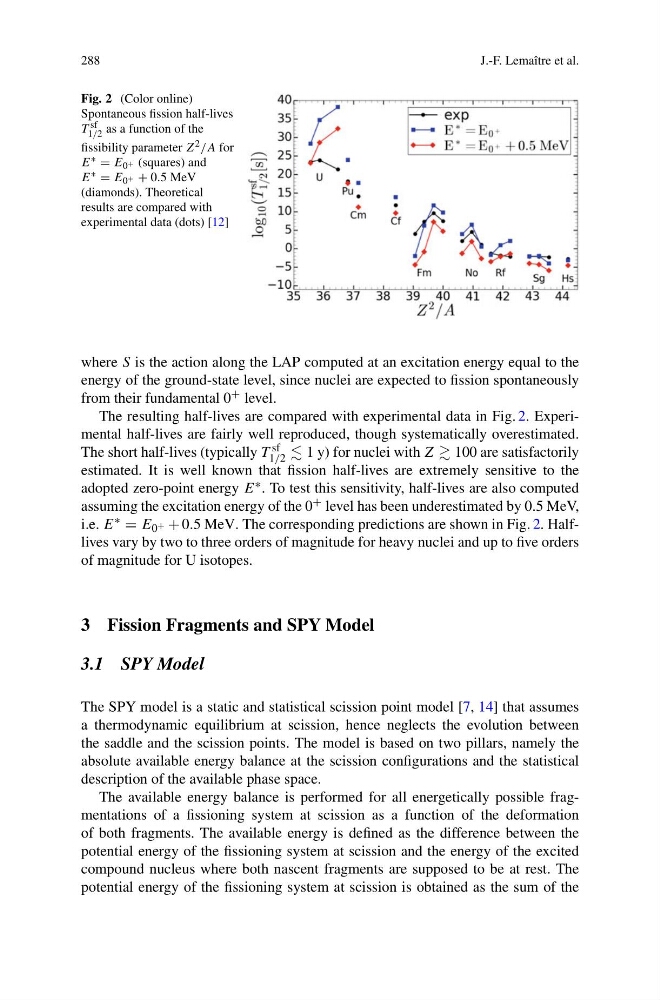
Fig. 2 (Color online)
Spontaneous fission half-lives
T sf
1/2 as a function of the
fissibility parameter Z 2 /A for
E ∗ = E 0 + (squares) and
E ∗ = E 0 + + 0.5 MeV
(diamonds). Theoretical
results are compared with
experimental data (dots) [12]
where S is the action along the LAP computed at an excitation energy equal to the
energy of the ground-state level, since nuclei are expected to fission spontaneously
from their fundamental 0 + level.
The resulting half-lives are compared with experimental data in Fig. 2. Experimental half-lives are fairly well reproduced, though systematically overestimated.
The short half-lives (typically T sf
1/2 1 y) for nuclei with Z 100 are satisfactorily
estimated. It is well known that fission half-lives are extremely sensitive to the
adopted zero-point energy E ∗ . To test this sensitivity, half-lives are also computed
assuming the excitation energy of the 0 + level has been underestimated by 0.5 MeV,
i.e. E ∗ = E 0 + + 0.5 MeV. The corresponding predictions are shown in Fig. 2. Halflives vary by two to three orders of magnitude for heavy nuclei and up to five orders
of magnitude for U isotopes.
3 Fission Fragments and SPY Model
3.1 SPY Model
The SPY model is a static and statistical scission point model [7, 14] that assumes
a thermodynamic equilibrium at scission, hence neglects the evolution between
the saddle and the scission points. The model is based on two pillars, namely the
absolute available energy balance at the scission configurations and the statistical
description of the available phase space.
The available energy balance is performed for all energetically possible fragmentations of a fissioning system at scission as a function of the deformation
of both fragments. The available energy is defined as the difference between the
potential energy of the fissioning system at scission and the energy of the excited
compound nucleus where both nascent fragments are supposed to be at rest. The
potential energy of the fissioning system at scission is obtained as the sum of the
J.-F. Lemaître et al.
Fig. 2 (Color online)
Spontaneous fission half-lives
T sf
1/2 as a function of the
fissibility parameter Z 2 /A for
E ∗ = E 0 + (squares) and
E ∗ = E 0 + + 0.5 MeV
(diamonds). Theoretical
results are compared with
experimental data (dots) [12]
where S is the action along the LAP computed at an excitation energy equal to the
energy of the ground-state level, since nuclei are expected to fission spontaneously
from their fundamental 0 + level.
The resulting half-lives are compared with experimental data in Fig. 2. Experimental half-lives are fairly well reproduced, though systematically overestimated.
The short half-lives (typically T sf
1/2 1 y) for nuclei with Z 100 are satisfactorily
estimated. It is well known that fission half-lives are extremely sensitive to the
adopted zero-point energy E ∗ . To test this sensitivity, half-lives are also computed
assuming the excitation energy of the 0 + level has been underestimated by 0.5 MeV,
i.e. E ∗ = E 0 + + 0.5 MeV. The corresponding predictions are shown in Fig. 2. Halflives vary by two to three orders of magnitude for heavy nuclei and up to five orders
of magnitude for U isotopes.
3 Fission Fragments and SPY Model
3.1 SPY Model
The SPY model is a static and statistical scission point model [7, 14] that assumes
a thermodynamic equilibrium at scission, hence neglects the evolution between
the saddle and the scission points. The model is based on two pillars, namely the
absolute available energy balance at the scission configurations and the statistical
description of the available phase space.
The available energy balance is performed for all energetically possible fragmentations of a fissioning system at scission as a function of the deformation
of both fragments. The available energy is defined as the difference between the
potential energy of the fissioning system at scission and the energy of the excited
compound nucleus where both nascent fragments are supposed to be at rest. The
potential energy of the fissioning system at scission is obtained as the sum of the