

276
N. Schunck et al.
energy [14]. In this contribution, we discuss briefly some of the challenges for a
microscopic description of such a phenomenon.
2 Energy Density Functional Theory
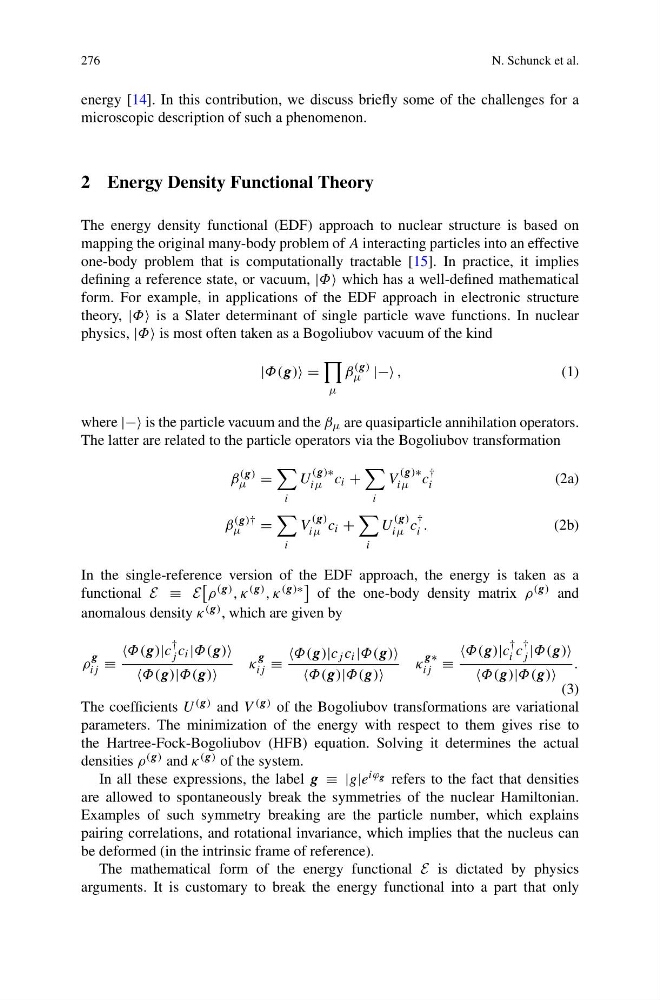
The energy density functional (EDF) approach to nuclear structure is based on
mapping the original many-body problem of A interacting particles into an effective
one-body problem that is computationally tractable [15]. In practice, it implies
defining a reference state, or vacuum, |Φ which has a well-defined mathematical
form. For example, in applications of the EDF approach in electronic structure
theory, |Φ is a Slater determinant of single particle wave functions. In nuclear
physics, |Φ is most often taken as a Bogoliubov vacuum of the kind
|Φ(g) =
μ
β
(g)
μ |−− ,
(1)
where |−− is the particle vacuum and the β μ are quasiparticle annihilation operators.
The latter are related to the particle operators via the Bogoliubov transformation
β
(g)
μ =
i
U
(g)∗
iμ c i +
i
V
(g)∗
iμ c
†
i
(2a)
β
(g)†
μ
=
i
V
(g)
iμ c i +
i
U
(g)
iμ c
†
i .
(2b)
In the single-reference version of the EDF approach, the energy is taken as a
functional E ≡ E
ρ (g) , κ (g) , κ (g)∗
of the one-body density matrix ρ (g) and
anomalous density κ (g) , which are given by
ρ
g
ij ≡
Φ(g)|c
†
j c i |Φ(g)
Φ(g)|Φ(g)
κ
g
ij ≡
Φ(g)|c j c i |Φ(g)
Φ(g)|Φ(g)
κ
g∗
ij ≡
Φ(g)|c
†
i c
†
j |Φ(g)
Φ(g)|Φ(g)
.
(3)
The coefficients U (g) and V (g) of the Bogoliubov transformations are variational
parameters. The minimization of the energy with respect to them gives rise to
the Hartree-Fock-Bogoliubov (HFB) equation. Solving it determines the actual
densities ρ (g) and κ (g) of the system.
In all these expressions, the label g ≡ |g|e iϕ g refers to the fact that densities
are allowed to spontaneously break the symmetries of the nuclear Hamiltonian.
Examples of such symmetry breaking are the particle number, which explains
pairing correlations, and rotational invariance, which implies that the nucleus can
be deformed (in the intrinsic frame of reference).
The mathematical form of the energy functional E is dictated by physics
arguments. It is customary to break the energy functional into a part that only
N. Schunck et al.
energy [14]. In this contribution, we discuss briefly some of the challenges for a
microscopic description of such a phenomenon.
2 Energy Density Functional Theory
The energy density functional (EDF) approach to nuclear structure is based on
mapping the original many-body problem of A interacting particles into an effective
one-body problem that is computationally tractable [15]. In practice, it implies
defining a reference state, or vacuum, |Φ which has a well-defined mathematical
form. For example, in applications of the EDF approach in electronic structure
theory, |Φ is a Slater determinant of single particle wave functions. In nuclear
physics, |Φ is most often taken as a Bogoliubov vacuum of the kind
|Φ(g) =
μ
β
(g)
μ |−− ,
(1)
where |−− is the particle vacuum and the β μ are quasiparticle annihilation operators.
The latter are related to the particle operators via the Bogoliubov transformation
β
(g)
μ =
i
U
(g)∗
iμ c i +
i
V
(g)∗
iμ c
†
i
(2a)
β
(g)†
μ
=
i
V
(g)
iμ c i +
i
U
(g)
iμ c
†
i .
(2b)
In the single-reference version of the EDF approach, the energy is taken as a
functional E ≡ E
ρ (g) , κ (g) , κ (g)∗
of the one-body density matrix ρ (g) and
anomalous density κ (g) , which are given by
ρ
g
ij ≡
Φ(g)|c
†
j c i |Φ(g)
Φ(g)|Φ(g)
κ
g
ij ≡
Φ(g)|c j c i |Φ(g)
Φ(g)|Φ(g)
κ
g∗
ij ≡
Φ(g)|c
†
i c
†
j |Φ(g)
Φ(g)|Φ(g)
.
(3)
The coefficients U (g) and V (g) of the Bogoliubov transformations are variational
parameters. The minimization of the energy with respect to them gives rise to
the Hartree-Fock-Bogoliubov (HFB) equation. Solving it determines the actual
densities ρ (g) and κ (g) of the system.
In all these expressions, the label g ≡ |g|e iϕ g refers to the fact that densities
are allowed to spontaneously break the symmetries of the nuclear Hamiltonian.
Examples of such symmetry breaking are the particle number, which explains
pairing correlations, and rotational invariance, which implies that the nucleus can
be deformed (in the intrinsic frame of reference).
The mathematical form of the energy functional E is dictated by physics
arguments. It is customary to break the energy functional into a part that only