

256
M. Hagiwara et al.
2 Experimental
The stack target was composed of natural zirconium foils, natural copper foils,
and natural titanium foils with their thickness of 5 μm. The zirconium foils were
sandwiched between copper and titanium foils that were acted as beam monitors,
energy degraders, and recoil catcher foils. The total target thickness was thicker
than the range of 46.4 MeV α particles to measure the beam current on the
targets. After 1-hour irradiation with beam current of 300 nA, γ-rays from each
foil were measured with a HPGe detector. The excitation function was deduced
from the activity measured and the projectile energies on each foil, which were
calculated by using the SRIM-2013 code [2]. The projectile energies and beam
fluxes were confirmed by comparing the measured excitation function and the
IAEA recommendation data for the nat Ti(α, X) 51 Cr reaction [3]. The uncertainties
of the target thicknesses (5%), number of incident particles (3%), and efficiency
determination (4%) were considered in addition to the statistical error.
3 Results
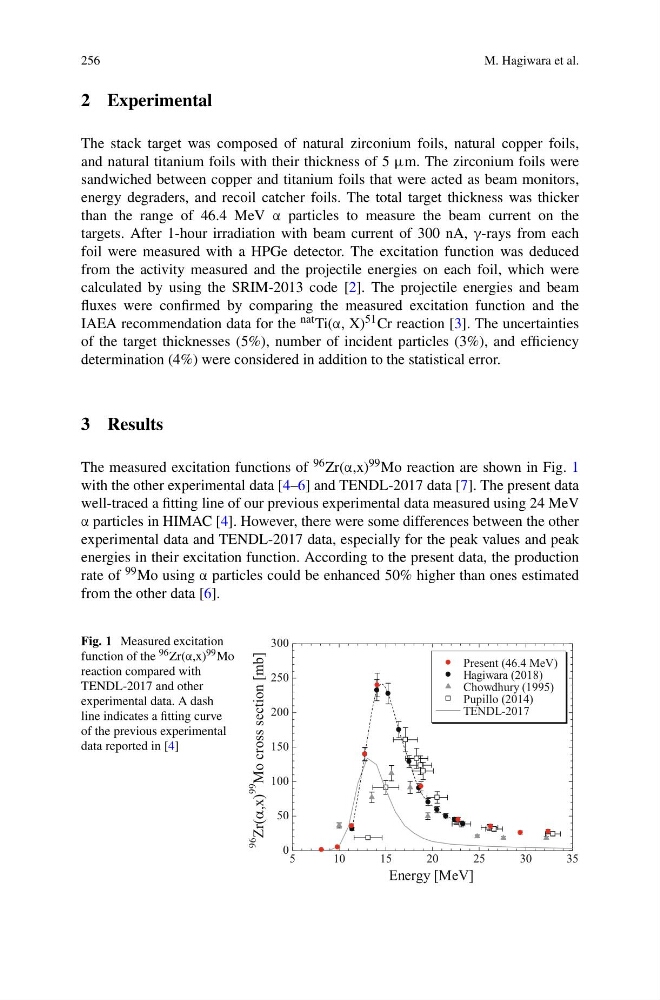
The measured excitation functions of 96 Zr(α,x) 99 Mo reaction are shown in Fig. 1
with the other experimental data [4–6] and TENDL-2017 data [7]. The present data
well-traced a fitting line of our previous experimental data measured using 24 MeV
α particles in HIMAC [4]. However, there were some differences between the other
experimental data and TENDL-2017 data, especially for the peak values and peak
energies in their excitation function. According to the present data, the production
rate of 99 Mo using α particles could be enhanced 50% higher than ones estimated
from the other data [6].
Fig. 1 Measured excitation
function of the 96 Zr(α,x) 99 Mo
reaction compared with
TENDL-2017 and other
experimental data. A dash
line indicates a fitting curve
of the previous experimental
data reported in [4]
5
10
15
20
25
30
35
0
50
100
150
200
250
300
96
Zr(α,x)
99
Mo cross section [mb]
Energy [MeV]
Present (46.4 MeV)
Hagiwara (2018)
Chowdhury (1995)
Pupillo (2014)
TENDL-2017
M. Hagiwara et al.
2 Experimental
The stack target was composed of natural zirconium foils, natural copper foils,
and natural titanium foils with their thickness of 5 μm. The zirconium foils were
sandwiched between copper and titanium foils that were acted as beam monitors,
energy degraders, and recoil catcher foils. The total target thickness was thicker
than the range of 46.4 MeV α particles to measure the beam current on the
targets. After 1-hour irradiation with beam current of 300 nA, γ-rays from each
foil were measured with a HPGe detector. The excitation function was deduced
from the activity measured and the projectile energies on each foil, which were
calculated by using the SRIM-2013 code [2]. The projectile energies and beam
fluxes were confirmed by comparing the measured excitation function and the
IAEA recommendation data for the nat Ti(α, X) 51 Cr reaction [3]. The uncertainties
of the target thicknesses (5%), number of incident particles (3%), and efficiency
determination (4%) were considered in addition to the statistical error.
3 Results
The measured excitation functions of 96 Zr(α,x) 99 Mo reaction are shown in Fig. 1
with the other experimental data [4–6] and TENDL-2017 data [7]. The present data
well-traced a fitting line of our previous experimental data measured using 24 MeV
α particles in HIMAC [4]. However, there were some differences between the other
experimental data and TENDL-2017 data, especially for the peak values and peak
energies in their excitation function. According to the present data, the production
rate of 99 Mo using α particles could be enhanced 50% higher than ones estimated
from the other data [6].
Fig. 1 Measured excitation
function of the 96 Zr(α,x) 99 Mo
reaction compared with
TENDL-2017 and other
experimental data. A dash
line indicates a fitting curve
of the previous experimental
data reported in [4]
5
10
15
20
25
30
35
0
50
100
150
200
250
300
96
Zr(α,x)
99
Mo cross section [mb]
Energy [MeV]
Present (46.4 MeV)
Hagiwara (2018)
Chowdhury (1995)
Pupillo (2014)
TENDL-2017