

248
K. Cherevko et al.
δ =
2
3
1
ρ 0
2
×
−33t 0 − 160W ρ 0
−1/3 + t 3 (1 + α)ρ 0
α 1
12
7(3α + 6) − 3(3α + 6) 2
15t 0 +
1
12 t 3 (1 + α)
(3α + 6) − (3α + 6) 2
2
σ ∞
(1)
where W is the parameter related to the effective masses, see Eq. (9) in Ref.[4], ρ 0
is the saturation density and α the power of the density dependence of the Skyrme
interaction. To evaluate the barrier heights and positions different nuclear potentials
based on the proximity concept [2] are used. Within that approach the nuclear part
V N of the total interaction potential V T = V N + V C is defined as:
V N (r) = 4πσ bRR
r − C 1 − C 2
b
(2)
with (ζ ) being the universal function. In the current work we attempt to account
for the curvature correction in the surface tension coefficient by changing σ in
Eq. (2) for σ curv with δ defined from Eq. (1). In calculating the shape of the nuclei
and the shortest distance we follow the approach of [5] and for the Coulomb part
V C in case of the deformed nuclei the formalism from [1] is used. SV-min Skyrme
force is used [6].
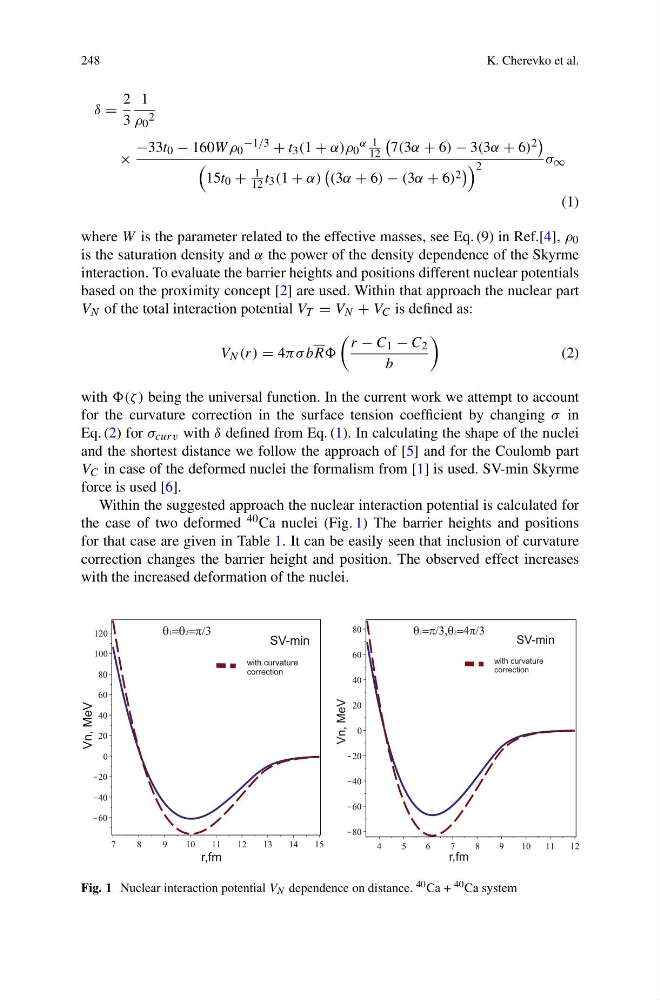
Within the suggested approach the nuclear interaction potential is calculated for
the case of two deformed 40 Ca nuclei (Fig. 1) The barrier heights and positions
for that case are given in Table 1. It can be easily seen that inclusion of curvature
correction changes the barrier height and position. The observed effect increases
with the increased deformation of the nuclei.
r,fm
V
e
M
,
n
V
SV-min
with curvature
correction
V
e
M
,
n
V
with curvature
correction
SV-min
r,fm
Fig. 1 Nuclear interaction potential V N dependence on distance. 40 Ca + 40 Ca system
K. Cherevko et al.
δ =
2
3
1
ρ 0
2
×
−33t 0 − 160W ρ 0
−1/3 + t 3 (1 + α)ρ 0
α 1
12
7(3α + 6) − 3(3α + 6) 2
15t 0 +
1
12 t 3 (1 + α)
(3α + 6) − (3α + 6) 2
2
σ ∞
(1)
where W is the parameter related to the effective masses, see Eq. (9) in Ref.[4], ρ 0
is the saturation density and α the power of the density dependence of the Skyrme
interaction. To evaluate the barrier heights and positions different nuclear potentials
based on the proximity concept [2] are used. Within that approach the nuclear part
V N of the total interaction potential V T = V N + V C is defined as:
V N (r) = 4πσ bRR
r − C 1 − C 2
b
(2)
with (ζ ) being the universal function. In the current work we attempt to account
for the curvature correction in the surface tension coefficient by changing σ in
Eq. (2) for σ curv with δ defined from Eq. (1). In calculating the shape of the nuclei
and the shortest distance we follow the approach of [5] and for the Coulomb part
V C in case of the deformed nuclei the formalism from [1] is used. SV-min Skyrme
force is used [6].
Within the suggested approach the nuclear interaction potential is calculated for
the case of two deformed 40 Ca nuclei (Fig. 1) The barrier heights and positions
for that case are given in Table 1. It can be easily seen that inclusion of curvature
correction changes the barrier height and position. The observed effect increases
with the increased deformation of the nuclei.
r,fm
V
e
M
,
n
V
SV-min
with curvature
correction
V
e
M
,
n
V
with curvature
correction
SV-min
r,fm
Fig. 1 Nuclear interaction potential V N dependence on distance. 40 Ca + 40 Ca system