

242
W. Loveland and L. Yao
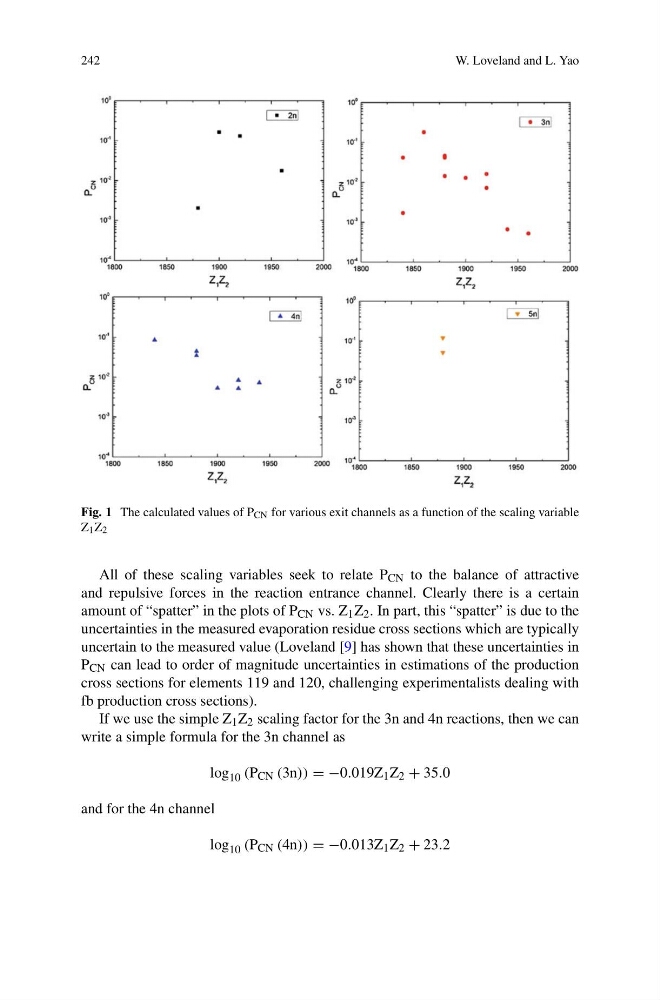
Fig. 1 The calculated values of P CN for various exit channels as a function of the scaling variable
Z 1 Z 2
All of these scaling variables seek to relate P CN to the balance of attractive
and repulsive forces in the reaction entrance channel. Clearly there is a certain
amount of “spatter” in the plots of P CN vs. Z 1 Z 2 . In part, this “spatter” is due to the
uncertainties in the measured evaporation residue cross sections which are typically
uncertain to the measured value (Loveland [9] has shown that these uncertainties in
P CN can lead to order of magnitude uncertainties in estimations of the production
cross sections for elements 119 and 120, challenging experimentalists dealing with
fb production cross sections).
If we use the simple Z 1 Z 2 scaling factor for the 3n and 4n reactions, then we can
write a simple formula for the 3n channel as
log 10 (P CN (3n)) = −0.019Z 1 Z 2 + 35.0
and for the 4n channel
log 10 (P CN (4n)) = −0.013Z 1 Z 2 + 23.2
W. Loveland and L. Yao
Fig. 1 The calculated values of P CN for various exit channels as a function of the scaling variable
Z 1 Z 2
All of these scaling variables seek to relate P CN to the balance of attractive
and repulsive forces in the reaction entrance channel. Clearly there is a certain
amount of “spatter” in the plots of P CN vs. Z 1 Z 2 . In part, this “spatter” is due to the
uncertainties in the measured evaporation residue cross sections which are typically
uncertain to the measured value (Loveland [9] has shown that these uncertainties in
P CN can lead to order of magnitude uncertainties in estimations of the production
cross sections for elements 119 and 120, challenging experimentalists dealing with
fb production cross sections).
If we use the simple Z 1 Z 2 scaling factor for the 3n and 4n reactions, then we can
write a simple formula for the 3n channel as
log 10 (P CN (3n)) = −0.019Z 1 Z 2 + 35.0
and for the 4n channel
log 10 (P CN (4n)) = −0.013Z 1 Z 2 + 23.2