

240
W. Loveland and L. Yao
2 Methodology
As explained in [1], the formalism for calculating the survival, against fission,
of a highly excited nucleus is relatively well-understood [3]. One starts with a
single particle model [4] of the level density in which one allows the level density
parameter to be a function of the excitation energy. Masses and shell corrections
are taken from [5]. The deformation dependent collective enhancement of the level
density is taken from [6]. The decay widths for decay by neutron, charged particle
and γ-emission are calculated with standard formulas. Corrections for Kramers
effects [7] are made to the fission widths. The fission barrier heights are calculated
using liquid drop barriers and excitation energy dependent shell corrections.
We begin with the compilation of Duellmann of evaluated evaporation residue
cross sections for reactions that produce nuclei with Z CN = 111–118 [8]. For each
reaction (projectile, target and beam energy), we calculated the spin dependent
evaporation residue cross section assuming P CN = 1 using the “Empirical Model”
of [3]. In [1], we presented evidence that this procedure results in a reasonable
agreement between the calculated and measured spin dependence of the evaporation
residue formation cross sections for the test case of 176 Yb( 48 Ca,4n) 220 Th reaction
and for the 48 Ca + 208 Pb reaction. Loveland [9] has made a detailed examination of
the strengths and weaknesses of models such as [3] and placed limits on how well
these models work.
3 Results
There are 28 cases we have examined. A summary of the measured and calculated
evaporation residue cross sections is given in Table 1. The fusion probability, P CN ,
is taken as the ratios of the calculated to the measured evaporation residue cross
sections since we have assumed P CN = 1 in our calculations. As expected, the P CN
values for the “cold fusion” reactions (1n out) are orders of magnitude smaller than
those for the hot fusion (2n–4n out) reactions. The deduced values of P CN generally
get smaller as the product of the atomic numbers of the colliding nuclei, Z 1 Z 2 ,
increases.
In Fig. 1, we show the P CN values, sorted by exit channel for the hot fusion
reactions, as a function of the simple scaling variable, Z 1 Z 2 , the product of the
atomic numbers of the reacting nuclei.
The use of other scaling variables such as x CN , x eff and x m does not significantly
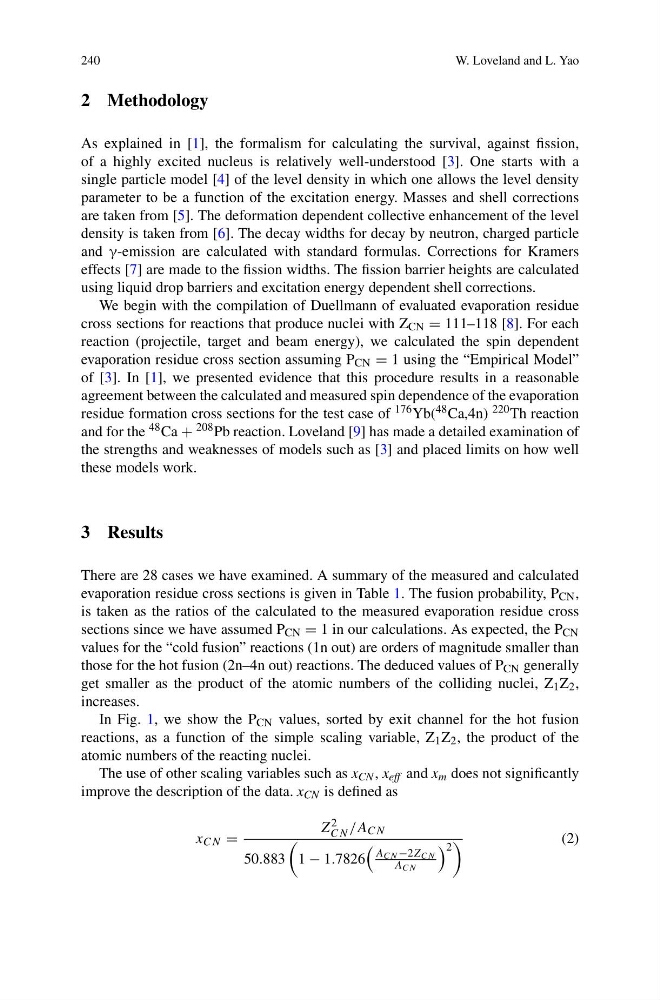
improve the description of the data. x CN is defined as
x CN =
Z 2
CN /A CN
50.883
1 − 1.7826
A CN −2Z CN
A CN
2
(2)
W. Loveland and L. Yao
2 Methodology
As explained in [1], the formalism for calculating the survival, against fission,
of a highly excited nucleus is relatively well-understood [3]. One starts with a
single particle model [4] of the level density in which one allows the level density
parameter to be a function of the excitation energy. Masses and shell corrections
are taken from [5]. The deformation dependent collective enhancement of the level
density is taken from [6]. The decay widths for decay by neutron, charged particle
and γ-emission are calculated with standard formulas. Corrections for Kramers
effects [7] are made to the fission widths. The fission barrier heights are calculated
using liquid drop barriers and excitation energy dependent shell corrections.
We begin with the compilation of Duellmann of evaluated evaporation residue
cross sections for reactions that produce nuclei with Z CN = 111–118 [8]. For each
reaction (projectile, target and beam energy), we calculated the spin dependent
evaporation residue cross section assuming P CN = 1 using the “Empirical Model”
of [3]. In [1], we presented evidence that this procedure results in a reasonable
agreement between the calculated and measured spin dependence of the evaporation
residue formation cross sections for the test case of 176 Yb( 48 Ca,4n) 220 Th reaction
and for the 48 Ca + 208 Pb reaction. Loveland [9] has made a detailed examination of
the strengths and weaknesses of models such as [3] and placed limits on how well
these models work.
3 Results
There are 28 cases we have examined. A summary of the measured and calculated
evaporation residue cross sections is given in Table 1. The fusion probability, P CN ,
is taken as the ratios of the calculated to the measured evaporation residue cross
sections since we have assumed P CN = 1 in our calculations. As expected, the P CN
values for the “cold fusion” reactions (1n out) are orders of magnitude smaller than
those for the hot fusion (2n–4n out) reactions. The deduced values of P CN generally
get smaller as the product of the atomic numbers of the colliding nuclei, Z 1 Z 2 ,
increases.
In Fig. 1, we show the P CN values, sorted by exit channel for the hot fusion
reactions, as a function of the simple scaling variable, Z 1 Z 2 , the product of the
atomic numbers of the reacting nuclei.
The use of other scaling variables such as x CN , x eff and x m does not significantly
improve the description of the data. x CN is defined as
x CN =
Z 2
CN /A CN
50.883
1 − 1.7826
A CN −2Z CN
A CN
2
(2)