

230
O. Gorton and J. E. Escher
space, generating a joint probability distribution for the parameters without visiting
every combination of parameters.
The nuclear level density model we employ is the composite Gilbert-Cameron
level density [4] with the Ignatyuk treatment of the energy dependence of the level
density parameter [5]. We varied five parameters within this prescription, which are,
following the notation of reference [1]: the asymptotic level density parameter ˜
a,
the shell correction energy δW , the level density damping parameter γ , the pairing
energy shift , and the effective moment of inertia that enters the expression for
the spin-cutoff factor. The γ -ray strength function description employed was the
enhanced generalized Lorentzian (EGLO) model for the E1 transitions, and the
standard Lorentzian (SLO) for the M1 transitions. These models are parameterized
by their peak energy, width, and strength [1]. We varied nine strength function
parameters, three for each peak, with the EGLO function having two peaks, and
the SLO having a single peak. A total of 14 parameters were varied simultaneously.
We employ a Metropolis-Hastings MCMC algorithm [6, 7], and explore convergence of the sampling process. The prior distributions for each parameter were
finite and flat, and centered around recommended parameter values from RIPL-3 [1].
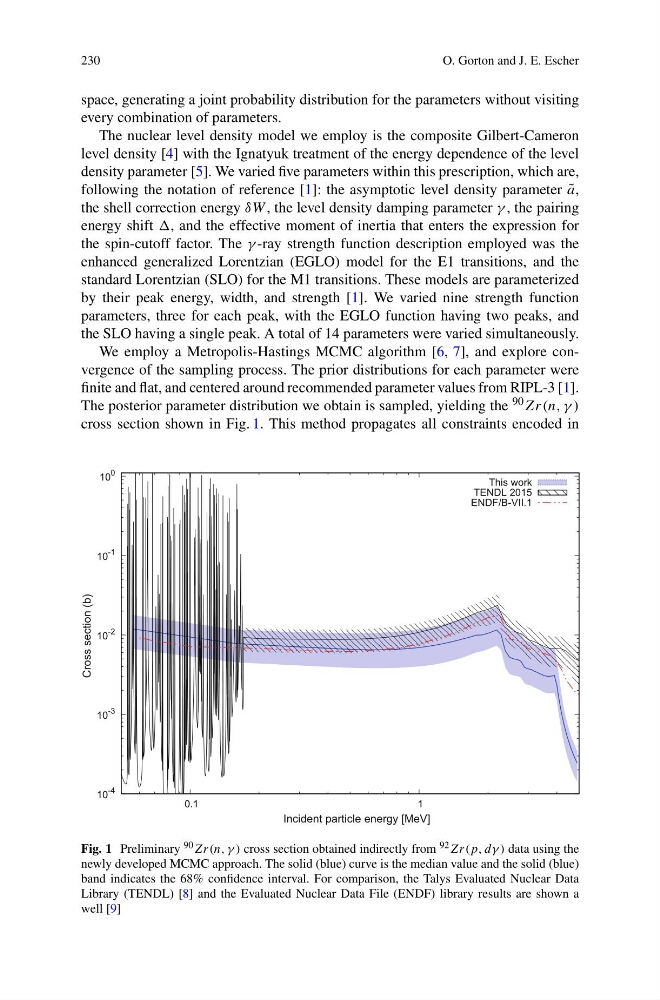
The posterior parameter distribution we obtain is sampled, yielding the 90 Zr(n, γ )
cross section shown in Fig. 1. This method propagates all constraints encoded in
10
-4
10
-3
10
-2
10
-1
10
0
0.1
1
Cross section (b)
Incident particle energy [MeV]
This work
TENDL 2015
ENDF/B-VII.1
Fig. 1 Preliminary 90 Zr(n, γ ) cross section obtained indirectly from 92 Zr(p, dγ ) data using the
newly developed MCMC approach. The solid (blue) curve is the median value and the solid (blue)
band indicates the 68% confidence interval. For comparison, the Talys Evaluated Nuclear Data
Library (TENDL) [8] and the Evaluated Nuclear Data File (ENDF) library results are shown a
well [9]
O. Gorton and J. E. Escher
space, generating a joint probability distribution for the parameters without visiting
every combination of parameters.
The nuclear level density model we employ is the composite Gilbert-Cameron
level density [4] with the Ignatyuk treatment of the energy dependence of the level
density parameter [5]. We varied five parameters within this prescription, which are,
following the notation of reference [1]: the asymptotic level density parameter ˜
a,
the shell correction energy δW , the level density damping parameter γ , the pairing
energy shift , and the effective moment of inertia that enters the expression for
the spin-cutoff factor. The γ -ray strength function description employed was the
enhanced generalized Lorentzian (EGLO) model for the E1 transitions, and the
standard Lorentzian (SLO) for the M1 transitions. These models are parameterized
by their peak energy, width, and strength [1]. We varied nine strength function
parameters, three for each peak, with the EGLO function having two peaks, and
the SLO having a single peak. A total of 14 parameters were varied simultaneously.
We employ a Metropolis-Hastings MCMC algorithm [6, 7], and explore convergence of the sampling process. The prior distributions for each parameter were
finite and flat, and centered around recommended parameter values from RIPL-3 [1].
The posterior parameter distribution we obtain is sampled, yielding the 90 Zr(n, γ )
cross section shown in Fig. 1. This method propagates all constraints encoded in
10
-4
10
-3
10
-2
10
-1
10
0
0.1
1
Cross section (b)
Incident particle energy [MeV]
This work
TENDL 2015
ENDF/B-VII.1
Fig. 1 Preliminary 90 Zr(n, γ ) cross section obtained indirectly from 92 Zr(p, dγ ) data using the
newly developed MCMC approach. The solid (blue) curve is the median value and the solid (blue)
band indicates the 68% confidence interval. For comparison, the Talys Evaluated Nuclear Data
Library (TENDL) [8] and the Evaluated Nuclear Data File (ENDF) library results are shown a
well [9]