

222
J. E. Escher et al.
we summarize recent progress in determining capture cross sections and discuss
potential applications to other reaction mechanisms.
2 Applications to Neutron Capture
Early applications of the surrogate approach simply used the measured coincidence
probability P δχ (E ex ) to describe the decay of the CN in the desired (neutroninduced) reaction, without regard to the fact that the manner in which the CN is
produced affects the spins and parities of the CN and hence its decay. While this
(Weisskopf-Ewing) approximation worked reasonably well for (n,f) reactions [1, 2],
it did not produce the correct neutron capture cross sections, due to the dependence
of the decay on the CN spin distribution [3]. Typically, the surrogate reaction
populates spins in the CN that are much higher than those relevant to low-energy
neutron capture. When the first few states of the target nucleus have low spins,
this results in neutron emission being suppressed and gamma emission being
enhanced, and therefore the estimated capture cross section is too high. This was
explained in a number of theoretical studies of the method [4–6] and also observed
experimentally [7, 8]. Employing ratio approaches did not resolve the problem [5, 9].
The key to overcoming this challenge is to treat the surrogate reaction data as a
constraint for the nuclear structure models that enter the CN reaction calculation.
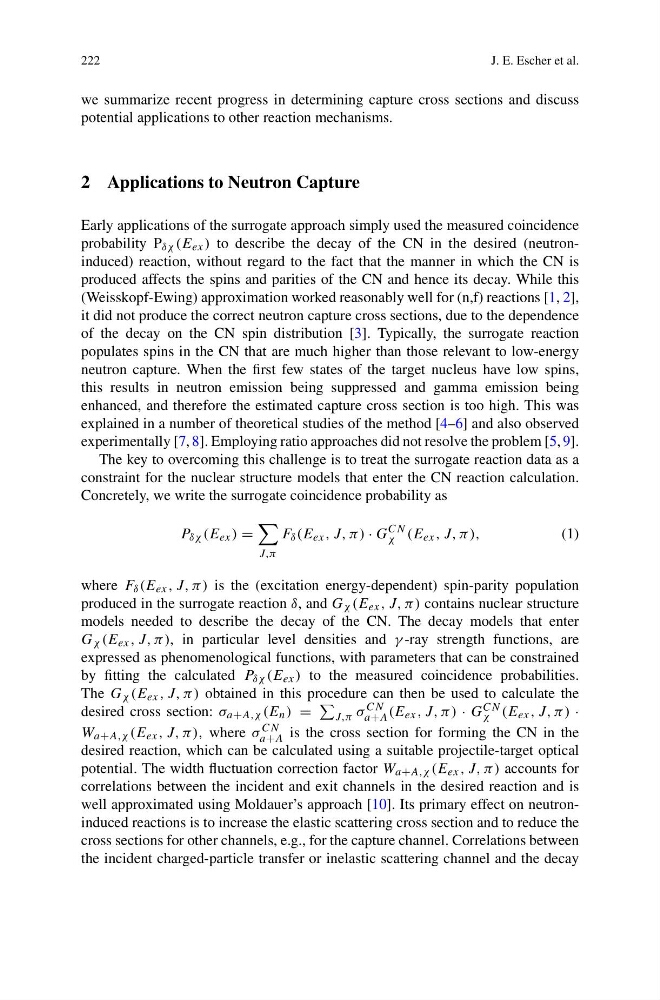
Concretely, we write the surrogate coincidence probability as
P δχ (E ex ) =
J,π
F δ (E ex , J, π) · G
CN
χ (E ex , J, π),
(1)
where F δ (E ex , J, π) is the (excitation energy-dependent) spin-parity population
produced in the surrogate reaction δ, and G χ (E ex , J, π) contains nuclear structure
models needed to describe the decay of the CN. The decay models that enter
G χ (E ex , J, π), in particular level densities and γ -ray strength functions, are
expressed as phenomenological functions, with parameters that can be constrained
by fitting the calculated P δχ (E ex ) to the measured coincidence probabilities.
The G χ (E ex , J, π) obtained in this procedure can then be used to calculate the
desired cross section: σ a+A,χ (E n ) =
J,π σ CN
a+A (E ex , J, π) · G CN
χ (E ex , J, π) ·
W a+A,χ (E ex , J, π), where σ CN
a+A is the cross section for forming the CN in the
desired reaction, which can be calculated using a suitable projectile-target optical
potential. The width fluctuation correction factor W a+A,χ (E ex , J, π) accounts for
correlations between the incident and exit channels in the desired reaction and is
well approximated using Moldauer’s approach [10]. Its primary effect on neutroninduced reactions is to increase the elastic scattering cross section and to reduce the
cross sections for other channels, e.g., for the capture channel. Correlations between
the incident charged-particle transfer or inelastic scattering channel and the decay
J. E. Escher et al.
we summarize recent progress in determining capture cross sections and discuss
potential applications to other reaction mechanisms.
2 Applications to Neutron Capture
Early applications of the surrogate approach simply used the measured coincidence
probability P δχ (E ex ) to describe the decay of the CN in the desired (neutroninduced) reaction, without regard to the fact that the manner in which the CN is
produced affects the spins and parities of the CN and hence its decay. While this
(Weisskopf-Ewing) approximation worked reasonably well for (n,f) reactions [1, 2],
it did not produce the correct neutron capture cross sections, due to the dependence
of the decay on the CN spin distribution [3]. Typically, the surrogate reaction
populates spins in the CN that are much higher than those relevant to low-energy
neutron capture. When the first few states of the target nucleus have low spins,
this results in neutron emission being suppressed and gamma emission being
enhanced, and therefore the estimated capture cross section is too high. This was
explained in a number of theoretical studies of the method [4–6] and also observed
experimentally [7, 8]. Employing ratio approaches did not resolve the problem [5, 9].
The key to overcoming this challenge is to treat the surrogate reaction data as a
constraint for the nuclear structure models that enter the CN reaction calculation.
Concretely, we write the surrogate coincidence probability as
P δχ (E ex ) =
J,π
F δ (E ex , J, π) · G
CN
χ (E ex , J, π),
(1)
where F δ (E ex , J, π) is the (excitation energy-dependent) spin-parity population
produced in the surrogate reaction δ, and G χ (E ex , J, π) contains nuclear structure
models needed to describe the decay of the CN. The decay models that enter
G χ (E ex , J, π), in particular level densities and γ -ray strength functions, are
expressed as phenomenological functions, with parameters that can be constrained
by fitting the calculated P δχ (E ex ) to the measured coincidence probabilities.
The G χ (E ex , J, π) obtained in this procedure can then be used to calculate the
desired cross section: σ a+A,χ (E n ) =
J,π σ CN
a+A (E ex , J, π) · G CN
χ (E ex , J, π) ·
W a+A,χ (E ex , J, π), where σ CN
a+A is the cross section for forming the CN in the
desired reaction, which can be calculated using a suitable projectile-target optical
potential. The width fluctuation correction factor W a+A,χ (E ex , J, π) accounts for
correlations between the incident and exit channels in the desired reaction and is
well approximated using Moldauer’s approach [10]. Its primary effect on neutroninduced reactions is to increase the elastic scattering cross section and to reduce the
cross sections for other channels, e.g., for the capture channel. Correlations between
the incident charged-particle transfer or inelastic scattering channel and the decay