

Prospects for Surrogate Neutron Capture Measurements with Radioactive Ion. . .
219
40
2
4
6
8
10
12
14
60
80
100
120
140
Lab Angle (deg)
Particle Energy (MeV)
160
135 Xe
2040
2406
2836
3114
((5/2 - ))
((1/2 - ))
(3/2 - )
(7/2 - )
288
527
3/2 +
1/2 +
11/2 -
2118
1513
1074
10 3
10 2
10
1
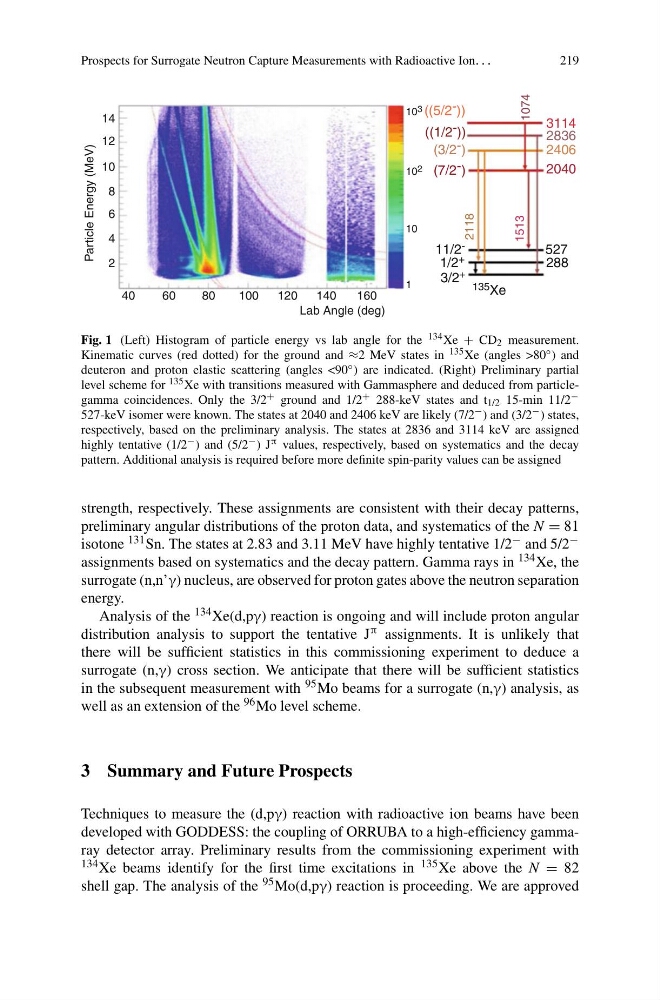
Fig. 1 (Left) Histogram of particle energy vs lab angle for the 134 Xe + CD 2 measurement.
Kinematic curves (red dotted) for the ground and ≈2 MeV states in 135 Xe (angles >80 ◦ ) and
deuteron and proton elastic scattering (angles <90 ◦ ) are indicated. (Right) Preliminary partial
level scheme for 135 Xe with transitions measured with Gammasphere and deduced from particlegamma coincidences. Only the 3/2 + ground and 1/2 + 288-keV states and t 1/2 15-min 11/2 −
527-keV isomer were known. The states at 2040 and 2406 keV are likely (7/2 − ) and (3/2 − ) states,
respectively, based on the preliminary analysis. The states at 2836 and 3114 keV are assigned
highly tentative (1/2 − ) and (5/2 − ) J π values, respectively, based on systematics and the decay
pattern. Additional analysis is required before more definite spin-parity values can be assigned
strength, respectively. These assignments are consistent with their decay patterns,
preliminary angular distributions of the proton data, and systematics of the N = 81
isotone 131 Sn. The states at 2.83 and 3.11 MeV have highly tentative 1/2 − and 5/2 −
assignments based on systematics and the decay pattern. Gamma rays in 134 Xe, the
surrogate (n,n’γ) nucleus, are observed for proton gates above the neutron separation
energy.
Analysis of the 134 Xe(d,pγ) reaction is ongoing and will include proton angular
distribution analysis to support the tentative J π assignments. It is unlikely that
there will be sufficient statistics in this commissioning experiment to deduce a
surrogate (n,γ) cross section. We anticipate that there will be sufficient statistics
in the subsequent measurement with 95 Mo beams for a surrogate (n,γ) analysis, as
well as an extension of the 96 Mo level scheme.
3 Summary and Future Prospects
Techniques to measure the (d,pγ) reaction with radioactive ion beams have been
developed with GODDESS: the coupling of ORRUBA to a high-efficiency gammaray detector array. Preliminary results from the commissioning experiment with
134 Xe beams identify for the first time excitations in 135 Xe above the N = 82
shell gap. The analysis of the 95 Mo(d,pγ) reaction is proceeding. We are approved
219
40
2
4
6
8
10
12
14
60
80
100
120
140
Lab Angle (deg)
Particle Energy (MeV)
160
135 Xe
2040
2406
2836
3114
((5/2 - ))
((1/2 - ))
(3/2 - )
(7/2 - )
288
527
3/2 +
1/2 +
11/2 -
2118
1513
1074
10 3
10 2
10
1
Fig. 1 (Left) Histogram of particle energy vs lab angle for the 134 Xe + CD 2 measurement.
Kinematic curves (red dotted) for the ground and ≈2 MeV states in 135 Xe (angles >80 ◦ ) and
deuteron and proton elastic scattering (angles <90 ◦ ) are indicated. (Right) Preliminary partial
level scheme for 135 Xe with transitions measured with Gammasphere and deduced from particlegamma coincidences. Only the 3/2 + ground and 1/2 + 288-keV states and t 1/2 15-min 11/2 −
527-keV isomer were known. The states at 2040 and 2406 keV are likely (7/2 − ) and (3/2 − ) states,
respectively, based on the preliminary analysis. The states at 2836 and 3114 keV are assigned
highly tentative (1/2 − ) and (5/2 − ) J π values, respectively, based on systematics and the decay
pattern. Additional analysis is required before more definite spin-parity values can be assigned
strength, respectively. These assignments are consistent with their decay patterns,
preliminary angular distributions of the proton data, and systematics of the N = 81
isotone 131 Sn. The states at 2.83 and 3.11 MeV have highly tentative 1/2 − and 5/2 −
assignments based on systematics and the decay pattern. Gamma rays in 134 Xe, the
surrogate (n,n’γ) nucleus, are observed for proton gates above the neutron separation
energy.
Analysis of the 134 Xe(d,pγ) reaction is ongoing and will include proton angular
distribution analysis to support the tentative J π assignments. It is unlikely that
there will be sufficient statistics in this commissioning experiment to deduce a
surrogate (n,γ) cross section. We anticipate that there will be sufficient statistics
in the subsequent measurement with 95 Mo beams for a surrogate (n,γ) analysis, as
well as an extension of the 96 Mo level scheme.
3 Summary and Future Prospects
Techniques to measure the (d,pγ) reaction with radioactive ion beams have been
developed with GODDESS: the coupling of ORRUBA to a high-efficiency gammaray detector array. Preliminary results from the commissioning experiment with
134 Xe beams identify for the first time excitations in 135 Xe above the N = 82
shell gap. The analysis of the 95 Mo(d,pγ) reaction is proceeding. We are approved