

212
A. Henriques et al.
reactions since the beam will only interact with the desired material and in a welldefined interaction zone with a very well-defined energy, allowing a very precise
measurement of the excitation energy of the decaying nucleus.
3 A Future Set-up for Surrogate Reactions at Ion Storage
Rings
The promising advantages of performing surrogate-reaction experiments in inverse
kinematics using storage rings led to the start of a project [3], which aims to carry
out such studies in particular at the ESR and the CRYRING [12] storage rings of
GSI/FAIR.
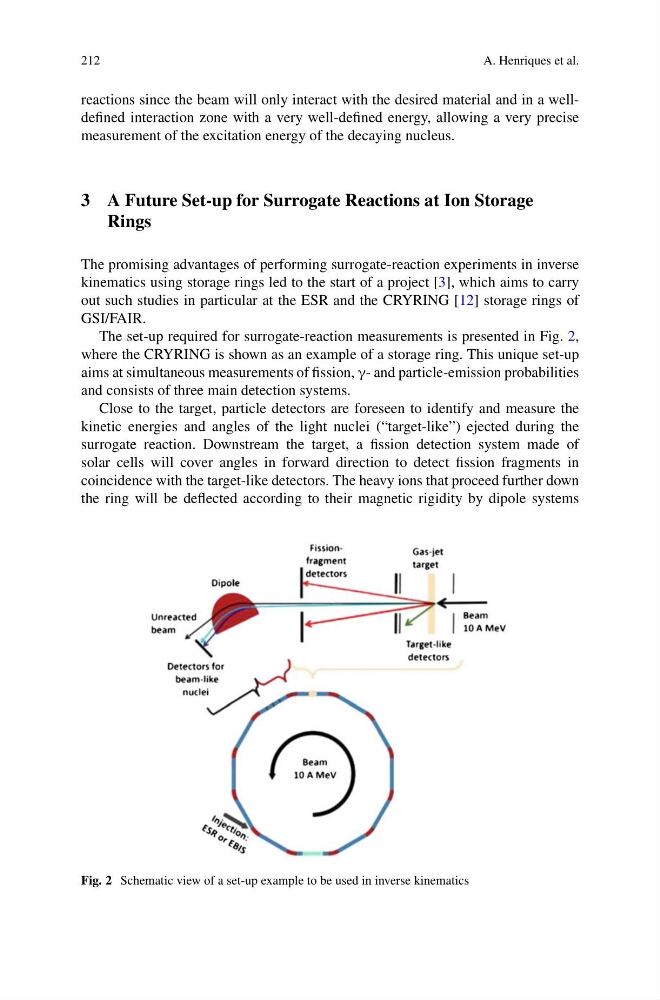
The set-up required for surrogate-reaction measurements is presented in Fig. 2,
where the CRYRING is shown as an example of a storage ring. This unique set-up
aims at simultaneous measurements of fission, γ- and particle-emission probabilities
and consists of three main detection systems.
Close to the target, particle detectors are foreseen to identify and measure the
kinetic energies and angles of the light nuclei (“target-like”) ejected during the
surrogate reaction. Downstream the target, a fission detection system made of
solar cells will cover angles in forward direction to detect fission fragments in
coincidence with the target-like detectors. The heavy ions that proceed further down
the ring will be deflected according to their magnetic rigidity by dipole systems
Fig. 2 Schematic view of a set-up example to be used in inverse kinematics
A. Henriques et al.
reactions since the beam will only interact with the desired material and in a welldefined interaction zone with a very well-defined energy, allowing a very precise
measurement of the excitation energy of the decaying nucleus.
3 A Future Set-up for Surrogate Reactions at Ion Storage
Rings
The promising advantages of performing surrogate-reaction experiments in inverse
kinematics using storage rings led to the start of a project [3], which aims to carry
out such studies in particular at the ESR and the CRYRING [12] storage rings of
GSI/FAIR.
The set-up required for surrogate-reaction measurements is presented in Fig. 2,
where the CRYRING is shown as an example of a storage ring. This unique set-up
aims at simultaneous measurements of fission, γ- and particle-emission probabilities
and consists of three main detection systems.
Close to the target, particle detectors are foreseen to identify and measure the
kinetic energies and angles of the light nuclei (“target-like”) ejected during the
surrogate reaction. Downstream the target, a fission detection system made of
solar cells will cover angles in forward direction to detect fission fragments in
coincidence with the target-like detectors. The heavy ions that proceed further down
the ring will be deflected according to their magnetic rigidity by dipole systems
Fig. 2 Schematic view of a set-up example to be used in inverse kinematics