

Attempting to Close the Loop on the Oslo Technique at 198 Au: Constraining. . .
191
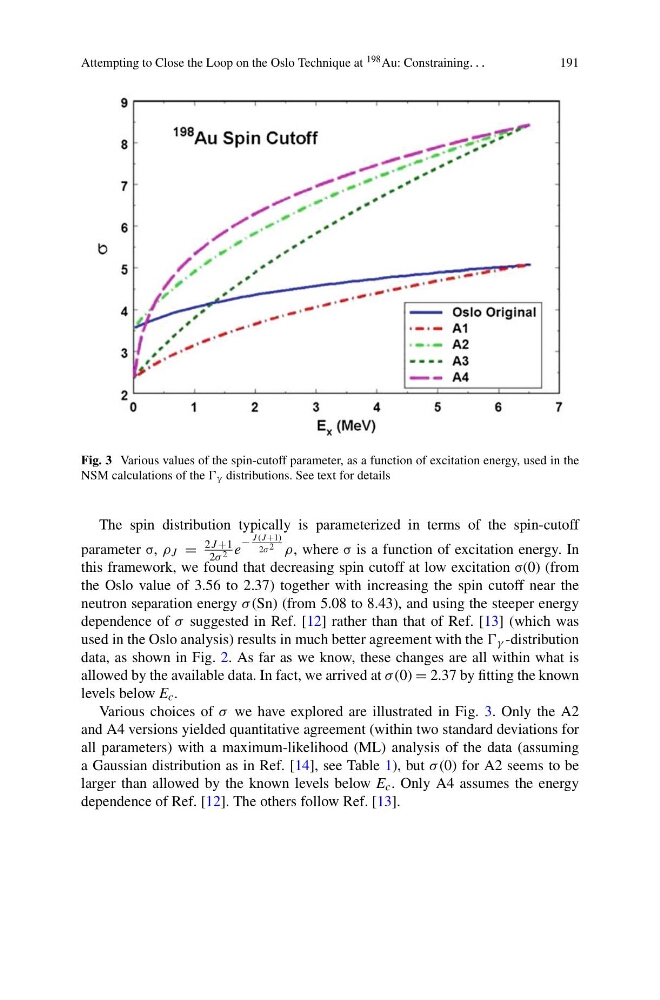
Fig. 3 Various values of the spin-cutoff parameter, as a function of excitation energy, used in the
NSM calculations of the γ distributions. See text for details
The spin distribution typically is parameterized in terms of the spin-cutoff
parameter σ, ρ J =
2J +1
2σ 2 e
−
J (J +1)
2σ 2 ρ, where σ is a function of excitation energy. In
this framework, we found that decreasing spin cutoff at low excitation σ(0) (from
the Oslo value of 3.56 to 2.37) together with increasing the spin cutoff near the
neutron separation energy σ (Sn) (from 5.08 to 8.43), and using the steeper energy
dependence of σ suggested in Ref. [12] rather than that of Ref. [13] (which was
used in the Oslo analysis) results in much better agreement with the γ -distribution
data, as shown in Fig. 2. As far as we know, these changes are all within what is
allowed by the available data. In fact, we arrived at σ (0) = 2.37 by fitting the known
levels below E c .
Various choices of σ we have explored are illustrated in Fig. 3. Only the A2
and A4 versions yielded quantitative agreement (within two standard deviations for
all parameters) with a maximum-likelihood (ML) analysis of the data (assuming
a Gaussian distribution as in Ref. [14], see Table 1), but σ (0) for A2 seems to be
larger than allowed by the known levels below E c . Only A4 assumes the energy
dependence of Ref. [12]. The others follow Ref. [13].
191
Fig. 3 Various values of the spin-cutoff parameter, as a function of excitation energy, used in the
NSM calculations of the γ distributions. See text for details
The spin distribution typically is parameterized in terms of the spin-cutoff
parameter σ, ρ J =
2J +1
2σ 2 e
−
J (J +1)
2σ 2 ρ, where σ is a function of excitation energy. In
this framework, we found that decreasing spin cutoff at low excitation σ(0) (from
the Oslo value of 3.56 to 2.37) together with increasing the spin cutoff near the
neutron separation energy σ (Sn) (from 5.08 to 8.43), and using the steeper energy
dependence of σ suggested in Ref. [12] rather than that of Ref. [13] (which was
used in the Oslo analysis) results in much better agreement with the γ -distribution
data, as shown in Fig. 2. As far as we know, these changes are all within what is
allowed by the available data. In fact, we arrived at σ (0) = 2.37 by fitting the known
levels below E c .
Various choices of σ we have explored are illustrated in Fig. 3. Only the A2
and A4 versions yielded quantitative agreement (within two standard deviations for
all parameters) with a maximum-likelihood (ML) analysis of the data (assuming
a Gaussian distribution as in Ref. [14], see Table 1), but σ (0) for A2 seems to be
larger than allowed by the known levels below E c . Only A4 assumes the energy
dependence of Ref. [12]. The others follow Ref. [13].