

Actinide Capture
177
Egamma (MeV)
0
1
2
3
4
5
6
7
8
0
100
200
300
400
500
600
700
10.93 eV 1+
17.66 eV 1+
22.26 eV 1+
11.90 eV 1+
GLO No SM J1
GLO 1 pk SM J1
GLO 2 pk SM J1
=2
cl
E gamma M
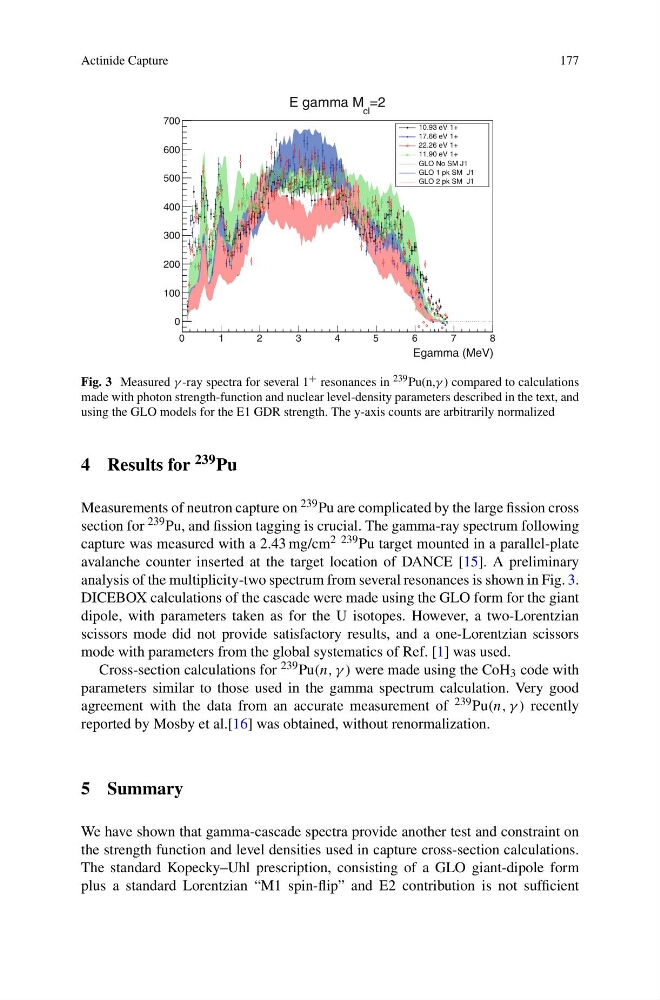
Fig. 3 Measured γ -ray spectra for several 1 + resonances in 239 Pu(n,γ ) compared to calculations
made with photon strength-function and nuclear level-density parameters described in the text, and
using the GLO models for the E1 GDR strength. The y-axis counts are arbitrarily normalized
4 Results for 239 Pu
Measurements of neutron capture on 239 Pu are complicated by the large fission cross
section for 239 Pu, and fission tagging is crucial. The gamma-ray spectrum following
capture was measured with a 2.43 mg/cm 2 239 Pu target mounted in a parallel-plate
avalanche counter inserted at the target location of DANCE [15]. A preliminary
analysis of the multiplicity-two spectrum from several resonances is shown in Fig. 3.
DICEBOX calculations of the cascade were made using the GLO form for the giant
dipole, with parameters taken as for the U isotopes. However, a two-Lorentzian
scissors mode did not provide satisfactory results, and a one-Lorentzian scissors
mode with parameters from the global systematics of Ref. [1] was used.
Cross-section calculations for 239 Pu(n, γ ) were made using the CoH 3 code with
parameters similar to those used in the gamma spectrum calculation. Very good
agreement with the data from an accurate measurement of 239 Pu(n, γ ) recently
reported by Mosby et al.[16] was obtained, without renormalization.
5 Summary
We have shown that gamma-cascade spectra provide another test and constraint on
the strength function and level densities used in capture cross-section calculations.
The standard Kopecky–Uhl prescription, consisting of a GLO giant-dipole form
plus a standard Lorentzian “M1 spin-flip” and E2 contribution is not sufficient
177
Egamma (MeV)
0
1
2
3
4
5
6
7
8
0
100
200
300
400
500
600
700
10.93 eV 1+
17.66 eV 1+
22.26 eV 1+
11.90 eV 1+
GLO No SM J1
GLO 1 pk SM J1
GLO 2 pk SM J1
=2
cl
E gamma M
Fig. 3 Measured γ -ray spectra for several 1 + resonances in 239 Pu(n,γ ) compared to calculations
made with photon strength-function and nuclear level-density parameters described in the text, and
using the GLO models for the E1 GDR strength. The y-axis counts are arbitrarily normalized
4 Results for 239 Pu
Measurements of neutron capture on 239 Pu are complicated by the large fission cross
section for 239 Pu, and fission tagging is crucial. The gamma-ray spectrum following
capture was measured with a 2.43 mg/cm 2 239 Pu target mounted in a parallel-plate
avalanche counter inserted at the target location of DANCE [15]. A preliminary
analysis of the multiplicity-two spectrum from several resonances is shown in Fig. 3.
DICEBOX calculations of the cascade were made using the GLO form for the giant
dipole, with parameters taken as for the U isotopes. However, a two-Lorentzian
scissors mode did not provide satisfactory results, and a one-Lorentzian scissors
mode with parameters from the global systematics of Ref. [1] was used.
Cross-section calculations for 239 Pu(n, γ ) were made using the CoH 3 code with
parameters similar to those used in the gamma spectrum calculation. Very good
agreement with the data from an accurate measurement of 239 Pu(n, γ ) recently
reported by Mosby et al.[16] was obtained, without renormalization.
5 Summary
We have shown that gamma-cascade spectra provide another test and constraint on
the strength function and level densities used in capture cross-section calculations.
The standard Kopecky–Uhl prescription, consisting of a GLO giant-dipole form
plus a standard Lorentzian “M1 spin-flip” and E2 contribution is not sufficient