

174
J. L. Ullmann et al.
σ capt (E n ) =
π
k 2
n
J J
g c
T n T γ
T n + T γ
W nγ .
(1)
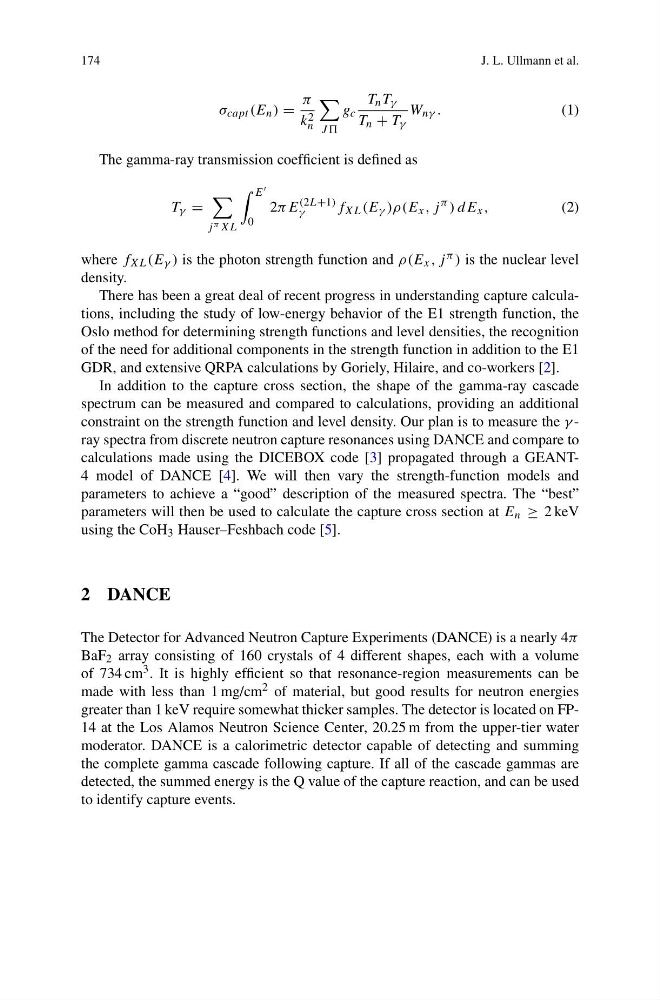
The gamma-ray transmission coefficient is defined as
T γ =
j π XL
E
0
2πE
(2L+1)
γ
f XL (E γ )ρ(E x , j
π ) dE x ,
(2)
where f XL (E γ ) is the photon strength function and ρ(E x , j π ) is the nuclear level
density.
There has been a great deal of recent progress in understanding capture calculations, including the study of low-energy behavior of the E1 strength function, the
Oslo method for determining strength functions and level densities, the recognition
of the need for additional components in the strength function in addition to the E1
GDR, and extensive QRPA calculations by Goriely, Hilaire, and co-workers [2].
In addition to the capture cross section, the shape of the gamma-ray cascade
spectrum can be measured and compared to calculations, providing an additional
constraint on the strength function and level density. Our plan is to measure the γ -
ray spectra from discrete neutron capture resonances using DANCE and compare to
calculations made using the DICEBOX code [3] propagated through a GEANT4 model of DANCE [4]. We will then vary the strength-function models and
parameters to achieve a “good” description of the measured spectra. The “best”
parameters will then be used to calculate the capture cross section at E n ≥ 2 keV
using the CoH 3 Hauser–Feshbach code [5].
2 DANCE
The Detector for Advanced Neutron Capture Experiments (DANCE) is a nearly 4π
BaF 2 array consisting of 160 crystals of 4 different shapes, each with a volume
of 734 cm 3 . It is highly efficient so that resonance-region measurements can be
made with less than 1 mg/cm 2 of material, but good results for neutron energies
greater than 1 keV require somewhat thicker samples. The detector is located on FP14 at the Los Alamos Neutron Science Center, 20.25 m from the upper-tier water
moderator. DANCE is a calorimetric detector capable of detecting and summing
the complete gamma cascade following capture. If all of the cascade gammas are
detected, the summed energy is the Q value of the capture reaction, and can be used
to identify capture events.
J. L. Ullmann et al.
σ capt (E n ) =
π
k 2
n
J J
g c
T n T γ
T n + T γ
W nγ .
(1)
The gamma-ray transmission coefficient is defined as
T γ =
j π XL
E
0
2πE
(2L+1)
γ
f XL (E γ )ρ(E x , j
π ) dE x ,
(2)
where f XL (E γ ) is the photon strength function and ρ(E x , j π ) is the nuclear level
density.
There has been a great deal of recent progress in understanding capture calculations, including the study of low-energy behavior of the E1 strength function, the
Oslo method for determining strength functions and level densities, the recognition
of the need for additional components in the strength function in addition to the E1
GDR, and extensive QRPA calculations by Goriely, Hilaire, and co-workers [2].
In addition to the capture cross section, the shape of the gamma-ray cascade
spectrum can be measured and compared to calculations, providing an additional
constraint on the strength function and level density. Our plan is to measure the γ -
ray spectra from discrete neutron capture resonances using DANCE and compare to
calculations made using the DICEBOX code [3] propagated through a GEANT4 model of DANCE [4]. We will then vary the strength-function models and
parameters to achieve a “good” description of the measured spectra. The “best”
parameters will then be used to calculate the capture cross section at E n ≥ 2 keV
using the CoH 3 Hauser–Feshbach code [5].
2 DANCE
The Detector for Advanced Neutron Capture Experiments (DANCE) is a nearly 4π
BaF 2 array consisting of 160 crystals of 4 different shapes, each with a volume
of 734 cm 3 . It is highly efficient so that resonance-region measurements can be
made with less than 1 mg/cm 2 of material, but good results for neutron energies
greater than 1 keV require somewhat thicker samples. The detector is located on FP14 at the Los Alamos Neutron Science Center, 20.25 m from the upper-tier water
moderator. DANCE is a calorimetric detector capable of detecting and summing
the complete gamma cascade following capture. If all of the cascade gammas are
detected, the summed energy is the Q value of the capture reaction, and can be used
to identify capture events.