

156
P. von Neumann-Cosel
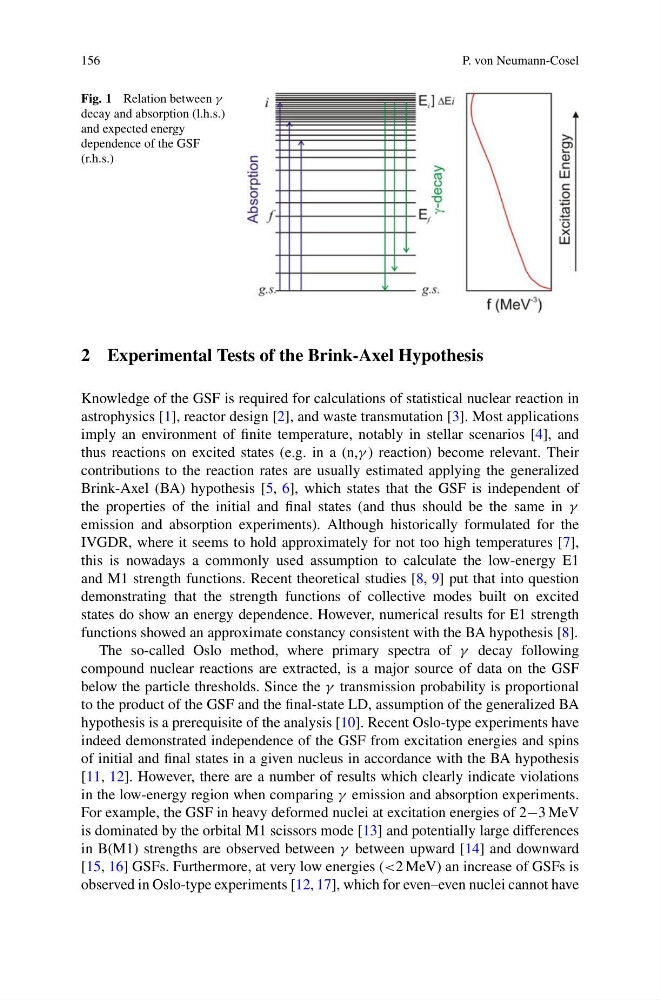
Fig. 1 Relation between γ
decay and absorption (l.h.s.)
and expected energy
dependence of the GSF
(r.h.s.)
2 Experimental Tests of the Brink-Axel Hypothesis
Knowledge of the GSF is required for calculations of statistical nuclear reaction in
astrophysics [1], reactor design [2], and waste transmutation [3]. Most applications
imply an environment of finite temperature, notably in stellar scenarios [4], and
thus reactions on excited states (e.g. in a (n,γ ) reaction) become relevant. Their
contributions to the reaction rates are usually estimated applying the generalized
Brink-Axel (BA) hypothesis [5, 6], which states that the GSF is independent of
the properties of the initial and final states (and thus should be the same in γ
emission and absorption experiments). Although historically formulated for the
IVGDR, where it seems to hold approximately for not too high temperatures [7],
this is nowadays a commonly used assumption to calculate the low-energy E1
and M1 strength functions. Recent theoretical studies [8, 9] put that into question
demonstrating that the strength functions of collective modes built on excited
states do show an energy dependence. However, numerical results for E1 strength
functions showed an approximate constancy consistent with the BA hypothesis [8].
The so-called Oslo method, where primary spectra of γ decay following
compound nuclear reactions are extracted, is a major source of data on the GSF
below the particle thresholds. Since the γ transmission probability is proportional
to the product of the GSF and the final-state LD, assumption of the generalized BA
hypothesis is a prerequisite of the analysis [10]. Recent Oslo-type experiments have
indeed demonstrated independence of the GSF from excitation energies and spins
of initial and final states in a given nucleus in accordance with the BA hypothesis
[11, 12]. However, there are a number of results which clearly indicate violations
in the low-energy region when comparing γ emission and absorption experiments.
For example, the GSF in heavy deformed nuclei at excitation energies of 2−3 MeV
is dominated by the orbital M1 scissors mode [13] and potentially large differences
in B(M1) strengths are observed between γ between upward [14] and downward
[15, 16] GSFs. Furthermore, at very low energies (<2 MeV) an increase of GSFs is
observed in Oslo-type experiments [12, 17], which for even–even nuclei cannot have
P. von Neumann-Cosel
Fig. 1 Relation between γ
decay and absorption (l.h.s.)
and expected energy
dependence of the GSF
(r.h.s.)
2 Experimental Tests of the Brink-Axel Hypothesis
Knowledge of the GSF is required for calculations of statistical nuclear reaction in
astrophysics [1], reactor design [2], and waste transmutation [3]. Most applications
imply an environment of finite temperature, notably in stellar scenarios [4], and
thus reactions on excited states (e.g. in a (n,γ ) reaction) become relevant. Their
contributions to the reaction rates are usually estimated applying the generalized
Brink-Axel (BA) hypothesis [5, 6], which states that the GSF is independent of
the properties of the initial and final states (and thus should be the same in γ
emission and absorption experiments). Although historically formulated for the
IVGDR, where it seems to hold approximately for not too high temperatures [7],
this is nowadays a commonly used assumption to calculate the low-energy E1
and M1 strength functions. Recent theoretical studies [8, 9] put that into question
demonstrating that the strength functions of collective modes built on excited
states do show an energy dependence. However, numerical results for E1 strength
functions showed an approximate constancy consistent with the BA hypothesis [8].
The so-called Oslo method, where primary spectra of γ decay following
compound nuclear reactions are extracted, is a major source of data on the GSF
below the particle thresholds. Since the γ transmission probability is proportional
to the product of the GSF and the final-state LD, assumption of the generalized BA
hypothesis is a prerequisite of the analysis [10]. Recent Oslo-type experiments have
indeed demonstrated independence of the GSF from excitation energies and spins
of initial and final states in a given nucleus in accordance with the BA hypothesis
[11, 12]. However, there are a number of results which clearly indicate violations
in the low-energy region when comparing γ emission and absorption experiments.
For example, the GSF in heavy deformed nuclei at excitation energies of 2−3 MeV
is dominated by the orbital M1 scissors mode [13] and potentially large differences
in B(M1) strengths are observed between γ between upward [14] and downward
[15, 16] GSFs. Furthermore, at very low energies (<2 MeV) an increase of GSFs is
observed in Oslo-type experiments [12, 17], which for even–even nuclei cannot have