

140
S. M. Grimes
J
(2J + 1)ρ(E, J ) = ρ T (E)S(J )
(4)
since each level consists of (2J + 1) degenerate states with spin projections (−J <
J z < J ), where J z is the spin projection on the z-axis.
Bohr and Mottelson [2] discussed in some details the effect of nuclear deformation. In most cases nuclear deformation results in an axially symmetric ellipsoidal
form. This results in two spin cutoff factors. σ is the cutoff factor for rotations
about the symmetry axes (z-axis), while σ ⊥ is the factor for rotations about an
axis perpendicular to a symmetry axis. Bohr and Mottelson conclude that level
density for deformed nucleus will be a factor of σ 2
⊥ larger than would the case for
a corresponding spherical nucleus. A similar result has been obtained by Junghans
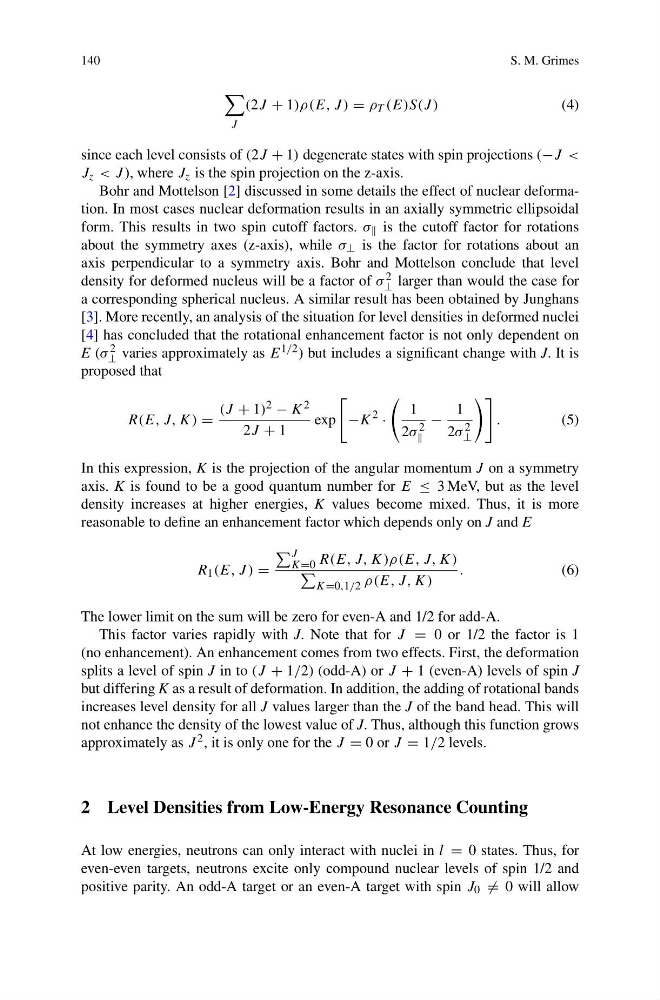
[3]. More recently, an analysis of the situation for level densities in deformed nuclei
[4] has concluded that the rotational enhancement factor is not only dependent on
E (σ 2
⊥ varies approximately as E 1/2 ) but includes a significant change with J. It is
proposed that
R(E, J, K) =
(J + 1) 2 − K 2
2J + 1
exp
−K
2
·
1
2σ 2
−
1
2σ 2
⊥
.
(5)
In this expression, K is the projection of the angular momentum J on a symmetry
axis. K is found to be a good quantum number for E ≤ 3 MeV, but as the level
density increases at higher energies, K values become mixed. Thus, it is more
reasonable to define an enhancement factor which depends only on J and E
R 1 (E, J ) =
J
K=0 R(E, J, K)ρ(E, J, K)
K=0,1/2 ρ(E, J, K)
.
(6)
The lower limit on the sum will be zero for even-A and 1/2 for add-A.
This factor varies rapidly with J. Note that for J = 0 or 1/2 the factor is 1
(no enhancement). An enhancement comes from two effects. First, the deformation
splits a level of spin J in to (J + 1/2) (odd-A) or J + 1 (even-A) levels of spin J
but differing K as a result of deformation. In addition, the adding of rotational bands
increases level density for all J values larger than the J of the band head. This will
not enhance the density of the lowest value of J. Thus, although this function grows
approximately as J 2 , it is only one for the J = 0 or J = 1/2 levels.
2 Level Densities from Low-Energy Resonance Counting
At low energies, neutrons can only interact with nuclei in l = 0 states. Thus, for
even-even targets, neutrons excite only compound nuclear levels of spin 1/2 and
positive parity. An odd-A target or an even-A target with spin J 0 = 0 will allow
S. M. Grimes
J
(2J + 1)ρ(E, J ) = ρ T (E)S(J )
(4)
since each level consists of (2J + 1) degenerate states with spin projections (−J <
J z < J ), where J z is the spin projection on the z-axis.
Bohr and Mottelson [2] discussed in some details the effect of nuclear deformation. In most cases nuclear deformation results in an axially symmetric ellipsoidal
form. This results in two spin cutoff factors. σ is the cutoff factor for rotations
about the symmetry axes (z-axis), while σ ⊥ is the factor for rotations about an
axis perpendicular to a symmetry axis. Bohr and Mottelson conclude that level
density for deformed nucleus will be a factor of σ 2
⊥ larger than would the case for
a corresponding spherical nucleus. A similar result has been obtained by Junghans
[3]. More recently, an analysis of the situation for level densities in deformed nuclei
[4] has concluded that the rotational enhancement factor is not only dependent on
E (σ 2
⊥ varies approximately as E 1/2 ) but includes a significant change with J. It is
proposed that
R(E, J, K) =
(J + 1) 2 − K 2
2J + 1
exp
−K
2
·
1
2σ 2
−
1
2σ 2
⊥
.
(5)
In this expression, K is the projection of the angular momentum J on a symmetry
axis. K is found to be a good quantum number for E ≤ 3 MeV, but as the level
density increases at higher energies, K values become mixed. Thus, it is more
reasonable to define an enhancement factor which depends only on J and E
R 1 (E, J ) =
J
K=0 R(E, J, K)ρ(E, J, K)
K=0,1/2 ρ(E, J, K)
.
(6)
The lower limit on the sum will be zero for even-A and 1/2 for add-A.
This factor varies rapidly with J. Note that for J = 0 or 1/2 the factor is 1
(no enhancement). An enhancement comes from two effects. First, the deformation
splits a level of spin J in to (J + 1/2) (odd-A) or J + 1 (even-A) levels of spin J
but differing K as a result of deformation. In addition, the adding of rotational bands
increases level density for all J values larger than the J of the band head. This will
not enhance the density of the lowest value of J. Thus, although this function grows
approximately as J 2 , it is only one for the J = 0 or J = 1/2 levels.
2 Level Densities from Low-Energy Resonance Counting
At low energies, neutrons can only interact with nuclei in l = 0 states. Thus, for
even-even targets, neutrons excite only compound nuclear levels of spin 1/2 and
positive parity. An odd-A target or an even-A target with spin J 0 = 0 will allow