

Level Densities and Spectra
137
10
-3
10
-2
0
2
4
6
8
10
12
14
56 Fe(n,nx)
E i =14.1 MeV
θ=150°
d
2
σ/dE/dθ (b/MeV/sr)
Neutron Outgoing Energy (MeV)
Yabuta, 1988
Matsuyama, 1992
Takahashi, 1992
Gilbert-Cameron
HFB (fitted
56 Mn LD)
HFB (Smoothed
56 Fe LD)
10
-5
10
-4
10
-3
10
-2
0
1
2
3
4
5
6
7
8
9
56
Fe(n,nx)
E i =8.17 MeV
θ=150°
Neutron Outgoing Energy (MeV)
Xichao Ruan, 2009
Gilbert-Cameron
HFB (fitted
56
Mn LD)
HFB (Smoothed
56
Fe LD)
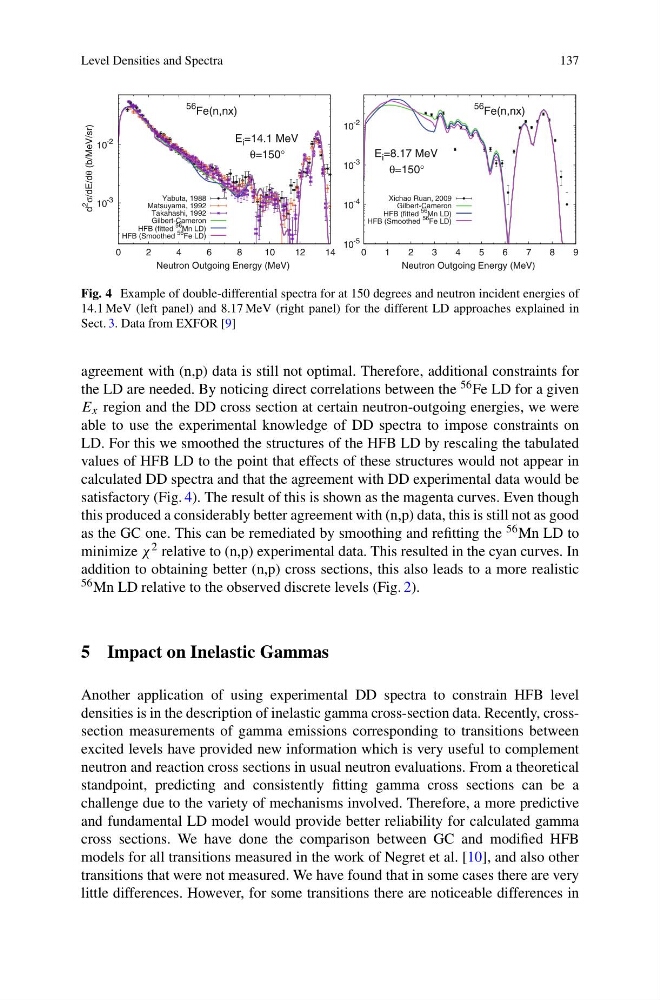
Fig. 4 Example of double-differential spectra for at 150 degrees and neutron incident energies of
14.1 MeV (left panel) and 8.17 MeV (right panel) for the different LD approaches explained in
Sect. 3. Data from EXFOR [9]
agreement with (n,p) data is still not optimal. Therefore, additional constraints for
the LD are needed. By noticing direct correlations between the 56 Fe LD for a given
E x region and the DD cross section at certain neutron-outgoing energies, we were
able to use the experimental knowledge of DD spectra to impose constraints on
LD. For this we smoothed the structures of the HFB LD by rescaling the tabulated
values of HFB LD to the point that effects of these structures would not appear in
calculated DD spectra and that the agreement with DD experimental data would be
satisfactory (Fig. 4). The result of this is shown as the magenta curves. Even though
this produced a considerably better agreement with (n,p) data, this is still not as good
as the GC one. This can be remediated by smoothing and refitting the 56 Mn LD to
minimize χ 2 relative to (n,p) experimental data. This resulted in the cyan curves. In
addition to obtaining better (n,p) cross sections, this also leads to a more realistic
56 Mn LD relative to the observed discrete levels (Fig. 2).
5 Impact on Inelastic Gammas
Another application of using experimental DD spectra to constrain HFB level
densities is in the description of inelastic gamma cross-section data. Recently, crosssection measurements of gamma emissions corresponding to transitions between
excited levels have provided new information which is very useful to complement
neutron and reaction cross sections in usual neutron evaluations. From a theoretical
standpoint, predicting and consistently fitting gamma cross sections can be a
challenge due to the variety of mechanisms involved. Therefore, a more predictive
and fundamental LD model would provide better reliability for calculated gamma
cross sections. We have done the comparison between GC and modified HFB
models for all transitions measured in the work of Negret et al. [10], and also other
transitions that were not measured. We have found that in some cases there are very
little differences. However, for some transitions there are noticeable differences in
137
10
-3
10
-2
0
2
4
6
8
10
12
14
56 Fe(n,nx)
E i =14.1 MeV
θ=150°
d
2
σ/dE/dθ (b/MeV/sr)
Neutron Outgoing Energy (MeV)
Yabuta, 1988
Matsuyama, 1992
Takahashi, 1992
Gilbert-Cameron
HFB (fitted
56 Mn LD)
HFB (Smoothed
56 Fe LD)
10
-5
10
-4
10
-3
10
-2
0
1
2
3
4
5
6
7
8
9
56
Fe(n,nx)
E i =8.17 MeV
θ=150°
Neutron Outgoing Energy (MeV)
Xichao Ruan, 2009
Gilbert-Cameron
HFB (fitted
56
Mn LD)
HFB (Smoothed
56
Fe LD)
Fig. 4 Example of double-differential spectra for at 150 degrees and neutron incident energies of
14.1 MeV (left panel) and 8.17 MeV (right panel) for the different LD approaches explained in
Sect. 3. Data from EXFOR [9]
agreement with (n,p) data is still not optimal. Therefore, additional constraints for
the LD are needed. By noticing direct correlations between the 56 Fe LD for a given
E x region and the DD cross section at certain neutron-outgoing energies, we were
able to use the experimental knowledge of DD spectra to impose constraints on
LD. For this we smoothed the structures of the HFB LD by rescaling the tabulated
values of HFB LD to the point that effects of these structures would not appear in
calculated DD spectra and that the agreement with DD experimental data would be
satisfactory (Fig. 4). The result of this is shown as the magenta curves. Even though
this produced a considerably better agreement with (n,p) data, this is still not as good
as the GC one. This can be remediated by smoothing and refitting the 56 Mn LD to
minimize χ 2 relative to (n,p) experimental data. This resulted in the cyan curves. In
addition to obtaining better (n,p) cross sections, this also leads to a more realistic
56 Mn LD relative to the observed discrete levels (Fig. 2).
5 Impact on Inelastic Gammas
Another application of using experimental DD spectra to constrain HFB level
densities is in the description of inelastic gamma cross-section data. Recently, crosssection measurements of gamma emissions corresponding to transitions between
excited levels have provided new information which is very useful to complement
neutron and reaction cross sections in usual neutron evaluations. From a theoretical
standpoint, predicting and consistently fitting gamma cross sections can be a
challenge due to the variety of mechanisms involved. Therefore, a more predictive
and fundamental LD model would provide better reliability for calculated gamma
cross sections. We have done the comparison between GC and modified HFB
models for all transitions measured in the work of Negret et al. [10], and also other
transitions that were not measured. We have found that in some cases there are very
little differences. However, for some transitions there are noticeable differences in