

Level Densities and Spectra
135
schemes obtained from constrained axially symmetric Hartree-Fock-Bogoliubov
method (HFBM) based on the BSk14 Skyrme force to construct incoherent particlehole state densities as functions of the excitation energy E x , the spin projection
M (on the intrinsic symmetry axis of the nucleus), and the parity π . Collective
effects are incorporated through a boson partition function providing vibrational
state densities dependent on multipolar phonon energies.
3 Implementing Constraints from Neutron Differential
Spectra Data
We adopted the n + 56 Fe reaction as our test case to identify the impact of details
of LD in the cross sections, using the same parametrization employed in the fastregion evaluation of 56 Fe present in the ENDF/B-VIII.0 evaluation [6, 7] as part
of the CIELO project [8], ensuring that all calculated cross sections are mutually
consistent and in good agreement with experimental data. We performed reaction
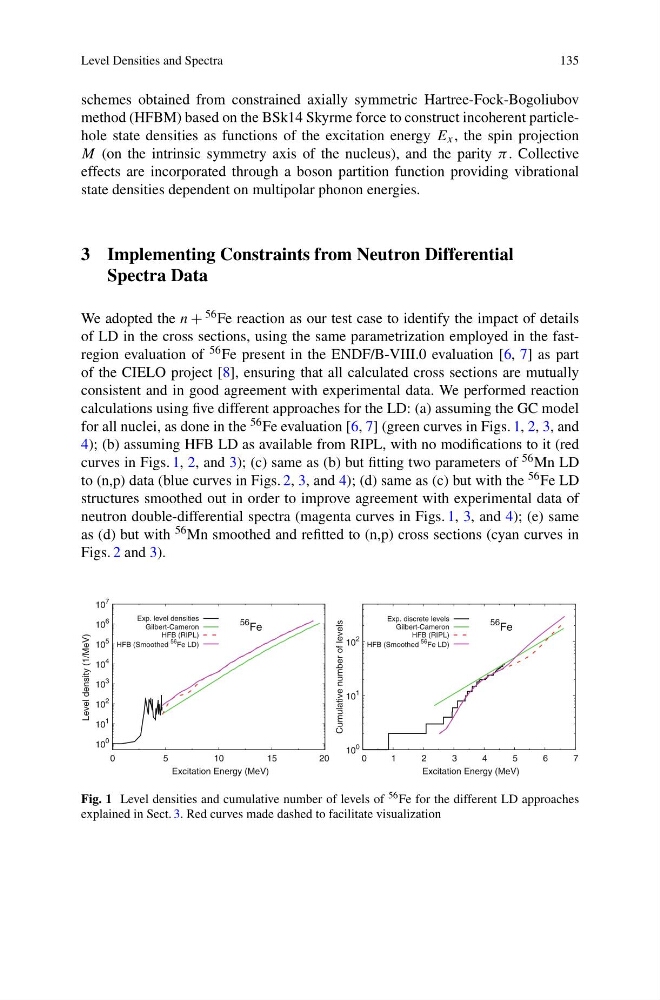
calculations using five different approaches for the LD: (a) assuming the GC model
for all nuclei, as done in the 56 Fe evaluation [6, 7] (green curves in Figs. 1, 2, 3, and
4); (b) assuming HFB LD as available from RIPL, with no modifications to it (red
curves in Figs. 1, 2, and 3); (c) same as (b) but fitting two parameters of 56 Mn LD
to (n,p) data (blue curves in Figs. 2, 3, and 4); (d) same as (c) but with the 56 Fe LD
structures smoothed out in order to improve agreement with experimental data of
neutron double-differential spectra (magenta curves in Figs. 1, 3, and 4); (e) same
as (d) but with 56 Mn smoothed and refitted to (n,p) cross sections (cyan curves in
Figs. 2 and 3).
10
0
10
1
10
2
10
3
10
4
10
5
10
6
10
7
0
5
10
15
20
56
Fe
Level density (1/MeV)
Excitation Energy (MeV)
Exp. level densities
Gilbert-Cameron
HFB (RIPL)
HFB (Smoothed
56
Fe LD)
10
0
10
1
10
2
0
1
2
3
4
5
6
7
56
Fe
Cumulative number of levels
Excitation Energy (MeV)
Exp. discrete levels
Gilbert-Cameron
HFB (RIPL)
HFB (Smoothed
56 Fe LD)
Fig. 1 Level densities and cumulative number of levels of 56 Fe for the different LD approaches
explained in Sect. 3. Red curves made dashed to facilitate visualization
135
schemes obtained from constrained axially symmetric Hartree-Fock-Bogoliubov
method (HFBM) based on the BSk14 Skyrme force to construct incoherent particlehole state densities as functions of the excitation energy E x , the spin projection
M (on the intrinsic symmetry axis of the nucleus), and the parity π . Collective
effects are incorporated through a boson partition function providing vibrational
state densities dependent on multipolar phonon energies.
3 Implementing Constraints from Neutron Differential
Spectra Data
We adopted the n + 56 Fe reaction as our test case to identify the impact of details
of LD in the cross sections, using the same parametrization employed in the fastregion evaluation of 56 Fe present in the ENDF/B-VIII.0 evaluation [6, 7] as part
of the CIELO project [8], ensuring that all calculated cross sections are mutually
consistent and in good agreement with experimental data. We performed reaction
calculations using five different approaches for the LD: (a) assuming the GC model
for all nuclei, as done in the 56 Fe evaluation [6, 7] (green curves in Figs. 1, 2, 3, and
4); (b) assuming HFB LD as available from RIPL, with no modifications to it (red
curves in Figs. 1, 2, and 3); (c) same as (b) but fitting two parameters of 56 Mn LD
to (n,p) data (blue curves in Figs. 2, 3, and 4); (d) same as (c) but with the 56 Fe LD
structures smoothed out in order to improve agreement with experimental data of
neutron double-differential spectra (magenta curves in Figs. 1, 3, and 4); (e) same
as (d) but with 56 Mn smoothed and refitted to (n,p) cross sections (cyan curves in
Figs. 2 and 3).
10
0
10
1
10
2
10
3
10
4
10
5
10
6
10
7
0
5
10
15
20
56
Fe
Level density (1/MeV)
Excitation Energy (MeV)
Exp. level densities
Gilbert-Cameron
HFB (RIPL)
HFB (Smoothed
56
Fe LD)
10
0
10
1
10
2
0
1
2
3
4
5
6
7
56
Fe
Cumulative number of levels
Excitation Energy (MeV)
Exp. discrete levels
Gilbert-Cameron
HFB (RIPL)
HFB (Smoothed
56 Fe LD)
Fig. 1 Level densities and cumulative number of levels of 56 Fe for the different LD approaches
explained in Sect. 3. Red curves made dashed to facilitate visualization