

3 Dynamics of Spray Granulation in Continuously …
87
3.5.3 Large-Scale Simulation Results
Simulations were carried out for three different weir configurations and the base
case for setups with 3 mm particles of mono-disperse distributions in the two-staged
system. The overall goal of this study was to analyze the impact of weir designs on
the microscopic transport behavior of the particles in multi-chamber systems. After
an initializing time of 10 s for reaching stationary conditions regarding the supply
and discharge of the solids material inside the system the evaluation procedure was
started.
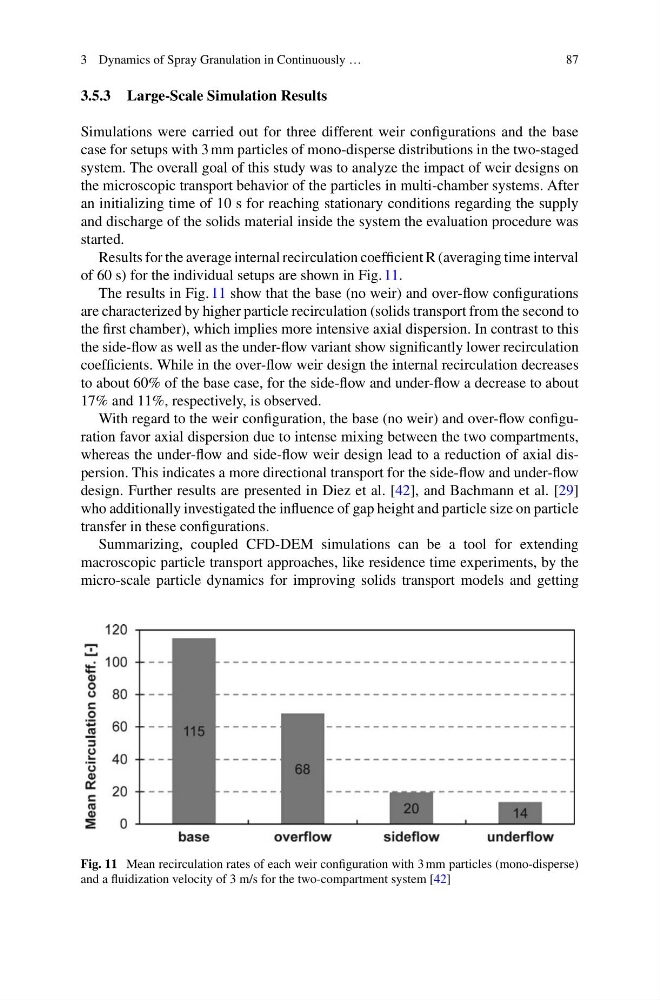
Results for the average internal recirculation coefficient R (averaging time interval
of 60 s) for the individual setups are shown in Fig. 11.
The results in Fig. 11 show that the base (no weir) and over-flow configurations
are characterized by higher particle recirculation (solids transport from the second to
the first chamber), which implies more intensive axial dispersion. In contrast to this
the side-flow as well as the under-flow variant show significantly lower recirculation
coefficients. While in the over-flow weir design the internal recirculation decreases
to about 60% of the base case, for the side-flow and under-flow a decrease to about
17% and 11%, respectively, is observed.
With regard to the weir configuration, the base (no weir) and over-flow configuration favor axial dispersion due to intense mixing between the two compartments,
whereas the under-flow and side-flow weir design lead to a reduction of axial dispersion. This indicates a more directional transport for the side-flow and under-flow
design. Further results are presented in Diez et al. [42], and Bachmann et al. [29]
who additionally investigated the influence of gap height and particle size on particle
transfer in these configurations.
Summarizing, coupled CFD-DEM simulations can be a tool for extending
macroscopic particle transport approaches, like residence time experiments, by the
micro-scale particle dynamics for improving solids transport models and getting
Fig. 11 Mean recirculation rates of each weir configuration with 3 mm particles (mono-disperse)
and a fluidization velocity of 3 m/s for the two-compartment system [42]
87
3.5.3 Large-Scale Simulation Results
Simulations were carried out for three different weir configurations and the base
case for setups with 3 mm particles of mono-disperse distributions in the two-staged
system. The overall goal of this study was to analyze the impact of weir designs on
the microscopic transport behavior of the particles in multi-chamber systems. After
an initializing time of 10 s for reaching stationary conditions regarding the supply
and discharge of the solids material inside the system the evaluation procedure was
started.
Results for the average internal recirculation coefficient R (averaging time interval
of 60 s) for the individual setups are shown in Fig. 11.
The results in Fig. 11 show that the base (no weir) and over-flow configurations
are characterized by higher particle recirculation (solids transport from the second to
the first chamber), which implies more intensive axial dispersion. In contrast to this
the side-flow as well as the under-flow variant show significantly lower recirculation
coefficients. While in the over-flow weir design the internal recirculation decreases
to about 60% of the base case, for the side-flow and under-flow a decrease to about
17% and 11%, respectively, is observed.
With regard to the weir configuration, the base (no weir) and over-flow configuration favor axial dispersion due to intense mixing between the two compartments,
whereas the under-flow and side-flow weir design lead to a reduction of axial dispersion. This indicates a more directional transport for the side-flow and under-flow
design. Further results are presented in Diez et al. [42], and Bachmann et al. [29]
who additionally investigated the influence of gap height and particle size on particle
transfer in these configurations.
Summarizing, coupled CFD-DEM simulations can be a tool for extending
macroscopic particle transport approaches, like residence time experiments, by the
micro-scale particle dynamics for improving solids transport models and getting
Fig. 11 Mean recirculation rates of each weir configuration with 3 mm particles (mono-disperse)
and a fluidization velocity of 3 m/s for the two-compartment system [42]