

17 A Framework for Dynamic Simulation of Interconnected …
595
1. all parameters of tear streams in the partition are initialized;
2. units within the partition are calculated sequentially;
3. new values of tear streams’ parameters are obtained;
4. the computed and initial values are compared to check convergence;
5. based on obtained values, new initials for tear streams are calculated;
6. calculations are repeated from step 2.
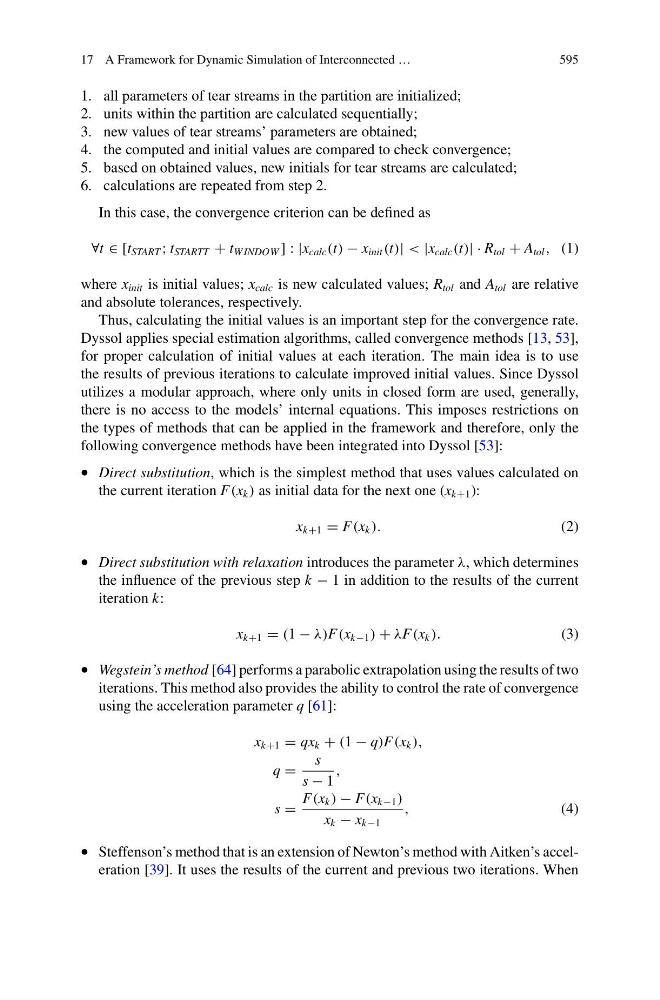
In this case, the convergence criterion can be defined as
∀t ∈ [t START ; t STARTT + t W INDOW ] : |x calc (t) − x init (t)| < |x calc (t)| · R tol + A tol , (1)
where x init is initial values; x calc is new calculated values; R tol and A tol are relative
and absolute tolerances, respectively.
Thus, calculating the initial values is an important step for the convergence rate.
Dyssol applies special estimation algorithms, called convergence methods [13, 53],
for proper calculation of initial values at each iteration. The main idea is to use
the results of previous iterations to calculate improved initial values. Since Dyssol
utilizes a modular approach, where only units in closed form are used, generally,
there is no access to the models’ internal equations. This imposes restrictions on
the types of methods that can be applied in the framework and therefore, only the
following convergence methods have been integrated into Dyssol [53]:
• Direct substitution, which is the simplest method that uses values calculated on
the current iteration F(x k ) as initial data for the next one (x k+1 ):
x k+1 = F(x k ).
(2)
• Direct substitution with relaxation introduces the parameter λ, which determines
the influence of the previous step k − 1 in addition to the results of the current
iteration k:
x k+1 = (1 − λ)F(x k−1 ) + λF(x k ).
(3)
• Wegstein’s method [64] performs a parabolic extrapolation using the results of two
iterations. This method also provides the ability to control the rate of convergence
using the acceleration parameter q [61]:
x k+1 = qx k + (1 − q)F(x k ),
q =
s
s − 1
,
s =
F(x k ) − F(x k−1 )
x k − x k−1
,
(4)
• Steffenson’s method that is an extension of Newton’s method with Aitken’s acceleration [39]. It uses the results of the current and previous two iterations. When
595
1. all parameters of tear streams in the partition are initialized;
2. units within the partition are calculated sequentially;
3. new values of tear streams’ parameters are obtained;
4. the computed and initial values are compared to check convergence;
5. based on obtained values, new initials for tear streams are calculated;
6. calculations are repeated from step 2.
In this case, the convergence criterion can be defined as
∀t ∈ [t START ; t STARTT + t W INDOW ] : |x calc (t) − x init (t)| < |x calc (t)| · R tol + A tol , (1)
where x init is initial values; x calc is new calculated values; R tol and A tol are relative
and absolute tolerances, respectively.
Thus, calculating the initial values is an important step for the convergence rate.
Dyssol applies special estimation algorithms, called convergence methods [13, 53],
for proper calculation of initial values at each iteration. The main idea is to use
the results of previous iterations to calculate improved initial values. Since Dyssol
utilizes a modular approach, where only units in closed form are used, generally,
there is no access to the models’ internal equations. This imposes restrictions on
the types of methods that can be applied in the framework and therefore, only the
following convergence methods have been integrated into Dyssol [53]:
• Direct substitution, which is the simplest method that uses values calculated on
the current iteration F(x k ) as initial data for the next one (x k+1 ):
x k+1 = F(x k ).
(2)
• Direct substitution with relaxation introduces the parameter λ, which determines
the influence of the previous step k − 1 in addition to the results of the current
iteration k:
x k+1 = (1 − λ)F(x k−1 ) + λF(x k ).
(3)
• Wegstein’s method [64] performs a parabolic extrapolation using the results of two
iterations. This method also provides the ability to control the rate of convergence
using the acceleration parameter q [61]:
x k+1 = qx k + (1 − q)F(x k ),
q =
s
s − 1
,
s =
F(x k ) − F(x k−1 )
x k − x k−1
,
(4)
• Steffenson’s method that is an extension of Newton’s method with Aitken’s acceleration [39]. It uses the results of the current and previous two iterations. When