

586
V. Skorych et al.
• allow simultaneous description of solid, liquid and vapor phases;
• provide a correct and convenient description of multidimensional distributed
properties of solid phase materials;
• enable modelling of solids processing units within a flowsheet simulation
environment;
• provide the ability to describe and track time-dependent changes in material
parameters to allow dynamic simulations.
Based on these requirements, the structure of the material stream object, which
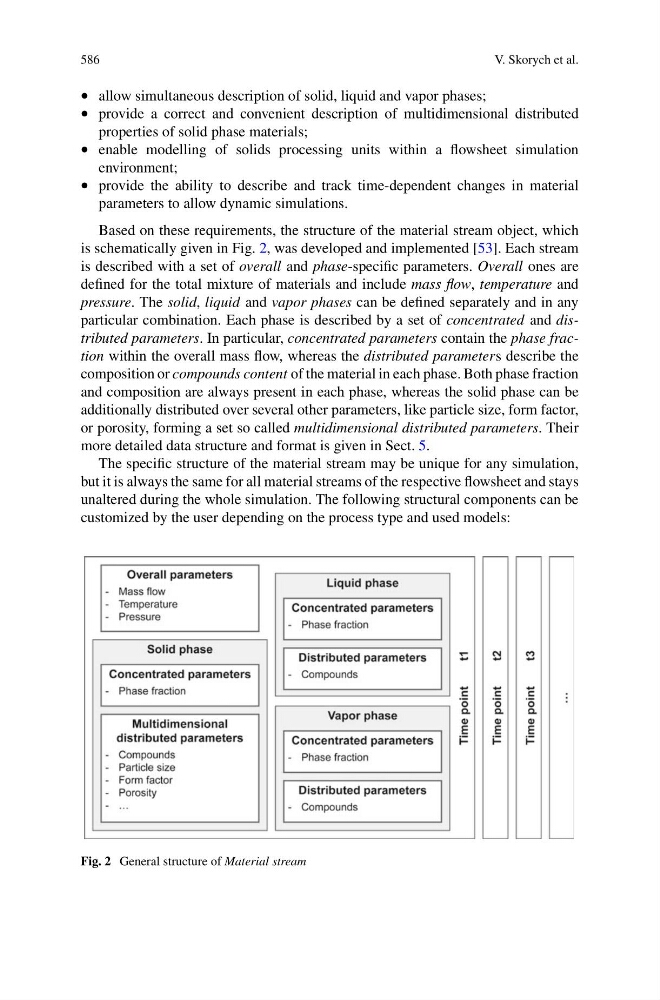
is schematically given in Fig. 2, was developed and implemented [53]. Each stream
is described with a set of overall and phase-specific parameters. Overall ones are
defined for the total mixture of materials and include mass flow, temperature and
pressure. The solid, liquid and vapor phases can be defined separately and in any
particular combination. Each phase is described by a set of concentrated and distributed parameters. In particular, concentrated parameters contain the phase fraction within the overall mass flow, whereas the distributed parameters describe the
composition or compounds content of the material in each phase. Both phase fraction
and composition are always present in each phase, whereas the solid phase can be
additionally distributed over several other parameters, like particle size, form factor,
or porosity, forming a set so called multidimensional distributed parameters. Their
more detailed data structure and format is given in Sect. 5.
The specific structure of the material stream may be unique for any simulation,
but it is always the same for all material streams of the respective flowsheet and stays
unaltered during the whole simulation. The following structural components can be
customized by the user depending on the process type and used models:
Fig. 2 General structure of Material stream
V. Skorych et al.
• allow simultaneous description of solid, liquid and vapor phases;
• provide a correct and convenient description of multidimensional distributed
properties of solid phase materials;
• enable modelling of solids processing units within a flowsheet simulation
environment;
• provide the ability to describe and track time-dependent changes in material
parameters to allow dynamic simulations.
Based on these requirements, the structure of the material stream object, which
is schematically given in Fig. 2, was developed and implemented [53]. Each stream
is described with a set of overall and phase-specific parameters. Overall ones are
defined for the total mixture of materials and include mass flow, temperature and
pressure. The solid, liquid and vapor phases can be defined separately and in any
particular combination. Each phase is described by a set of concentrated and distributed parameters. In particular, concentrated parameters contain the phase fraction within the overall mass flow, whereas the distributed parameters describe the
composition or compounds content of the material in each phase. Both phase fraction
and composition are always present in each phase, whereas the solid phase can be
additionally distributed over several other parameters, like particle size, form factor,
or porosity, forming a set so called multidimensional distributed parameters. Their
more detailed data structure and format is given in Sect. 5.
The specific structure of the material stream may be unique for any simulation,
but it is always the same for all material streams of the respective flowsheet and stays
unaltered during the whole simulation. The following structural components can be
customized by the user depending on the process type and used models:
Fig. 2 General structure of Material stream