

16 Modeling, Simulation and Optimization of Process Chains
569
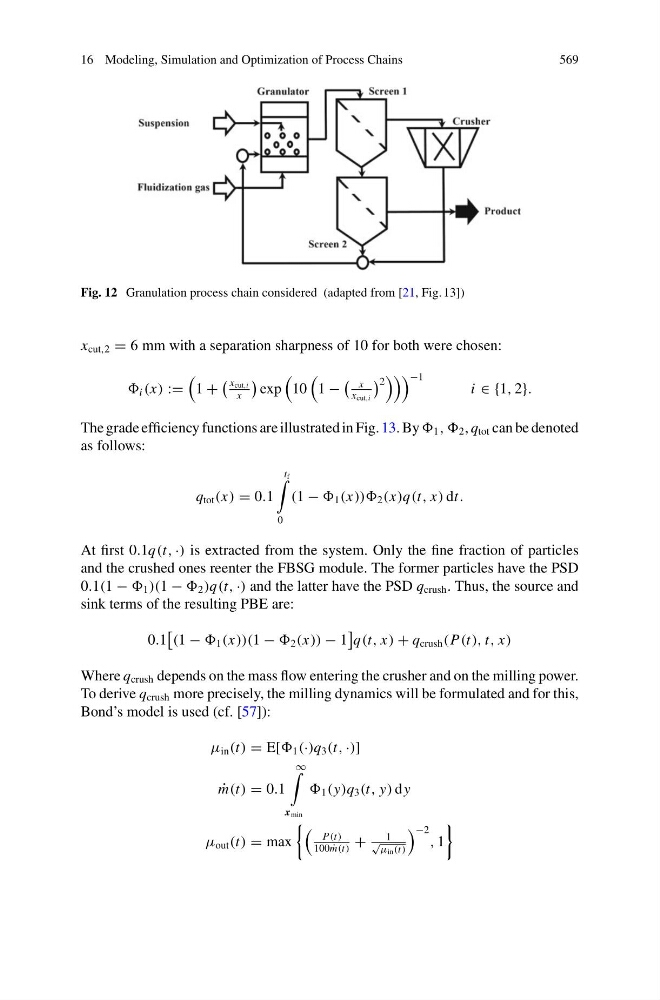
Fig. 12 Granulation process chain considered (adapted from [21, Fig. 13])
x cut,2 = 6 mm with a separation sharpness of 10 for both were chosen:
i (x) :=
1 +
x cut,i
x
exp
10
1 −
x
x cut,i
2
−1
i ∈ {1, 2}.
The grade efficiency functions are illustrated in Fig. 13. By 1 , , 2 , q tot can be denoted
as follows:
q tot (x) = 0.1
t f
0
(1 − 1 (x))) 2 (x)q(t, x) dt.
At first 0.1q(t, ·) is extracted from the system. Only the fine fraction of particles
and the crushed ones reenter the FBSG module. The former particles have the PSD
0.1(1 − 1 )(1 − 2 )q(t, ·) and the latter have the PSD q crush . Thus, the source and
sink terms of the resulting PBE are:
0.1
(1 − 1 (x))(1 − 2 (x)) − 1
q(t, x) + q crush (P(t), t, x)
Where q crush depends on the mass flow entering the crusher and on the milling power.
To derive q crush more precisely, the milling dynamics will be formulated and for this,
Bond’s model is used (cf. [57]):
μ in (t) = E[ 1 (·)q 3 (t, ·)]
˙
m(t) = 0.1
∞
x min
1 (y)q 3 (t, y) dy
μ out (t) = max
P(t)
100 ˙
m(t)
+
1
√
μ in (t)
−2 , 1
569
Fig. 12 Granulation process chain considered (adapted from [21, Fig. 13])
x cut,2 = 6 mm with a separation sharpness of 10 for both were chosen:
i (x) :=
1 +
x cut,i
x
exp
10
1 −
x
x cut,i
2
−1
i ∈ {1, 2}.
The grade efficiency functions are illustrated in Fig. 13. By 1 , , 2 , q tot can be denoted
as follows:
q tot (x) = 0.1
t f
0
(1 − 1 (x))) 2 (x)q(t, x) dt.
At first 0.1q(t, ·) is extracted from the system. Only the fine fraction of particles
and the crushed ones reenter the FBSG module. The former particles have the PSD
0.1(1 − 1 )(1 − 2 )q(t, ·) and the latter have the PSD q crush . Thus, the source and
sink terms of the resulting PBE are:
0.1
(1 − 1 (x))(1 − 2 (x)) − 1
q(t, x) + q crush (P(t), t, x)
Where q crush depends on the mass flow entering the crusher and on the milling power.
To derive q crush more precisely, the milling dynamics will be formulated and for this,
Bond’s model is used (cf. [57]):
μ in (t) = E[ 1 (·)q 3 (t, ·)]
˙
m(t) = 0.1
∞
x min
1 (y)q 3 (t, y) dy
μ out (t) = max
P(t)
100 ˙
m(t)
+
1
√
μ in (t)
−2 , 1