

16 Modeling, Simulation and Optimization of Process Chains
551
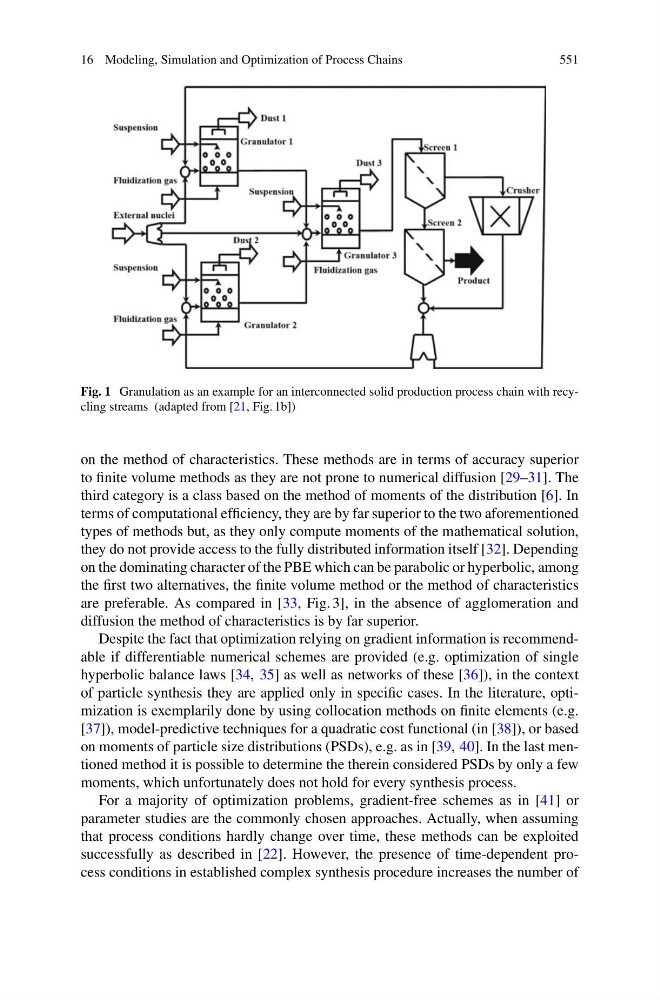
Fig. 1 Granulation as an example for an interconnected solid production process chain with recycling streams (adapted from [21, Fig. 1b])
on the method of characteristics. These methods are in terms of accuracy superior
to finite volume methods as they are not prone to numerical diffusion [29–31]. The
third category is a class based on the method of moments of the distribution [6]. In
terms of computational efficiency, they are by far superior to the two aforementioned
types of methods but, as they only compute moments of the mathematical solution,
they do not provide access to the fully distributed information itself [32]. Depending
on the dominating character of the PBE which can be parabolic or hyperbolic, among
the first two alternatives, the finite volume method or the method of characteristics
are preferable. As compared in [33, Fig. 3], in the absence of agglomeration and
diffusion the method of characteristics is by far superior.
Despite the fact that optimization relying on gradient information is recommendable if differentiable numerical schemes are provided (e.g. optimization of single
hyperbolic balance laws [34, 35] as well as networks of these [36]), in the context
of particle synthesis they are applied only in specific cases. In the literature, optimization is exemplarily done by using collocation methods on finite elements (e.g.
[37]), model-predictive techniques for a quadratic cost functional (in [38]), or based
on moments of particle size distributions (PSDs), e.g. as in [39, 40]. In the last mentioned method it is possible to determine the therein considered PSDs by only a few
moments, which unfortunately does not hold for every synthesis process.
For a majority of optimization problems, gradient-free schemes as in [41] or
parameter studies are the commonly chosen approaches. Actually, when assuming
that process conditions hardly change over time, these methods can be exploited
successfully as described in [22]. However, the presence of time-dependent process conditions in established complex synthesis procedure increases the number of
551
Fig. 1 Granulation as an example for an interconnected solid production process chain with recycling streams (adapted from [21, Fig. 1b])
on the method of characteristics. These methods are in terms of accuracy superior
to finite volume methods as they are not prone to numerical diffusion [29–31]. The
third category is a class based on the method of moments of the distribution [6]. In
terms of computational efficiency, they are by far superior to the two aforementioned
types of methods but, as they only compute moments of the mathematical solution,
they do not provide access to the fully distributed information itself [32]. Depending
on the dominating character of the PBE which can be parabolic or hyperbolic, among
the first two alternatives, the finite volume method or the method of characteristics
are preferable. As compared in [33, Fig. 3], in the absence of agglomeration and
diffusion the method of characteristics is by far superior.
Despite the fact that optimization relying on gradient information is recommendable if differentiable numerical schemes are provided (e.g. optimization of single
hyperbolic balance laws [34, 35] as well as networks of these [36]), in the context
of particle synthesis they are applied only in specific cases. In the literature, optimization is exemplarily done by using collocation methods on finite elements (e.g.
[37]), model-predictive techniques for a quadratic cost functional (in [38]), or based
on moments of particle size distributions (PSDs), e.g. as in [39, 40]. In the last mentioned method it is possible to determine the therein considered PSDs by only a few
moments, which unfortunately does not hold for every synthesis process.
For a majority of optimization problems, gradient-free schemes as in [41] or
parameter studies are the commonly chosen approaches. Actually, when assuming
that process conditions hardly change over time, these methods can be exploited
successfully as described in [22]. However, the presence of time-dependent process conditions in established complex synthesis procedure increases the number of