

48
L. Lindmüller et al.
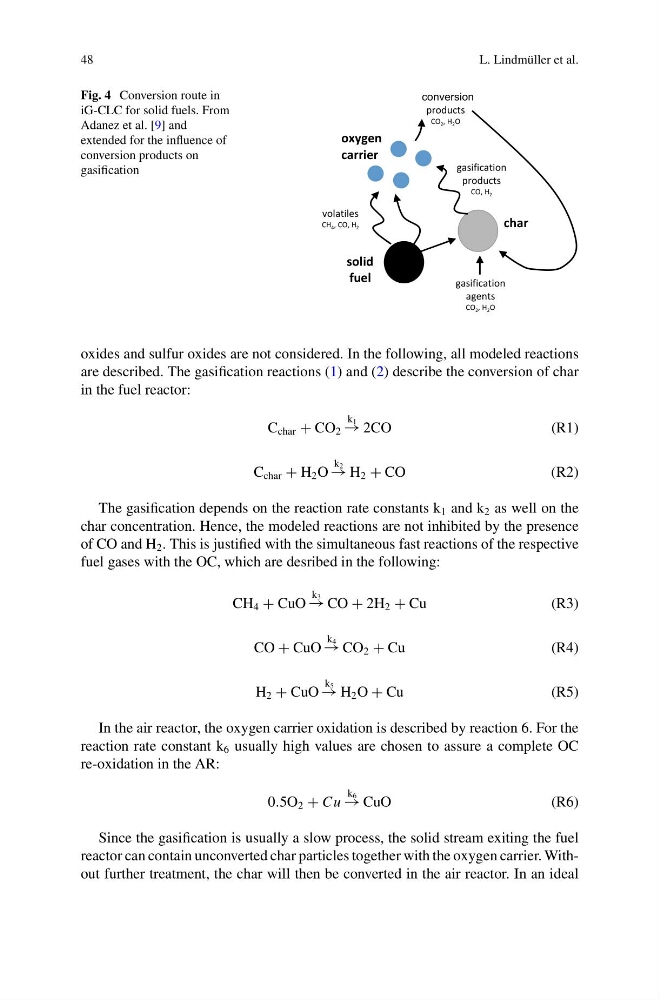
Fig. 4 Conversion route in
iG-CLC for solid fuels. From
Adanez et al. [9] and
extended for the influence of
conversion products on
gasification
oxygen
carrier
volatiles
CH 4 , CO, H 2
gasification
products
CO, H 2
solid
fuel
char
conversion
products
CO 2 , H 2 O
gasification
agents
CO 2 , H 2 O
oxides and sulfur oxides are not considered. In the following, all modeled reactions
are described. The gasification reactions (1) and (2) describe the conversion of char
in the fuel reactor:
C char + CO 2
k 1
→ 2CO
(R1)
C char + H 2 O
k 2
→ H 2 + CO
(R2)
The gasification depends on the reaction rate constants k 1 and k 2 as well on the
char concentration. Hence, the modeled reactions are not inhibited by the presence
of CO and H 2 . This is justified with the simultaneous fast reactions of the respective
fuel gases with the OC, which are desribed in the following:
CH 4 + CuO
k 3
→ CO + 2H 2 + Cu
(R3)
CO + CuO
k 4
→ CO 2 + Cu
(R4)
H 2 + CuO
k 5
→ H 2 O + Cu
(R5)
In the air reactor, the oxygen carrier oxidation is described by reaction 6. For the
reaction rate constant k 6 usually high values are chosen to assure a complete OC
re-oxidation in the AR:
0.5O 2 + Cu
k 6
→ CuO
(R6)
Since the gasification is usually a slow process, the solid stream exiting the fuel
reactor can contain unconverted char particles together with the oxygen carrier. Without further treatment, the char will then be converted in the air reactor. In an ideal
L. Lindmüller et al.
Fig. 4 Conversion route in
iG-CLC for solid fuels. From
Adanez et al. [9] and
extended for the influence of
conversion products on
gasification
oxygen
carrier
volatiles
CH 4 , CO, H 2
gasification
products
CO, H 2
solid
fuel
char
conversion
products
CO 2 , H 2 O
gasification
agents
CO 2 , H 2 O
oxides and sulfur oxides are not considered. In the following, all modeled reactions
are described. The gasification reactions (1) and (2) describe the conversion of char
in the fuel reactor:
C char + CO 2
k 1
→ 2CO
(R1)
C char + H 2 O
k 2
→ H 2 + CO
(R2)
The gasification depends on the reaction rate constants k 1 and k 2 as well on the
char concentration. Hence, the modeled reactions are not inhibited by the presence
of CO and H 2 . This is justified with the simultaneous fast reactions of the respective
fuel gases with the OC, which are desribed in the following:
CH 4 + CuO
k 3
→ CO + 2H 2 + Cu
(R3)
CO + CuO
k 4
→ CO 2 + Cu
(R4)
H 2 + CuO
k 5
→ H 2 O + Cu
(R5)
In the air reactor, the oxygen carrier oxidation is described by reaction 6. For the
reaction rate constant k 6 usually high values are chosen to assure a complete OC
re-oxidation in the AR:
0.5O 2 + Cu
k 6
→ CuO
(R6)
Since the gasification is usually a slow process, the solid stream exiting the fuel
reactor can contain unconverted char particles together with the oxygen carrier. Without further treatment, the char will then be converted in the air reactor. In an ideal