

532
G. Kotalczyk and F. E. Kruis
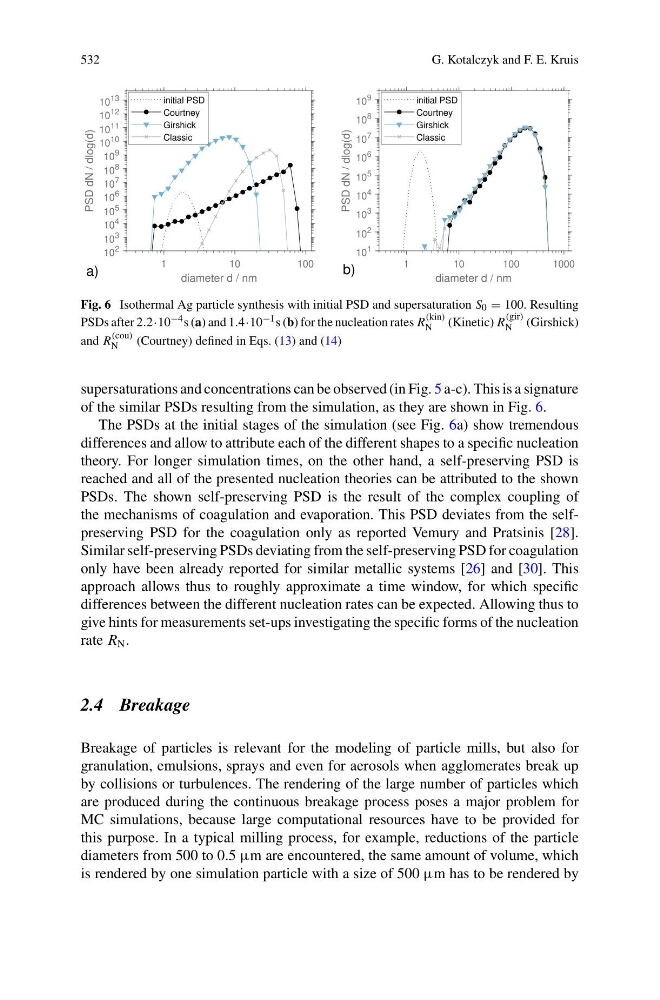
Fig. 6 Isothermal Ag particle synthesis with initial PSD and supersaturation S 0 = 100. Resulting
PSDs after 2.2·10 −4 s (a) and 1.4·10 −1 s (b) for the nucleation rates R
(kin)
N
(Kinetic) R
(gir)
N (Girshick)
and R
(cou)
N
(Courtney) defined in Eqs. (13) and (14)
supersaturations and concentrations can be observed (in Fig. 5 a-c). This is a signature
of the similar PSDs resulting from the simulation, as they are shown in Fig. 6.
The PSDs at the initial stages of the simulation (see Fig. 6a) show tremendous
differences and allow to attribute each of the different shapes to a specific nucleation
theory. For longer simulation times, on the other hand, a self-preserving PSD is
reached and all of the presented nucleation theories can be attributed to the shown
PSDs. The shown self-preserving PSD is the result of the complex coupling of
the mechanisms of coagulation and evaporation. This PSD deviates from the selfpreserving PSD for the coagulation only as reported Vemury and Pratsinis [28].
Similar self-preserving PSDs deviating from the self-preserving PSD for coagulation
only have been already reported for similar metallic systems [26] and [30]. This
approach allows thus to roughly approximate a time window, for which specific
differences between the different nucleation rates can be expected. Allowing thus to
give hints for measurements set-ups investigating the specific forms of the nucleation
rate R N .
2.4 Breakage
Breakage of particles is relevant for the modeling of particle mills, but also for
granulation, emulsions, sprays and even for aerosols when agglomerates break up
by collisions or turbulences. The rendering of the large number of particles which
are produced during the continuous breakage process poses a major problem for
MC simulations, because large computational resources have to be provided for
this purpose. In a typical milling process, for example, reductions of the particle
diameters from 500 to 0.5 μm are encountered, the same amount of volume, which
is rendered by one simulation particle with a size of 500 μm has to be rendered by
G. Kotalczyk and F. E. Kruis
Fig. 6 Isothermal Ag particle synthesis with initial PSD and supersaturation S 0 = 100. Resulting
PSDs after 2.2·10 −4 s (a) and 1.4·10 −1 s (b) for the nucleation rates R
(kin)
N
(Kinetic) R
(gir)
N (Girshick)
and R
(cou)
N
(Courtney) defined in Eqs. (13) and (14)
supersaturations and concentrations can be observed (in Fig. 5 a-c). This is a signature
of the similar PSDs resulting from the simulation, as they are shown in Fig. 6.
The PSDs at the initial stages of the simulation (see Fig. 6a) show tremendous
differences and allow to attribute each of the different shapes to a specific nucleation
theory. For longer simulation times, on the other hand, a self-preserving PSD is
reached and all of the presented nucleation theories can be attributed to the shown
PSDs. The shown self-preserving PSD is the result of the complex coupling of
the mechanisms of coagulation and evaporation. This PSD deviates from the selfpreserving PSD for the coagulation only as reported Vemury and Pratsinis [28].
Similar self-preserving PSDs deviating from the self-preserving PSD for coagulation
only have been already reported for similar metallic systems [26] and [30]. This
approach allows thus to roughly approximate a time window, for which specific
differences between the different nucleation rates can be expected. Allowing thus to
give hints for measurements set-ups investigating the specific forms of the nucleation
rate R N .
2.4 Breakage
Breakage of particles is relevant for the modeling of particle mills, but also for
granulation, emulsions, sprays and even for aerosols when agglomerates break up
by collisions or turbulences. The rendering of the large number of particles which
are produced during the continuous breakage process poses a major problem for
MC simulations, because large computational resources have to be provided for
this purpose. In a typical milling process, for example, reductions of the particle
diameters from 500 to 0.5 μm are encountered, the same amount of volume, which
is rendered by one simulation particle with a size of 500 μm has to be rendered by