

504
R. Ahrens et al.
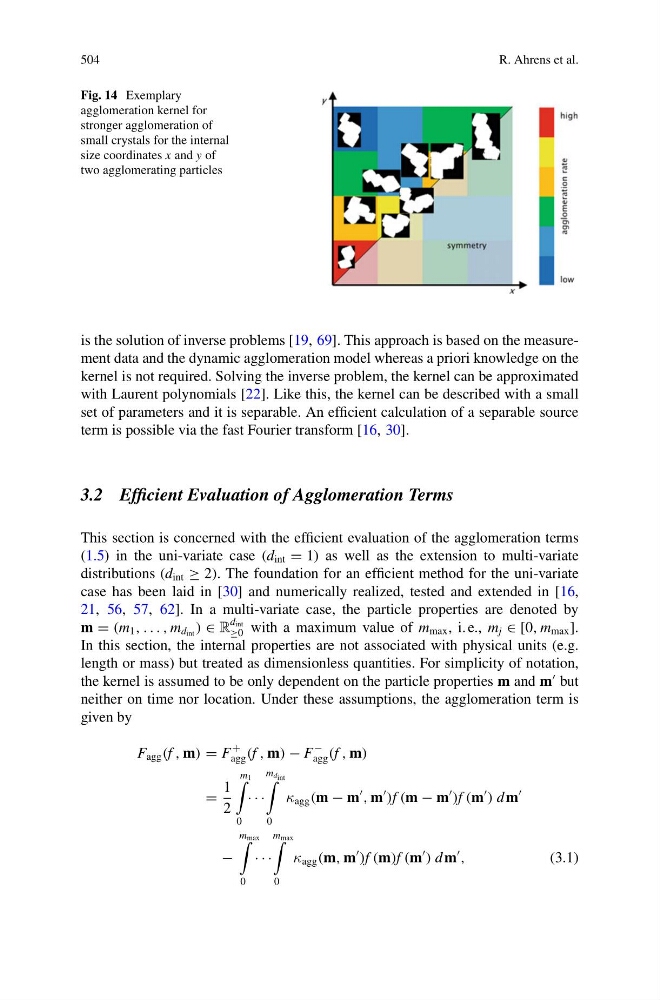
Fig. 14 Exemplary
agglomeration kernel for
stronger agglomeration of
small crystals for the internal
size coordinates x and y of
two agglomerating particles
is the solution of inverse problems [19, 69]. This approach is based on the measurement data and the dynamic agglomeration model whereas a priori knowledge on the
kernel is not required. Solving the inverse problem, the kernel can be approximated
with Laurent polynomials [22]. Like this, the kernel can be described with a small
set of parameters and it is separable. An efficient calculation of a separable source
term is possible via the fast Fourier transform [16, 30].
3.2 Efficient Evaluation of Agglomeration Terms
This section is concerned with the efficient evaluation of the agglomeration terms
(1.5) in the uni-variate case (d int = 1) as well as the extension to multi-variate
distributions (d int ≥ 2). The foundation for an efficient method for the uni-variate
case has been laid in [30] and numerically realized, tested and extended in [16,
21, 56, 57, 62]. In a multi-variate case, the particle properties are denoted by
m = (m 1 , . . . , m d int ) ∈ R
d int
≥0 with a maximum value of m max , i.e., m j ∈ [0, m max ].
In this section, the internal properties are not associated with physical units (e.g.
length or mass) but treated as dimensionless quantities. For simplicity of notation,
the kernel is assumed to be only dependent on the particle properties m and m
but
neither on time nor location. Under these assumptions, the agglomeration term is
given by
F agg (f , m) = F
+
agg (f , m) − F
−
agg (f , m)
=
1
2
m 1
0
· · ·
m d int
0
κ agg (m − m
, m
)f (m − m
)f (m
) d m
−
m max
0
· · ·
m max
0
κ agg (m, m
)f (m)f (m
) d m
,
(3.1)
R. Ahrens et al.
Fig. 14 Exemplary
agglomeration kernel for
stronger agglomeration of
small crystals for the internal
size coordinates x and y of
two agglomerating particles
is the solution of inverse problems [19, 69]. This approach is based on the measurement data and the dynamic agglomeration model whereas a priori knowledge on the
kernel is not required. Solving the inverse problem, the kernel can be approximated
with Laurent polynomials [22]. Like this, the kernel can be described with a small
set of parameters and it is separable. An efficient calculation of a separable source
term is possible via the fast Fourier transform [16, 30].
3.2 Efficient Evaluation of Agglomeration Terms
This section is concerned with the efficient evaluation of the agglomeration terms
(1.5) in the uni-variate case (d int = 1) as well as the extension to multi-variate
distributions (d int ≥ 2). The foundation for an efficient method for the uni-variate
case has been laid in [30] and numerically realized, tested and extended in [16,
21, 56, 57, 62]. In a multi-variate case, the particle properties are denoted by
m = (m 1 , . . . , m d int ) ∈ R
d int
≥0 with a maximum value of m max , i.e., m j ∈ [0, m max ].
In this section, the internal properties are not associated with physical units (e.g.
length or mass) but treated as dimensionless quantities. For simplicity of notation,
the kernel is assumed to be only dependent on the particle properties m and m
but
neither on time nor location. Under these assumptions, the agglomeration term is
given by
F agg (f , m) = F
+
agg (f , m) − F
−
agg (f , m)
=
1
2
m 1
0
· · ·
m d int
0
κ agg (m − m
, m
)f (m − m
)f (m
) d m
−
m max
0
· · ·
m max
0
κ agg (m, m
)f (m)f (m
) d m
,
(3.1)