

478
R. Ahrens et al.
nabla operator with respect to the internal coordinates. Nucleation is included via
appropriate boundary conditions with respect to the internal coordinates. The righthand side of (1.4) describes the agglomeration (aggregation, coalescence) of crystals
and their breakage (fragmentation).
To simplify the presentation below, the case d int = 1 will be considered in the
remainder of this section, i.e., a so-called uni-variate population. Then, Ω int is just an
interval, e.g., an interval with respect to the mass of the crystals Ω int = [m min , m max ]
in kg and it is ∇ int = ∂ m . In this case, the agglomeration term for every time-space
point (t, x) has the form
F agg (u, T , f ) =
1
2
m max
m min
κ agg (u, T , m − m
, m
)f (m − m
)f (m
) dm
−
m max
m min
κ agg (u, T , m − m
, m
)f (m)f (m
) dm
,
(1.5)
where κ agg ( m
3
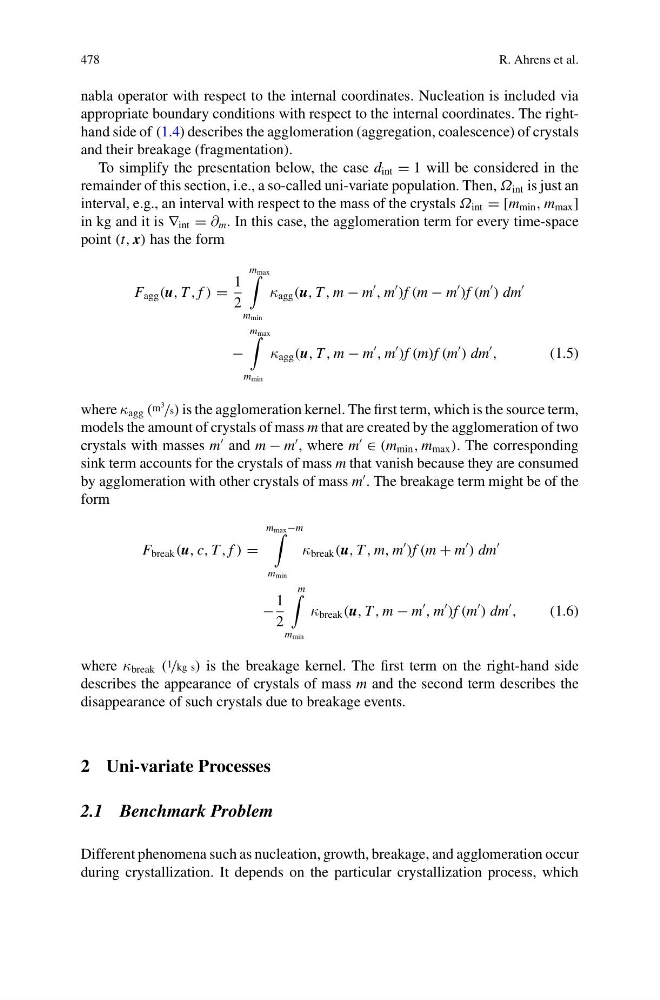
/s) is the agglomeration kernel. The first term, which is the source term,
models the amount of crystals of mass m that are created by the agglomeration of two
crystals with masses m
and m − m
, where m
∈ (m min , m max ). The corresponding
sink term accounts for the crystals of mass m that vanish because they are consumed
by agglomeration with other crystals of mass m
. The breakage term might be of the
form
F break (u, c, T , f ) =
m max −m
m min
κ break (u, T , m, m
)f (m + m
) dm
−
1
2
m
m min
κ break (u, T , m − m
, m
)f (m
) dm
,
(1.6)
where κ break ( 1 /kg s) is the breakage kernel. The first term on the right-hand side
describes the appearance of crystals of mass m and the second term describes the
disappearance of such crystals due to breakage events.
2 Uni-variate Processes
2.1 Benchmark Problem
Different phenomena such as nucleation, growth, breakage, and agglomeration occur
during crystallization. It depends on the particular crystallization process, which
R. Ahrens et al.
nabla operator with respect to the internal coordinates. Nucleation is included via
appropriate boundary conditions with respect to the internal coordinates. The righthand side of (1.4) describes the agglomeration (aggregation, coalescence) of crystals
and their breakage (fragmentation).
To simplify the presentation below, the case d int = 1 will be considered in the
remainder of this section, i.e., a so-called uni-variate population. Then, Ω int is just an
interval, e.g., an interval with respect to the mass of the crystals Ω int = [m min , m max ]
in kg and it is ∇ int = ∂ m . In this case, the agglomeration term for every time-space
point (t, x) has the form
F agg (u, T , f ) =
1
2
m max
m min
κ agg (u, T , m − m
, m
)f (m − m
)f (m
) dm
−
m max
m min
κ agg (u, T , m − m
, m
)f (m)f (m
) dm
,
(1.5)
where κ agg ( m
3
/s) is the agglomeration kernel. The first term, which is the source term,
models the amount of crystals of mass m that are created by the agglomeration of two
crystals with masses m
and m − m
, where m
∈ (m min , m max ). The corresponding
sink term accounts for the crystals of mass m that vanish because they are consumed
by agglomeration with other crystals of mass m
. The breakage term might be of the
form
F break (u, c, T , f ) =
m max −m
m min
κ break (u, T , m, m
)f (m + m
) dm
−
1
2
m
m min
κ break (u, T , m − m
, m
)f (m
) dm
,
(1.6)
where κ break ( 1 /kg s) is the breakage kernel. The first term on the right-hand side
describes the appearance of crystals of mass m and the second term describes the
disappearance of such crystals due to breakage events.
2 Uni-variate Processes
2.1 Benchmark Problem
Different phenomena such as nucleation, growth, breakage, and agglomeration occur
during crystallization. It depends on the particular crystallization process, which