

444
S. Schiele et al.
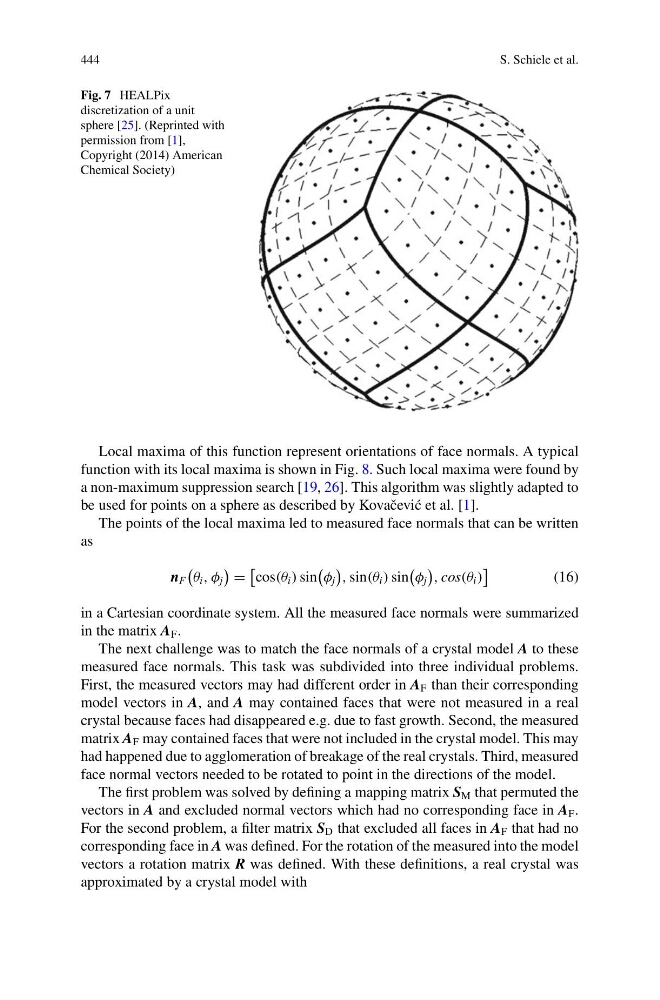
Fig. 7 HEALPix
discretization of a unit
sphere [25]. (Reprinted with
permission from [1],
Copyright (2014) American
Chemical Society)
Local maxima of this function represent orientations of face normals. A typical
function with its local maxima is shown in Fig. 8. Such local maxima were found by
a non-maximum suppression search [19, 26]. This algorithm was slightly adapted to
be used for points on a sphere as described by Kovaˇ cevi´ c et al. [1].
The points of the local maxima led to measured face normals that can be written
as
n F
θ i , φ j
=
cos(θ i ) sin
φ j
, sin(θ i ) sin
φ j
, cos(θ i )
(16)
in a Cartesian coordinate system. All the measured face normals were summarized
in the matrix A F .
The next challenge was to match the face normals of a crystal model A to these
measured face normals. This task was subdivided into three individual problems.
First, the measured vectors may had different order in A F than their corresponding
model vectors in A, and A may contained faces that were not measured in a real
crystal because faces had disappeared e.g. due to fast growth. Second, the measured
matrix A F may contained faces that were not included in the crystal model. This may
had happened due to agglomeration of breakage of the real crystals. Third, measured
face normal vectors needed to be rotated to point in the directions of the model.
The first problem was solved by defining a mapping matrix S M that permuted the
vectors in A and excluded normal vectors which had no corresponding face in A F .
For the second problem, a filter matrix S D that excluded all faces in A F that had no
corresponding face in A was defined. For the rotation of the measured into the model
vectors a rotation matrix R was defined. With these definitions, a real crystal was
approximated by a crystal model with
S. Schiele et al.
Fig. 7 HEALPix
discretization of a unit
sphere [25]. (Reprinted with
permission from [1],
Copyright (2014) American
Chemical Society)
Local maxima of this function represent orientations of face normals. A typical
function with its local maxima is shown in Fig. 8. Such local maxima were found by
a non-maximum suppression search [19, 26]. This algorithm was slightly adapted to
be used for points on a sphere as described by Kovaˇ cevi´ c et al. [1].
The points of the local maxima led to measured face normals that can be written
as
n F
θ i , φ j
=
cos(θ i ) sin
φ j
, sin(θ i ) sin
φ j
, cos(θ i )
(16)
in a Cartesian coordinate system. All the measured face normals were summarized
in the matrix A F .
The next challenge was to match the face normals of a crystal model A to these
measured face normals. This task was subdivided into three individual problems.
First, the measured vectors may had different order in A F than their corresponding
model vectors in A, and A may contained faces that were not measured in a real
crystal because faces had disappeared e.g. due to fast growth. Second, the measured
matrix A F may contained faces that were not included in the crystal model. This may
had happened due to agglomeration of breakage of the real crystals. Third, measured
face normal vectors needed to be rotated to point in the directions of the model.
The first problem was solved by defining a mapping matrix S M that permuted the
vectors in A and excluded normal vectors which had no corresponding face in A F .
For the second problem, a filter matrix S D that excluded all faces in A F that had no
corresponding face in A was defined. For the rotation of the measured into the model
vectors a rotation matrix R was defined. With these definitions, a real crystal was
approximated by a crystal model with